17 May 2026 · 3 min read
The Volcano That Built a Mountain of Tin: Tasmania's Renison Bell
Tasmania's Renison Bell tin deposit formed 360 million years ago when hot fluids from a Devonian granite altered sedimentary rocks, creating one of the world's richest tin systems.
On Tasmania's west coast, a mountain named Mount Bischoff once held nearly 10 percent of the world's tin. What remains is a ragged open pit, a history of boom and bust, and a geological story that begins deep in the Devonian period, when magma invaded ancient seafloor sediments and cooked them into ore.
The Granite That Delivered
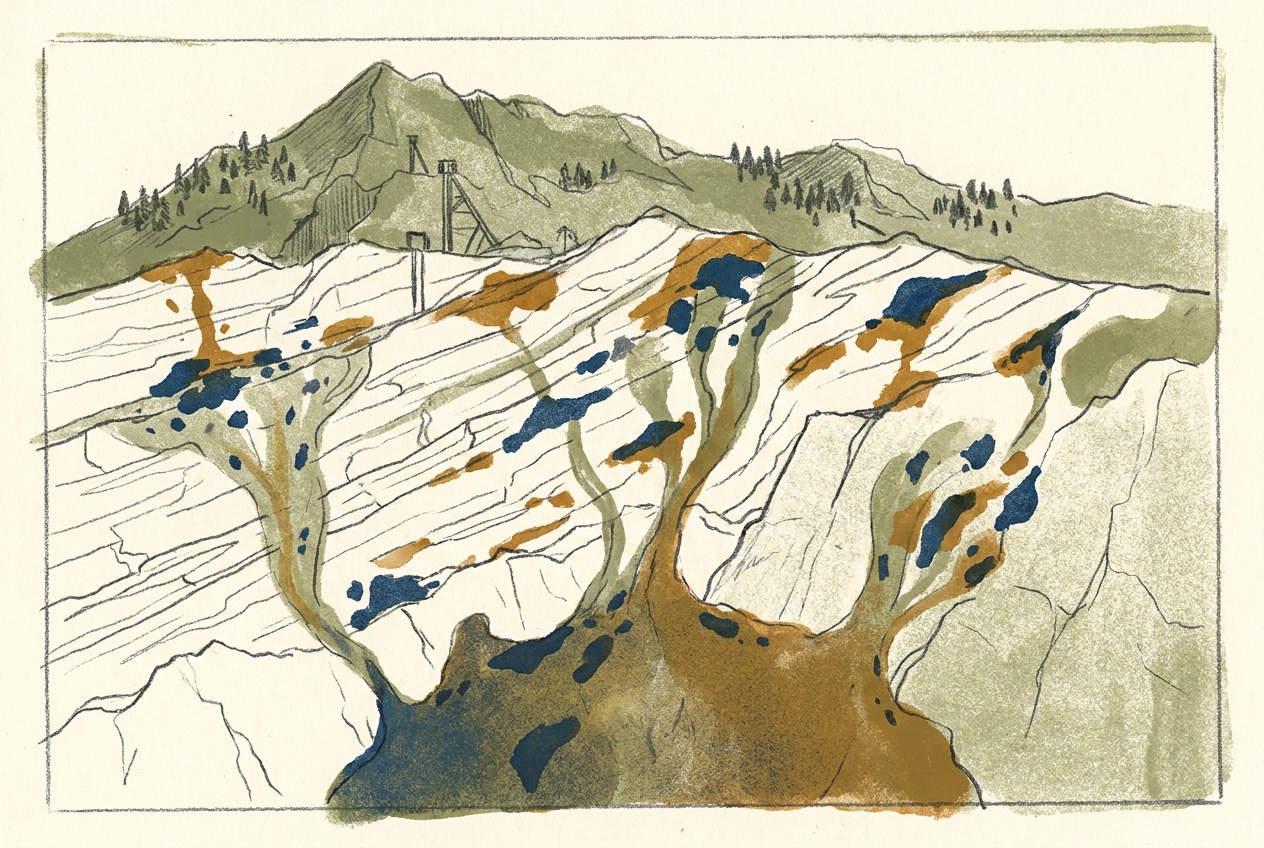
Around 360 million years ago, during the Devonian, a massive body of molten granite rose through Tasmania's crust. As it cooled, it released hydrothermal fluids—superheated, metal-rich brines that migrated upward along faults and fractures. These fluids carried tin, tungsten, and other elements dissolved from the cooling granite itself.
When the fluids encountered the surrounding sedimentary rocks—a sequence of quartz-rich sandstones and carbonaceous shales laid down in a Silurian-Devonian marine basin—they reacted chemically. The hot solutions deposited cassiterite, the primary ore mineral of tin, along with sulfides and other minerals. At Renison Bell, this process created one of the world's largest tin deposits, with ore bodies extending hundreds of metres below the surface.
The key was the carbonaceous shales. Their organic content acted as a chemical reductant, triggering precipitation of tin from the hydrothermal fluids. Without those specific sedimentary rocks, the tin would have remained dispersed in the granite, never concentrated enough to mine.
Tin is not rare in Earth's crust—about 2 parts per million—but it almost never occurs in economic concentrations. Tasmania's west coast is one of the few places where the conditions aligned.
The Mountain That Became a Mine
Mount Bischoff was discovered in 1871 by a prospector named James "Philosopher" Smith, who recognised the significance of the heavy black cassiterite pebbles in the creeks. The mountain itself was a gossan—a rusty, iron-stained cap of weathered ore that stood out against the dark rainforest. Within a decade, the Bischoff mine was the world's largest tin producer.
The Renison Bell deposit, discovered later in the 1890s, lies about 10 kilometres to the south. Unlike Mount Bischoff's spectacular surface outcrop, Renison Bell was buried beneath dense vegetation and required underground mining from the start. The geology is similar: tin-bearing fluids deposited cassiterite along a series of parallel fault zones within the sedimentary sequence, creating a network of steeply dipping ore shoots.
Mining at Renison Bell has continued intermittently for over a century. The operation extends more than 600 metres underground, following the ore bodies as they plunge into the earth. The rock is hard, the conditions wet, and the grades variable—but the deposit has proven remarkably persistent.
The Landscape That Records the Process
The west coast of Tasmania is a landscape of extremes: temperate rainforest receiving over 3 metres of rain annually, steep quartzite ridges, and deep valleys carved by Pleistocene glaciers. The tin deposits sit within what geologists call the Dundas Trough, a belt of folded and faulted sedimentary rocks that accumulated in a deep marine basin during the Silurian and Devonian.
The Devonian granites that drove the mineralisation intruded into this trough during a period of continental collision, when the tectonic plates that carried eastern Australia and Tasmania were being compressed against the rest of the continent. The same compressive forces folded the sedimentary rocks into tight anticlines and synclines, creating the structural traps that focused the tin-bearing fluids.
Walking across the Renison Bell lease today, you see grey-green shales, quartz veins stained orange by iron, and the occasional glint of cassiterite in a fresh rock face. The rainforest has reclaimed much of the old workings. But the geological story is written in every outcrop: a sequence of sedimentation, intrusion, alteration, and uplift that spans 150 million years.
What the Tin Tells Us
Tin deposits like Renison Bell are not just economic resources. They are records of crustal processes that concentrate trace elements into mineable bodies. The same hydrothermal systems that deposited tin also transported copper, lead, zinc, and silver—byproducts that helped make the mines viable.
Tasmania's west coast tin province is one of the best-studied examples of granite-related tin mineralisation in the world. The deposits formed at temperatures between 300 and 500 degrees Celsius, at depths of 3 to 5 kilometres, from fluids that migrated along structures that remained active for millions of years.
The Renison Bell deposit is still producing today, though at reduced rates. The ore that comes out of the ground is the same material that precipitated in the Devonian—cassiterite crystals, black and heavy, that once lay dissolved in hot water circulating through fractured rock. A mountain of tin, built by a cooling granite and preserved for 360 million years.
More like this
- The 5,000-Year-Old Volcanoes That Still Smoke in the SouthIn Victoria's Newer Volcanics Province, 400 volcanic vents erupted as recently as 5,000 years ago—the youngest volcanic field in mainland Australia, where craters still hold blue lakes and scoria cone
- The 1.85-Billion-Year-Old Caldera That Still Feeds the FurnaceIn South Australia's Middleback Ranges, a 1.85-billion-year-old volcanic caldera collapsed and later became one of the world's richest iron ore deposits.
- The 190,000-Year-Old Lava Tube That Still Holds a River of StoneIn Queensland's Undara volcano, 190,000-year-old lava tubes preserve the longest known flow on Earth—a frozen river of basalt that still shelters bats, ferns, and the memory of Pleistocene fire.