17 May 2026 · 2 min read
The Lava That Sealed a Swamp: Queensland's Miocene Petrified Forest
In central Queensland, 25-million-year-old basalt flows entombed an ancient rainforest, preserving upright tree trunks in lava casts that reveal Australia's last warm, wet greenhouse phase.
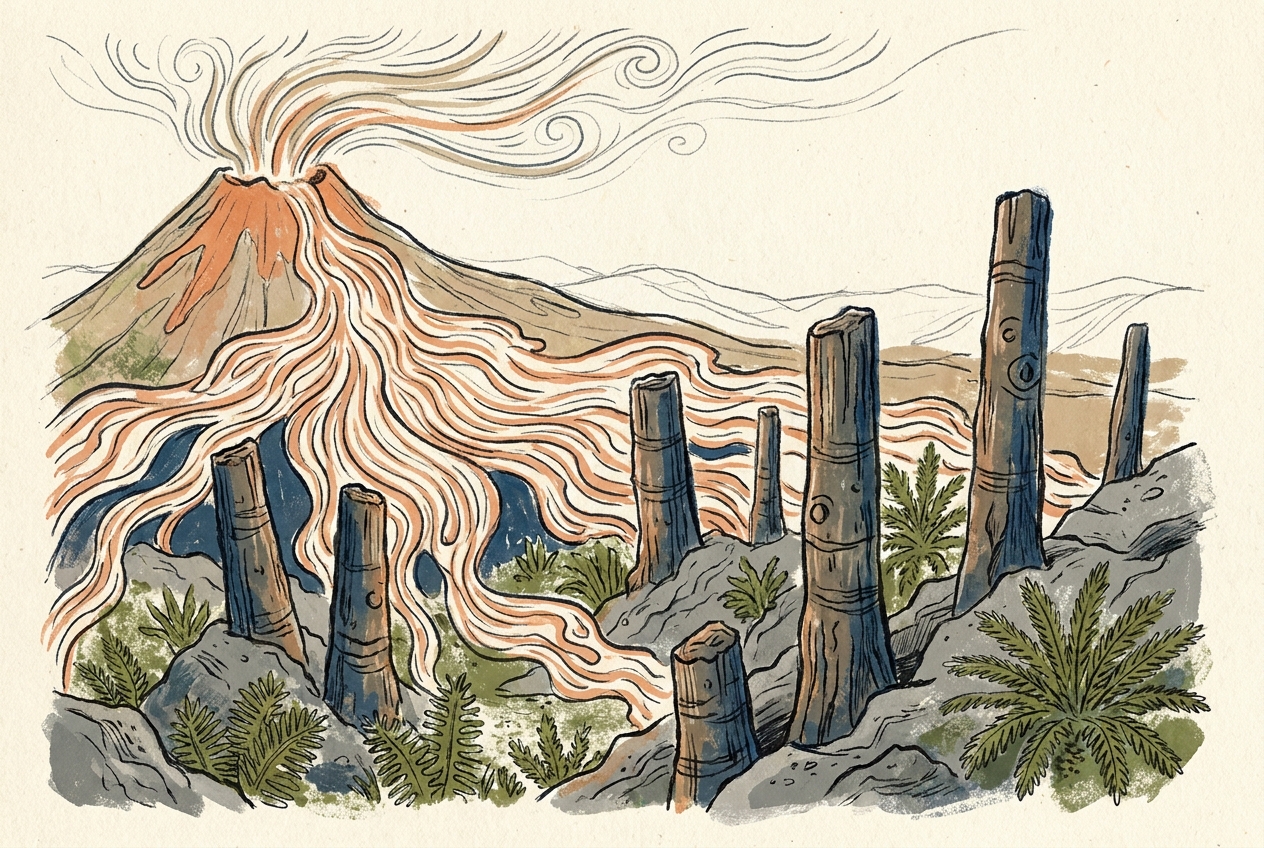
Near the town of Springsure in central Queensland, a hillside of black basalt holds the ghosts of trees. Whole trunks stand upright, locked in volcanic rock, their bark replaced by stone but their shape perfectly preserved—a forest caught mid-life 25 million years ago.
The Greenhouse That Vanished
In the Miocene, Australia was not the dry continent it is today. Rainforest stretched across much of the interior, fed by warm, wet air sweeping in from a still-warm Antarctic. The region around what is now Springsure was a lowland swamp forest, thick with conifers, flowering trees, and palms.
Then the lava came. Basaltic flows from nearby volcanic vents—part of a broad Miocene volcanic province that stretched across eastern Australia—poured into the swamp. The molten rock, at temperatures above 1,000°C, instantly incinerated the forest's surface. But in the low, wet depressions, something different happened.
Casts in Stone
Where the basalt encountered standing water, it chilled and crusted over before it could consume the trees entirely. The trunks, soaked and heavy, stood their ground as the lava pooled around them. When the wood later rotted away, it left hollow moulds inside the hardened basalt—tree-shaped cavities preserving every knot and root.
Some of these moulds are now filled with sediment that later washed in, creating natural casts. Others remain open, allowing a visitor to reach into the space once occupied by a Miocene tree trunk. The site preserves not just individual trees but an entire forest floor, with logs, branches, and leaf litter all recorded in the volcanic rock.
To stand beside a basalt column and find it hollow, lined with the impression of bark, is to touch a moment when fire and water met and held still.
A Window Into Australia's Wet Past
The Springsure petrified forest belongs to a time geologists call the Miocene climatic optimum—a period between 23 and 15 million years ago when global temperatures were 3–4°C warmer than today. Australia's interior, now semi-arid, supported diverse rainforests with tree ferns, cycads, and podocarps.
These fossils are rare. Most volcanic eruptions destroy organic matter completely. But the combination of swamp, standing water, and slow-moving basalt created a preservation window that lasted only as long as the water stayed. The result is a snapshot of a single forest, frozen in stone, recording a world that no longer exists.
What the Trees Tell Us
The species preserved at Springsure include ancestors of trees still found in Australia's remaining rainforest fragments: the bunya pine (Araucaria bidwillii), various eucalypts, and several now-extinct conifers. Their growth rings record seasonal rainfall patterns from a time when the Australian landmass was still drifting northward from Antarctica.
By studying the spacing and orientation of the preserved trunks, researchers have estimated the forest's density—about 400 trees per hectare, comparable to modern tropical rainforest. The trunks themselves reach up to 30 metres in height, suggesting a mature canopy that stood for centuries before the lava arrived.
The Springsure petrified forest is not a single fossil but a landscape: a whole ecosystem arrested in a moment of catastrophe. It is a reminder that the Australian continent, now the driest inhabited land on Earth, was once draped in green from coast to coast.
More like this
- The 5,000-Year-Old Volcanoes That Still Smoke in the SouthIn Victoria's Newer Volcanics Province, 400 volcanic vents erupted as recently as 5,000 years ago—the youngest volcanic field in mainland Australia, where craters still hold blue lakes and scoria cone
- The 560-Million-Year-Old Garden That Never Saw a PredatorIn South Australia's Flinders Ranges, 560-million-year-old Ediacara surfaces preserve entire seafloor communities of fronds, discs, and quilts — a garden of soft-bodied life that flourished before pre
- The 300-Million-Year-Old Forest That Died Standing UpIn New South Wales, a 300-million-year-old fossil forest preserves dozens of trees buried upright by a Permian volcanic eruption—an entire ecosystem frozen in ash.