14 May 2026 · 3 min read
The Lava That Built a Continent: The Kalkarindji Large Igneous Province
The Kalkarindji Large Igneous Province in northern Australia records a 510-million-year-old volcanic event that erupted 500,000 cubic kilometres of lava across a million square kilometres.
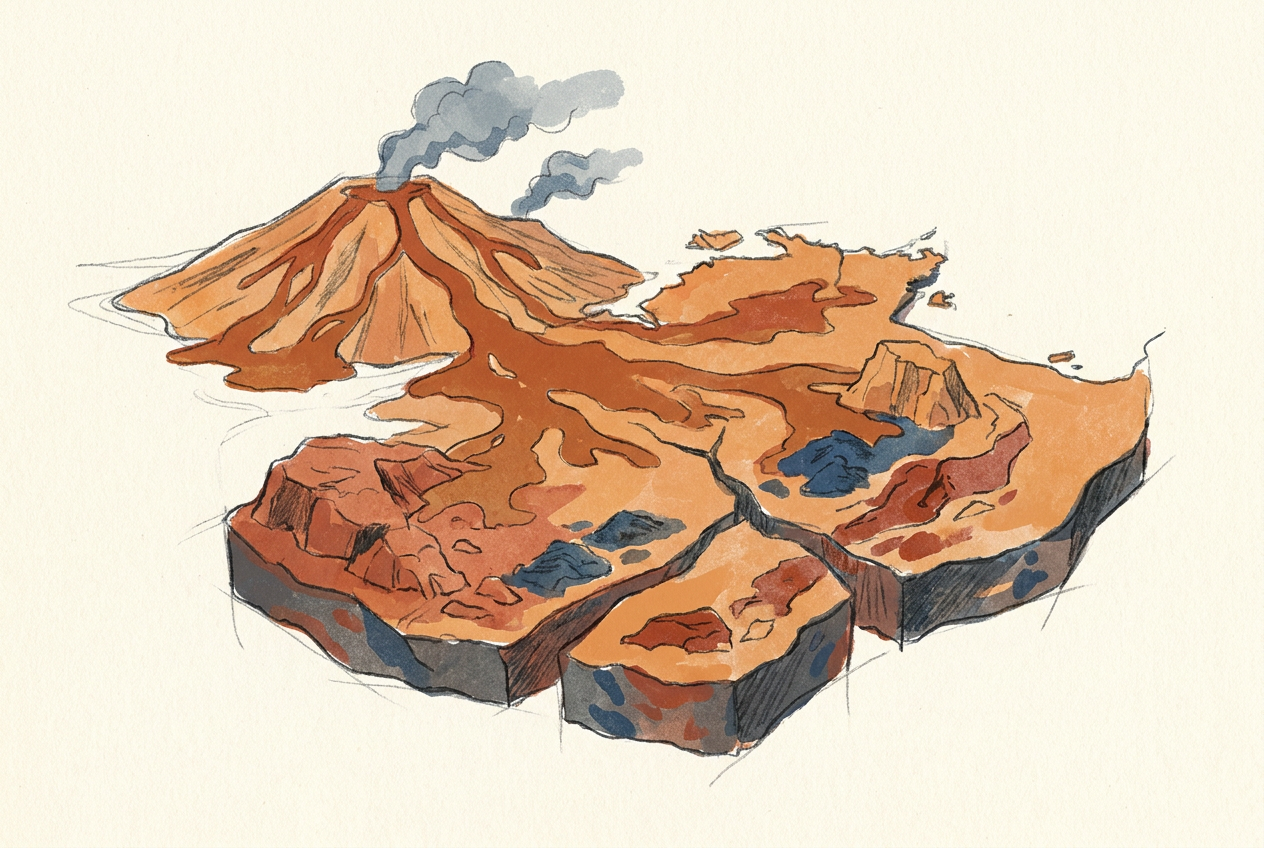
Half a billion years ago, northern Australia was a sea of lava. The ground did not erupt in isolated cones but split open along kilometres-long fissures, flooding the landscape with basalt so deep that it buried entire river systems and covered an area larger than South Australia.
This was the Kalkarindji Large Igneous Province—one of the most explosive and least-known volcanic events in Earth's history.
The Fissures That Opened a Continent
Kalkarindji lies mostly beneath the Victoria River region of the Northern Territory and into Western Australia. Its basalts date to the Cambrian Period, around 510 million years ago, when Australia sat near the South Pole as part of the supercontinent Gondwana.
The province originally covered at least a million square kilometres, with individual lava flows reaching 200 metres thick. The total volume of erupted magma exceeded 500,000 cubic kilometres—enough to cover the entire state of New South Wales under 600 metres of basalt.
What makes Kalkarindji unusual is not its size but its style. Most large igneous provinces, like India's Deccan Traps, erupted through multiple vents over millions of years. Kalkarindji's lavas emerged from a dense network of parallel fissures, each one a vertical crack in the crust that acted like a volcanic zipper. The basalt sheets that resulted are flat, featureless, and almost impossible to date with precision—but their chemical signature is unmistakable.
The Pulse That Changed the Atmosphere
Large igneous provinces do not just reshape landscapes. They reshape climates.
When Kalkarindji erupted, it released enormous volumes of sulfur dioxide, carbon dioxide, and fluorine into the Cambrian atmosphere. The timing is suggestive: the eruption coincides with a major extinction event at the end of the early Cambrian, around 510 million years ago, when many trilobite groups and other marine organisms disappeared from the fossil record.
The connection is not proven, but the mechanism is plausible. Flood basalt eruptions can trigger volcanic winters from sulfur aerosols, followed by long-term warming from CO₂. They can also acidify oceans. The Kalkarindji lavas poured directly into shallow Cambrian seas, and the interaction between hot basalt and seawater would have released halogen gases capable of damaging the ozone layer.
The same pulse of magma that built northern Australia may have nearly undone the Cambrian explosion of life.
The Copper That Came With the Lava
Kalkarindji's legacy is not only volcanic. The basalt contains copper mineralisation, particularly in the area around the Kalkarindji community (formerly Wave Hill) in the Northern Territory.
The copper formed when hydrothermal fluids—heated by the cooling basalt—leached metals from the lava and deposited them in fractures and vesicles. Small-scale mining occurred at several sites, including the Blue Moon and Copper Hills deposits. The grades are modest, but the deposits are a reminder that volcanic events do not only destroy; they concentrate.
Similar processes operate across Australia's flood basalt provinces. The difference at Kalkarindji is age. The basalt is so old that much of it has been eroded, weathered, or buried beneath younger sediments. What remains are scattered outcrops—flat-topped hills and mesa-like ridges that stand above the surrounding plains—that hint at the scale of what was lost.
The Landscape That Survived
Today, Kalkarindji basalt forms the resistant caprock of several prominent features in the Victoria River region. The basalts create flat-topped mesas, step-like escarpments, and broad plateaus that contrast with the softer sedimentary rocks around them.
The best exposures lie along the Victoria Highway west of Katherine, where road cuts reveal the dark, fine-grained basalt with its characteristic columnar jointing. The rock is dense and heavy, and it rings under a hammer. In the dry season, the basalt outcrops bake under the sun; in the wet, they shed water so quickly that the surrounding plains flood while the basalt surfaces remain dry.
Most visitors drive past without knowing what they are seeing. The rocks look ordinary—dark, weathered, unremarkable. But they are the remains of an event that pumped half a million cubic kilometres of lava across a continent, may have triggered a mass extinction, and left copper in the ground that people still mine today.
Kalkarindji is a reminder that the most consequential volcanic events are not always the most famous. Sometimes they are just the oldest, the quietest, and the most deeply buried.
More like this
- The 5,000-Year-Old Volcanoes That Still Smoke in the SouthIn Victoria's Newer Volcanics Province, 400 volcanic vents erupted as recently as 5,000 years ago—the youngest volcanic field in mainland Australia, where craters still hold blue lakes and scoria cone
- The 300-Million-Year-Old Forest That Died Standing UpIn New South Wales, a 300-million-year-old fossil forest preserves dozens of trees buried upright by a Permian volcanic eruption—an entire ecosystem frozen in ash.
- The 1.85-Billion-Year-Old Caldera That Still Feeds the FurnaceIn South Australia's Middleback Ranges, a 1.85-billion-year-old volcanic caldera collapsed and later became one of the world's richest iron ore deposits.