17 May 2026 · 3 min read
The Kimberley's Living Crust: Australia's 1.8-Billion-Year-Old Microbe Colony
In Western Australia's Kimberley region, the stunning rock art of the Napier Range is painted on fossilised microbial mats that once covered a 1.8-billion-year-old Proterozoic seafloor.
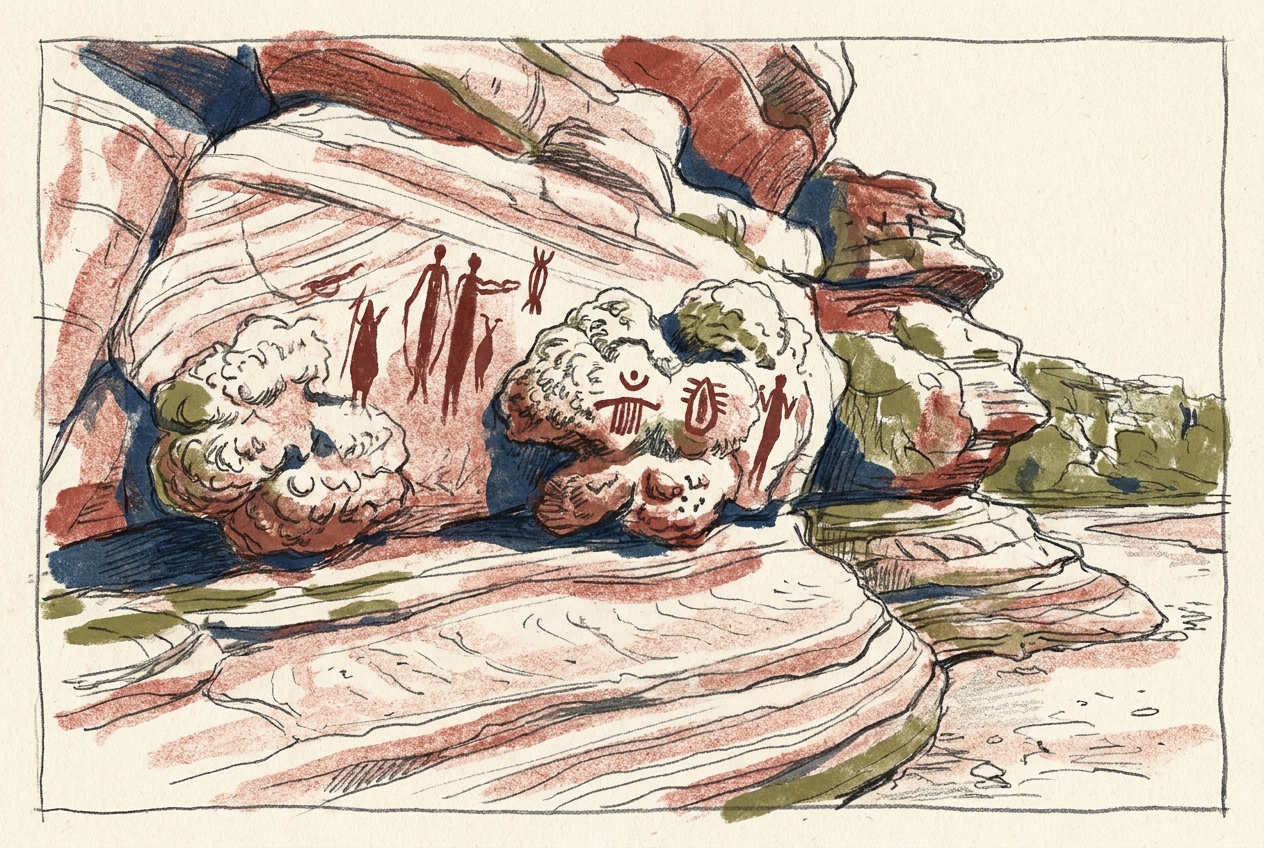
On the walls of the Napier Range in the Kimberley, the Wandjina spirits painted by Indigenous artists stare out from a canvas that is itself a fossil. The ochre figures rest on rock that was once alive—a 1.8-billion-year-old microbial mat that spread across an ancient seafloor like a living skin.
The Seafloor That Wasn't Rock
The Napier Range is part of the Kimberley Basin, a vast Proterozoic sedimentary basin that accumulated between 1.8 and 1.6 billion years ago. At that time, Australia was still attached to the supercontinent Nuna, and the Kimberley lay under a shallow, sunlit sea.
That sea contained no animals, no plants, not even algae. But it teemed with microbial communities—cyanobacteria and other single-celled organisms that formed layered mats across the seabed. These mats trapped sediment grains and precipitated calcium carbonate, building up millimeter by millimeter over thousands of years.
The result is a rock type called microbialite, preserved today as the broad, gently dipping limestone and dolomite beds of the Kimberley Group. What looks like ordinary sedimentary rock is actually a fossilised ecosystem, frozen in place.
The Wandjina were not painted on stone. They were painted on the remains of a world that breathed.
A Billion Years of Patience
The Napier Range's microbial mats are not the famous dome-shaped stromatolites of Shark Bay. They are stratiform microbialites—flat, layered crusts that once covered hundreds of square kilometres of seafloor. In cross-section, the rock reveals fine laminae, each a single generation of microbes.
These structures are among the oldest fossilised microbial communities on Earth that can be seen without a microscope. They predate the Ediacaran biota by more than a billion years and the first animals by nearly a billion and a half.
For most of Earth's history, microbial mats were the only life on the planet's surface. They shaped the atmosphere, built the first reefs, and created the oxygen that made animal evolution possible. The Kimberley's mats were part of that long, slow transformation.
The Painting on the Crust
The Wandjina rock art found throughout the Napier Range is estimated to be between 2,000 and 6,000 years old—young by geological standards, ancient by human ones. The artists selected the smooth, flat surfaces of the microbialite because the rock erodes into clean, vertical panels ideal for pigment.
The Wandjina figures themselves are cloud-spirits from Aboriginal cosmology, associated with rain, fertility, and the seasonal cycles of the Kimberley. Their white faces, black eyes, and halo-like headdresses are painted with ochre ground from local iron-rich deposits, bound with plant resin and water.
The choice of canvas was not arbitrary. The microbialite surfaces are unusually stable, resistant to the spalling and flaking that affect other rock types. The same microbial cohesion that held the seafloor together a billion years ago continues to hold the paintings today.
The Slowest Art Gallery
The Napier Range is eroding at a rate of roughly one millimetre per thousand years. At that pace, the Wandjina paintings may survive another 50,000 to 100,000 years before the rock crumbles entirely.
But the microbialite itself is being destroyed faster than it was ever created. Unlike the living stromatolites of Shark Bay, the Kimberley's fossil mats no longer grow. Once the rock weathers away, nothing will replace it.
The Wandjina spirits have watched over this country for perhaps six thousand years. The crust they were painted on watched over it for a billion years before that. The rock, the art, and the microbes are all layers of a single story—a living planet that learned to build stone from slime.
More like this
- The 560-Million-Year-Old Garden That Never Saw a PredatorIn South Australia's Flinders Ranges, 560-million-year-old Ediacara surfaces preserve entire seafloor communities of fronds, discs, and quilts — a garden of soft-bodied life that flourished before pre
- The 300-Million-Year-Old Forest That Died Standing UpIn New South Wales, a 300-million-year-old fossil forest preserves dozens of trees buried upright by a Permian volcanic eruption—an entire ecosystem frozen in ash.
- The 1.75-Billion-Year-Old Reef That Outranks the BarrierA 1.75-billion-year-old microbial reef in the Kimberley is the largest biological structure ever built by a single species, preserving a world without predators.