16 May 2026 · 3 min read
The Copper Veins That Built a Mountain: South Australia's Burra Mine
South Australia's Burra copper mine, discovered in 1845, extracted ore from a 1.6-billion-year-old hydrothermal vein system that concentrated copper along a fault in ancient sedimentary rocks.
In 1845, a shepherd named Thomas Pickett found a green-stained rock on a hillside 150 kilometres north of Adelaide. Within a year, that hillside became the Burra Burra Mine, and the green stain was bornite—a copper ore so rich the deposit yielded 5,000 tonnes of pure metal in its first decade, all from a single lode that ran like a buried spine through the slate.
The Rock That Held the Metal
The copper at Burra did not arrive by accident. It was deposited 1.6 billion years ago, during the Proterozoic, when the region was a shallow sea. Sediment accumulated in layers of silt and sand, compacting into the rocks now called the Burra Group. These are not spectacular formations—grey-green slate, fine-grained dolomite, beds of quartzite—but they contain the key ingredient: permeability.
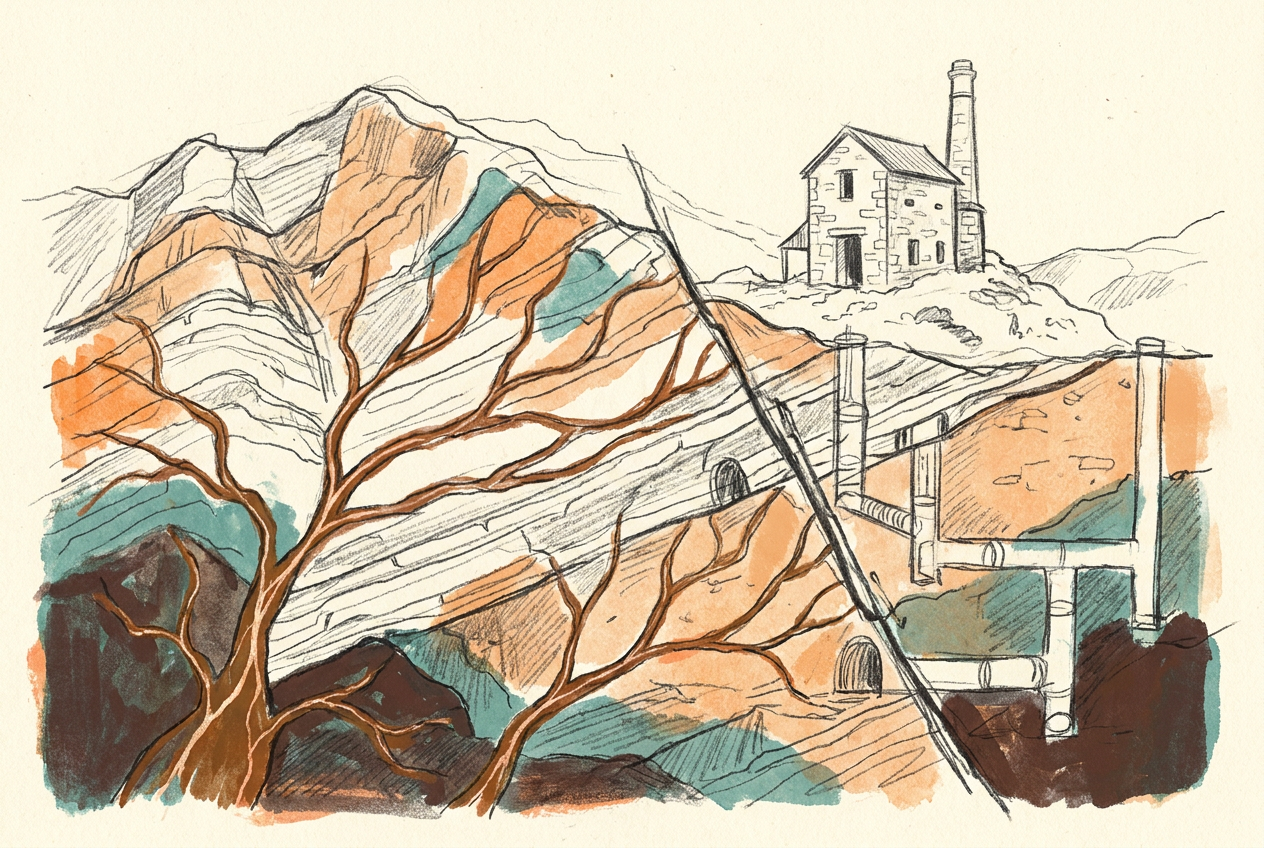
The metal came later, carried by hot brines that migrated through faults and fractures during the Delamerian Orogeny, a mountain-building event around 500 million years ago. These fluids, heated by deep crustal magma, leached copper from surrounding rocks and precipitated it where the chemistry was right. The result was a lens of almost pure chalcocite and bornite, draped along the contact between slate and dolomite like a folded blanket.
What made Burra extraordinary was purity. The main lode averaged 23 percent copper—ten times the grade of most modern mines. In places, the ore ran at 40 percent. Miners could pick lumps of native copper from the rock with their hands.
The Hole That Fed an Empire
The Burra Burra Mine opened in 1845 and closed in 1877, but in those 32 years it produced 52,000 tonnes of copper—roughly a quarter of Australia's total copper output for the entire 19th century. The mine was worked as a single open pit, a vertical gash cut into the hillside that eventually reached 70 metres deep. The company that owned it, the South Australian Mining Association, paid dividends so large it became the richest joint-stock company in the British Empire.
The miners worked in brutal conditions. The pit was a maze of timber platforms and hand-drilled holes, blasted with black powder. Ore was hauled up by horse winches, then crushed on site by steam engines. The copper was shipped to England, where it sheathed the hulls of Royal Navy ships and roofed the Houses of Parliament.
But the geology had limits. The ore body was a single, discontinuous lens. By the 1870s, the high-grade copper was gone. The mine closed, and the pit filled with water.
The Burra Burra Mine produced more copper in three decades than most mines produce in a century—and then it was empty.
The Scars That Tell the Story
Today, the Burra pit is a tourist site, a steep-walled amphitheatre lined with blue-green rock that still stains your boots. The water at the bottom is acidic, the legacy of sulphide oxidation. The surrounding hills are pocked with collapsed adits and grassed-over mullock heaps.
The geology is still visible in the pit walls. You can trace the folded contact between the grey slate and the buff dolomite, the same boundary that guided the copper fluids half a billion years ago. The ore is gone, but the structure remains—a reminder that mineral deposits are not random accidents but the product of specific, sequential events: sedimentation, deformation, fluid flow, and precipitation.
Burra was not the largest copper deposit in Australia. It was not the deepest or the longest-lived. But it was one of the richest, grade for grade, and it built the colony of South Australia. The copper that came out of that hillside paid for roads, railways, schools, and the first telegraph line to Melbourne. All of it came from a single vein, no more than a few metres thick, that happened to be in the right rock at the right time.
The pit sits empty now, but the story it tells is not exhausted. The same Proterozoic rocks that hosted the Burra copper extend for hundreds of kilometres beneath the Murray Basin, buried under younger sediment. Somewhere in that buried landscape, there may be another lens, another folded contact, another pocket of bornite waiting to be found. The geology does not repeat itself exactly, but it does rhyme.
More like this
- The 560-Million-Year-Old Garden That Never Saw a PredatorIn South Australia's Flinders Ranges, 560-million-year-old Ediacara surfaces preserve entire seafloor communities of fronds, discs, and quilts — a garden of soft-bodied life that flourished before pre
- The 1.75-Billion-Year-Old Reef That Outranks the BarrierA 1.75-billion-year-old microbial reef in the Kimberley is the largest biological structure ever built by a single species, preserving a world without predators.
- The 3.5-Billion-Year-Old Cones That Still Catch LightIn the Pilbara's Dresser Formation, 3.5-billion-year-old stromatolites preserve the oldest direct evidence of life on Earth—microbial mats that built layered domes in a volcanic caldera.