8 May 2026 · 3 min read
The Volcanic Ark: The Basalts of Barrington Tops
Explore the Barrington Tops of New South Wales, where Eocene basalt shield volcanoes created a high-altitude sanctuary for Australia's ancient Gondwanan rainforests.
In the high, cool forests of the Barrington Tops in New South Wales, the Antarctic Beech stands as a living fossil, its roots anchored in a soil that was born from the fires of a dying supercontinent. These trees are the biological descendants of a forest that once stretched across Gondwana, surviving today only because of the unique chemistry and elevation of a massive volcanic shield.
The Shield of the East
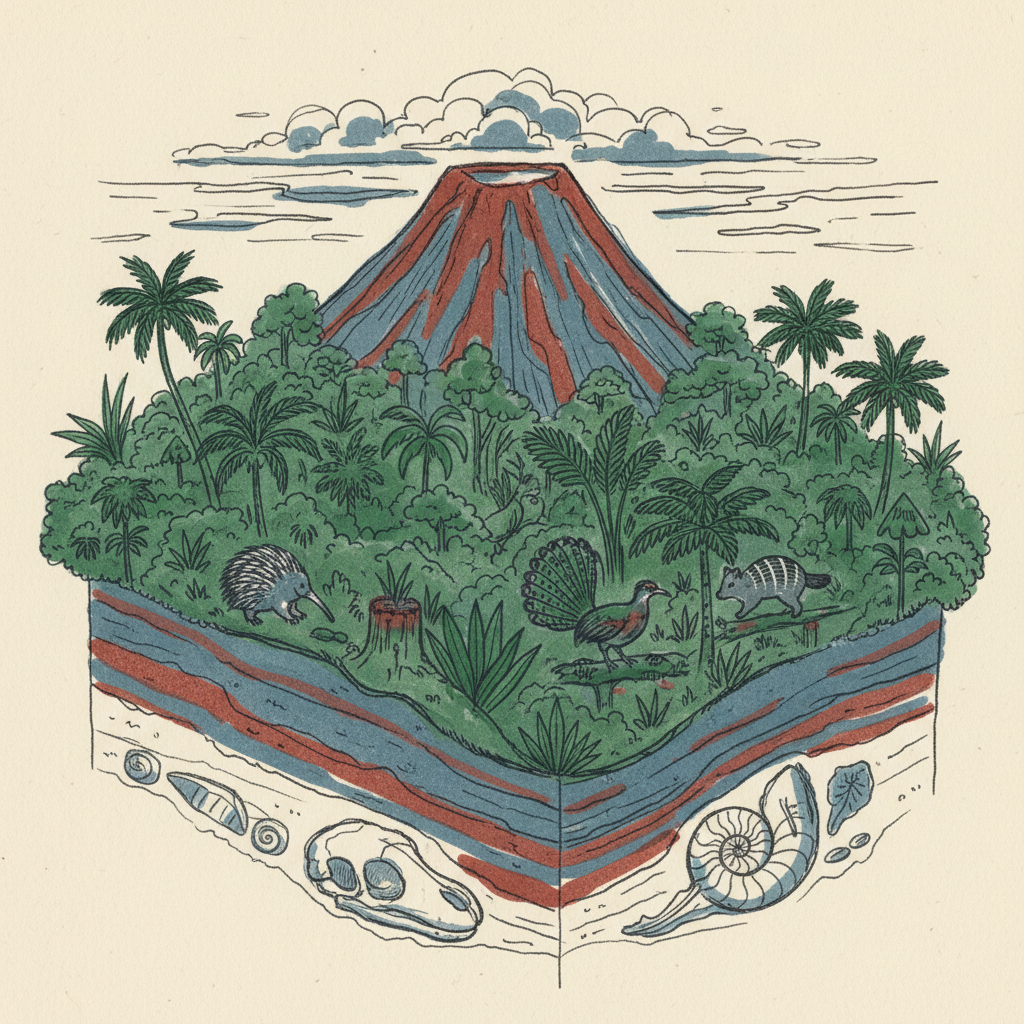
The Barrington Tops is the remnant of a colossal shield volcano that erupted approximately 55 to 44 million years ago during the Eocene. Unlike the explosive, ash-heavy eruptions of the Andes or the Cascades, this was a steady, terrestrial outpouring of fluid basalt. Over millions of years, layer upon layer of molten rock built a broad, gently sloping dome that dominated the landscape of eastern Australia.
This volcanic activity was part of a broader pattern of "hotspot" volcanism. As the Australian plate drifted northward over a stationary plume of heat in the mantle, a chain of volcanoes erupted in its wake. The Barrington volcano was one of the largest, a massive basaltic anchor that resisted the relentless erosion of the Tasman Sea’s weather systems. Today, the original summit is gone, but the resilient basalt core remains as a high-altitude plateau, rising more than 1,500 meters above sea level.
The Chemistry of Survival
The geology of the plateau dictates the life that grows upon it. Basalt is rich in iron, magnesium, and calcium, minerals that break down into deep, fertile red and black soils. These nutrient-dense clays hold moisture far better than the surrounding sandstone or granite terrains. For the Antarctic Beech (Nothofagus moorei), this soil is a vital sanctuary.
The basalt plateau acts as a thermal and nutritional island, a high-altitude ark that carries the remnants of a Cretaceous climate into the modern Australian heat.
Because the plateau is so high, it captures orographic rainfall and frequent mists, creating a microclimate that is significantly cooler and wetter than the lowlands. This combination—rich volcanic soil and constant moisture—allowed the temperate rainforests to persist even as the rest of the continent dried out. While the surrounding valleys are dominated by fire-adapted eucalypts, the plateau remains a dark, moss-covered realm of ancient lineages.
The Great Escarpment
The edges of the Barrington Tops are defined by dramatic, sheer cliffs where the basalt cap ends and the older, underlying rocks are exposed. This is the Great Escarpment, a geological feature that runs the length of eastern Australia. Here, the erosive power of the Manning and Hunter river systems has carved deep into the plateau's flanks, exposing the contact point between the Eocene lavas and the much older Carboniferous sediments below.
The process of "back-wearing" continues today. As the softer sedimentary rocks beneath the basalt are eroded away, the heavy basalt columns above lose their support and collapse in giant blocks. This constant crumbling keeps the cliffs vertical and ensures that the plateau remains isolated. It is this isolation that has protected the Barrington wilderness from the frequent bushfires that sweep through the drier Australian bush, preserving a continuous line of descent for the forest that predates the breakup of the southern continents.
A Legacy of Ice and Fire
The Barrington Tops represents a rare intersection of tectonic movement and biological preservation. The northward trek of the Australian plate provided the volcanic heat necessary to build the plateau, while the elevation provided by that same volcanic mass created a refuge from the warming climate.
- Age: 44–55 million years (Eocene volcanism).
- Composition: Primarily tholeiitic and alkalic basalt.
- Elevation: Reaching 1,586 meters at Brumlow Top.
- Significance: Part of the Gondwana Rainforests of Australia World Heritage area.
Walking through the moss-draped beech forests today is a lesson in geological permanence. The ground beneath the leaf litter is not merely dirt, but the weathered remains of a volcanic event that helped define the eastern edge of the continent. It is a landscape where the deep time of the mantle meets the fragile persistence of the ancient forest.
More like this
- The 110-Million-Year-Old River That Runs Backwards UndergroundWestern Australia's 110-million-year-old dune system has been slowly dissolving into a labyrinth of caves where an ancient river still flows, carrying the taste of a Cretaceous desert.
- The 5,000-Year-Old Volcanoes That Still Smoke in the SouthIn Victoria's Newer Volcanics Province, 400 volcanic vents erupted as recently as 5,000 years ago—the youngest volcanic field in mainland Australia, where craters still hold blue lakes and scoria cone
- The 300-Million-Year-Old Forest That Died Standing UpIn New South Wales, a 300-million-year-old fossil forest preserves dozens of trees buried upright by a Permian volcanic eruption—an entire ecosystem frozen in ash.