11 May 2026 · 3 min read
The Coal That Burned for 6,000 Years: The Burning Mountain of Wingen
Beneath a hill in New South Wales, a coal seam has been smouldering for at least 6,000 years—the oldest known continuously burning coal fire on Earth.
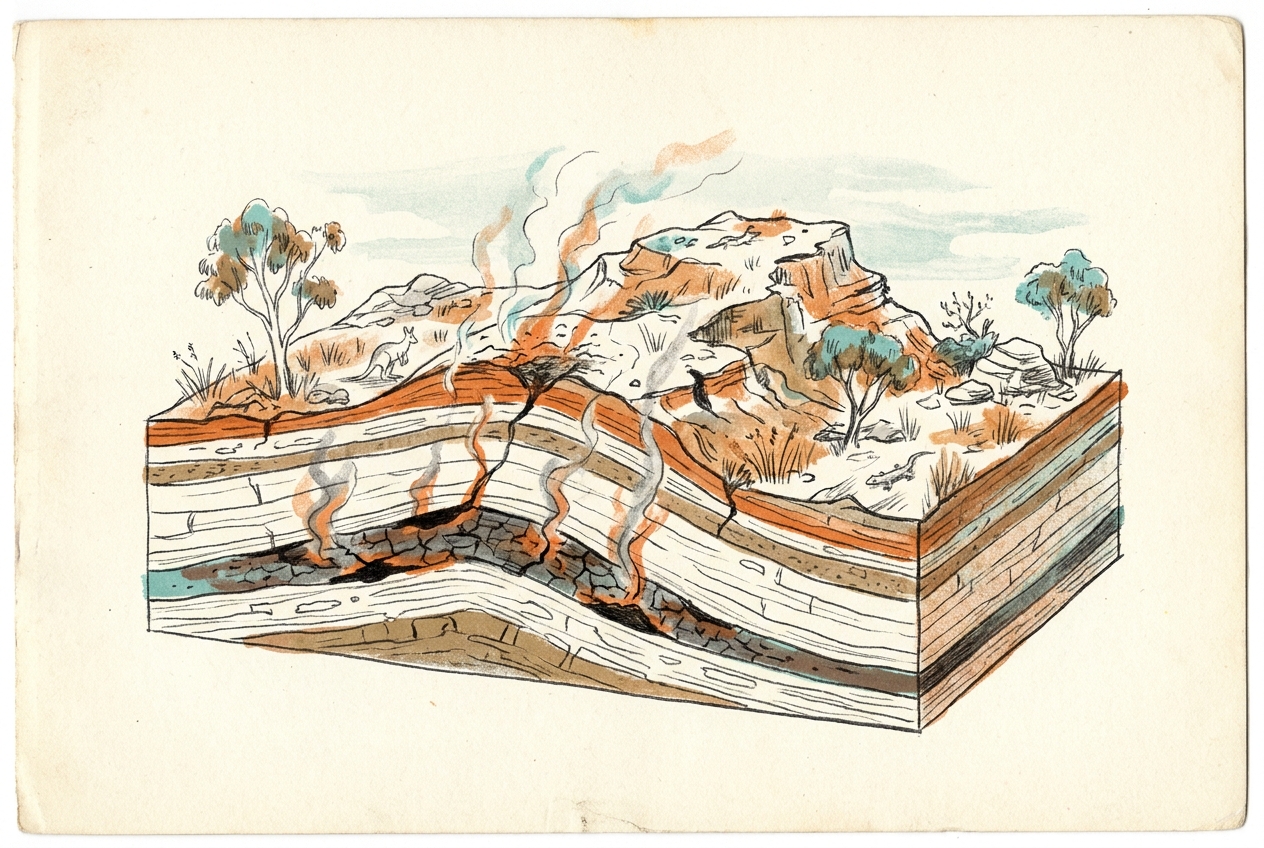
A plume of smoke rises from a forested hillside in the Hunter Valley of New South Wales, as it has for thousands of years. The local Wanaruah people called it Wingen, meaning "fire." Geological surveys have confirmed that the coal seam beneath this hill has been burning continuously for at least 6,000 years—possibly as many as 15,000—making it the oldest known coal fire on Earth.
The Seam That Would Not Quench
Mount Wingen is not a volcano. It is a low, unassuming hill underlain by the Greta Coal Measures, a Permian-age deposit laid down some 260 million years ago. Back then, Australia sat near the South Pole, and vast peat swamps accumulated in the cold, dark basins between glacial advances. Compression and time turned that peat into bituminous coal—a fuel rich enough to sustain combustion once ignited.
How the fire started is unknown. Lightning could have struck an exposed seam. A bushfire, a falling tree, a human spark—any of these could have kindled the coal. What matters is that once alight, the seam never went out. The fire creeps slowly underground, consuming fresh coal as it moves, sustained by oxygen drawn down through cracks in the overlying sandstone.
A Fire That Moves Like a Glacier
The burning front advances at roughly one metre per year. Above ground, the signs are unmistakable: bare, reddened rock where the heat has baked the sandstone into brick-like clinker; vents where steam and sulphur-rich gases escape; ground so hot that trees cannot root, and the soil steams after rain.
Drilling in the 1970s revealed the fire's internal structure. At depth, the coal seam is 7 to 10 metres thick. The fire burns hottest around 800 to 1,000 degrees Celsius, leaving behind a zone of ash and baked rock that collapses as the seam is consumed. The surface above slowly subsides, forming a shallow valley known as a "sag." This sag has migrated downslope over millennia, following the dip of the seam.
Six thousand years is barely a blink in geological time, but it is long enough for a single fire to reshape a hillside.
What Burns Beneath
Coal fires are common across the world. China, India, and the United States all have burning seams. But most are relatively young—decades or centuries old—started by mining accidents or careless ignition. Wingen is different: it predates human industry by millennia, and it may have been burning before the first farmers planted grain in the Fertile Crescent.
The fire has consumed an estimated 1.5 million tonnes of coal so far. The seam continues for at least another kilometre along strike, giving the fire fuel for perhaps another thousand years. There is no realistic way to extinguish it. Attempts in other countries—sealing vents, flooding seams with slurry—have rarely succeeded against deep, established fires.
A Slow-Motion Catastrophe
The Burning Mountain offers a quiet warning. Coal fires release carbon dioxide, methane, sulphur dioxide, and mercury. Wingen's emissions are modest compared to an industrial plant, but they have been running for longer than any human civilisation. The atmosphere has been receiving this coal-derived carbon since before the Bronze Age.
There is also a stranger implication. If a coal seam can ignite naturally and burn for ten thousand years, then the Permian coals of Australia have been smouldering, off and on, for millions of years. The carbon released by these ancient fires is folded into the geological record—a slow, natural leakage from the same reservoirs we now mine for energy. Wingen is not an anomaly. It is a reminder that coal, once buried, does not always stay put. Sometimes it burns, patient and undiminished, until the seam runs out.
More like this
- The 110-Million-Year-Old River That Runs Backwards UndergroundWestern Australia's 110-million-year-old dune system has been slowly dissolving into a labyrinth of caves where an ancient river still flows, carrying the taste of a Cretaceous desert.
- The 5,000-Year-Old Volcanoes That Still Smoke in the SouthIn Victoria's Newer Volcanics Province, 400 volcanic vents erupted as recently as 5,000 years ago—the youngest volcanic field in mainland Australia, where craters still hold blue lakes and scoria cone
- The 560-Million-Year-Old Garden That Never Saw a PredatorIn South Australia's Flinders Ranges, 560-million-year-old Ediacara surfaces preserve entire seafloor communities of fronds, discs, and quilts — a garden of soft-bodied life that flourished before pre