11 May 2026 · 3 min read
The Diamond That Grew: The Argyle Lamproite Pipe
In the remote East Kimberley, the Argyle lamproite pipe produced 90% of the world's pink diamonds through a rare geological accident 1.3 billion years in the making.
Most diamonds are born in the deep mantle and carried to the surface by kimberlite, a dark volcanic rock that erupts at extreme speed. Australia's Argyle deposit did something else entirely. It came up through a lamproite — a rarer, stranger magma — and it brought with it diamonds of a colour seen nowhere else on Earth.
The Wrong Rock in the Right Place
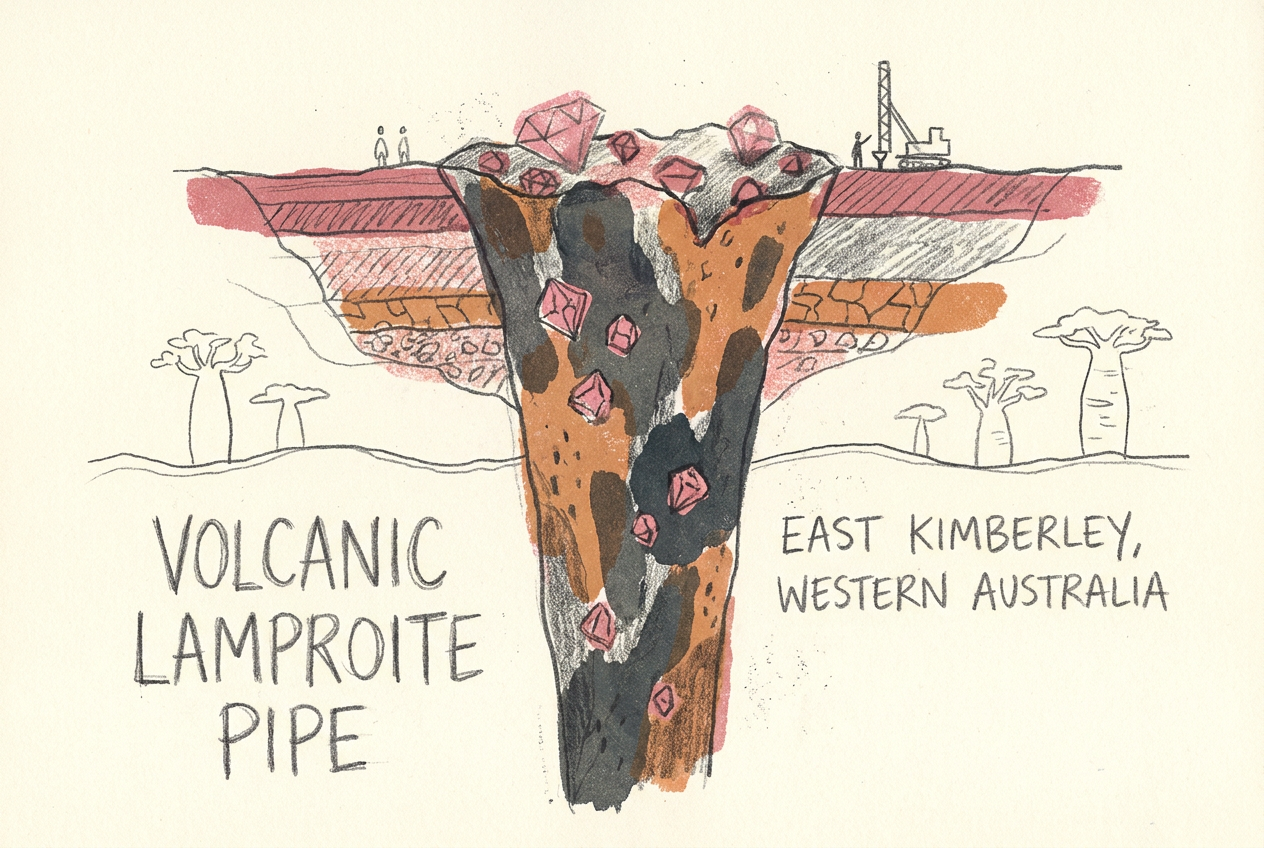
Argyle sits in the East Kimberley region of Western Australia, about 120 kilometres south of Kununurra. The deposit is a diatreme, a carrot-shaped volcanic pipe that punched through 1.8-billion-year-old Proterozoic sediments roughly 1.3 billion years ago. That much is typical. What is not typical is the host rock.
Lamproite is a potassium-rich, magnesium-rich volcanic rock with almost no aluminium. Before Argyle was discovered in 1979, lamproite was considered a geological curiosity — a rock type so rare that few geologists had ever seen it in the field. Only two other lamproite pipes were known to contain diamonds, and neither in commercial quantity. Argyle changed that. It became the richest diamond mine on Earth by volume, producing an average of 35 million carats per year at its peak.
The Colour of Catastrophe
Argyle's diamonds are unusual in another way. Approximately 90 percent of the world's pink, red, and brown diamonds come from this single pipe. The colour is not a chemical impurity — pink diamonds contain no nitrogen or boron, the elements that colour most gems. Instead, the pink colour is a deformation feature.
The Argyle lamproite erupted through the Halls Creek Orogen, a zone where ancient continental blocks had been colliding and shearing for hundreds of millions of years. The diamonds that rode this magma upward had already been bent and twisted by tectonic forces deep in the mantle, their crystal lattices deformed along planes called lamellae. Light passing through these distorted zones scatters differently, producing pink. The same deformation that gave the diamonds their colour also made them brittle. Argyle's stones are rarely large; most are smaller than a grain of rice.
The pink is not a gift of chemistry. It is a scar, preserved at high pressure for a billion years.
What the Pipe Left Behind
The Argyle pipe itself is small — about 500 metres across at its widest. By comparison, the Kimberley pipes of South Africa are often several times larger. But Argyle's diamond density was extraordinary, reaching 7 carats per tonne of rock. To put that in perspective, most economic diamond deposits contain less than 1 carat per tonne.
The mine closed in 2020, not because the pipe was exhausted but because the remaining ore lay too deep to extract economically. In its 37 years of operation, Argyle produced more than 865 million carats of rough diamonds. The open pit now sits as a 600-metre-wide scar in the savannah, slowly filling with groundwater.
What remains underground is still poorly understood. The lamproite magma that fed Argyle originated at depths of more than 150 kilometres, passing through a region of the mantle that had been enriched by subduction — ancient seafloor carried downward and melted. That enrichment, combined with the unique deformation history of the diamonds themselves, created a deposit that geology has not repeated anywhere else on the planet.
A Single Accident
Argyle is a reminder that mineral deposits are not inevitable. They require a specific sequence of events — a mantle enriched in carbon, a tectonic collision to deform the growing crystals, a rare magma type to carry them upward, and a crustal setting stable enough to preserve the pipe for over a billion years. Change any one variable, and the pink diamonds never form.
In the East Kimberley, all of those variables aligned exactly once. They have not aligned anywhere else since.
More like this
- The 5,000-Year-Old Volcanoes That Still Smoke in the SouthIn Victoria's Newer Volcanics Province, 400 volcanic vents erupted as recently as 5,000 years ago—the youngest volcanic field in mainland Australia, where craters still hold blue lakes and scoria cone
- The 300-Million-Year-Old Forest That Died Standing UpIn New South Wales, a 300-million-year-old fossil forest preserves dozens of trees buried upright by a Permian volcanic eruption—an entire ecosystem frozen in ash.
- The 1.85-Billion-Year-Old Caldera That Still Feeds the FurnaceIn South Australia's Middleback Ranges, a 1.85-billion-year-old volcanic caldera collapsed and later became one of the world's richest iron ore deposits.