11 May 2026 · 3 min read
The Sapphire Gravels: Gemstones of the New England Gemfields
Beneath New South Wales' New England region, 50-million-year-old volcanic gravels hold sapphires and zircons carried from deep within the continent's crust.
A fistful of river gravel from the New England tablelands can hold blue, green, yellow, and pink crystals—sapphires born 50 million years ago in the roots of ancient volcanoes. The pebbles look unremarkable at first, grey and water-worn, but split one open and the colour is trapped inside like frozen light.
This is the New England Gemfields, a belt of alluvial deposits stretching across northern New South Wales, from Glen Innes to Inverell. For over a century, fossickers have sifted these gravels for sapphire, zircon, and ruby. The stones are not native to the creeks. They arrived there by a slow sequence of volcanic violence and patient erosion.
The Volcanic Conveyor
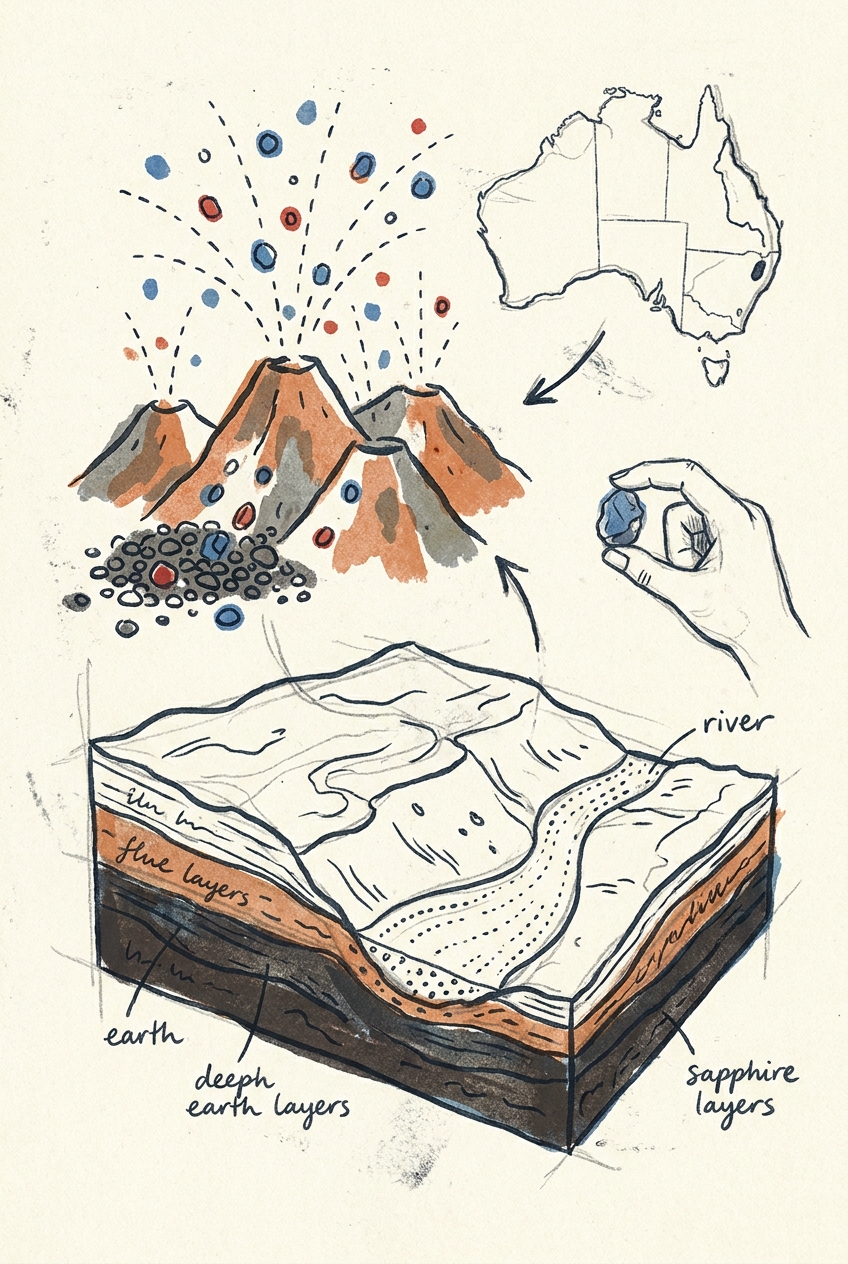
The sapphires began their journey in the Eocene, around 50 to 55 million years ago, when eastern Australia sat above a series of mantle plumes—hot columns of rock rising from deep within the Earth. As the continent drifted north over these hotspots, chains of volcanoes erupted along the eastern highlands.
One such chain produced the Central Volcano, a massive shield volcano that once covered much of northern New South Wales. Only its roots remain: the eroded plugs, dykes, and lava flows of the Nandewar and Warmunbungle ranges. Within those roots, at depths of 30 to 50 kilometres, intense heat and pressure transformed aluminium-rich rocks into corundum—the mineral that becomes sapphire when trace elements of iron, titanium, or chromium colour its crystal lattice.
The gemstones rode upward in basaltic magmas, carried as xenocrysts—foreign crystals that survived the violent ascent. When the lava reached the surface and cooled, the sapphires were locked inside basalt flows.
The Weathering Mill
Then the long unmaking began. Over tens of millions of years, the Central Volcano eroded to nothing. Rain, frost, and chemical weathering broke down the basalt, freeing the harder corundum crystals. Streams carried them downhill, tumbling and sorting the gems by density into gravel beds.
The richest deposits lie in paleochannels—ancient river courses now buried beneath younger sediments. At the Copeton and Inverell fields, these gravels sit in deep leads, old stream beds capped by basalt flows that protected them from further erosion. Miners follow these buried channels underground, extracting the sapphire-bearing gravel from shafts and drives.
What makes the New England stones unusual is their colour range. Unlike the classic blue sapphires of Sri Lanka or Kashmir, these Australian gems include parti-coloured stones—crystals that shift from green to yellow, or blue to green, within a single facet. The colour zoning records changing trace-element chemistry during the crystal's slow growth deep in the crust.
A Different Kind of Deposit
The New England sapphires are not gem-quality in the traditional sense. Many are dark, smoky, or heavily included. The deep blue stones that dominate the market are rare here. Instead, the fields produce a high proportion of green, yellow, and golden sapphires, along with the parti-coloured stones that have become the region's signature.
A sapphire from the New England fields carries the history of two continents: the Indian-Australian plate drifting north over a mantle hotspot, and the vanished volcanic highlands that once stood where the tablelands now lie.
The gravels also yield zircon, ruby, and diamond—though diamond finds are rare and small. The zircons are especially revealing. Many are the high-temperature cubic variety, formed in the same deep crustal conditions as the sapphires. Uranium-lead dating of these zircons confirms the 50-million-year age of the volcanic event, and the zircons themselves often show radiation damage from trace uranium, giving them a distinctive greenish hue.
The Fossicker's Landscape
Today, the New England Gemfields are a landscape of small-scale mining. Private claims, public fossicking areas, and commercial operations coexist among the paddocks and eucalyptus woodlands. At the Blue Sapphire Mine near Glen Innes, visitors can wash their own gravel through sieve boxes, watching for the telltale glint of a faceted surface among the pebbles.
The industry is modest—a far cry from the industrial-scale gem mining of Southeast Asia or East Africa. But the stones that emerge from these gravels carry a story that no other deposit can tell: of deep mantle plumes, of a continent drifting north, of a volcano that once stood kilometres high and then vanished completely, leaving only scattered crystals in the creek beds.
Every sapphire found in a New England gravel is a remnant of that vanished mountain. It endured the heat of the mantle, the violence of eruption, the slow work of weather, and the long journey down ancient rivers. All to end up in a sieve, held up to the light, still blue.
More like this
- The 110-Million-Year-Old River That Runs Backwards UndergroundWestern Australia's 110-million-year-old dune system has been slowly dissolving into a labyrinth of caves where an ancient river still flows, carrying the taste of a Cretaceous desert.
- The 5,000-Year-Old Volcanoes That Still Smoke in the SouthIn Victoria's Newer Volcanics Province, 400 volcanic vents erupted as recently as 5,000 years ago—the youngest volcanic field in mainland Australia, where craters still hold blue lakes and scoria cone
- The 300-Million-Year-Old Forest That Died Standing UpIn New South Wales, a 300-million-year-old fossil forest preserves dozens of trees buried upright by a Permian volcanic eruption—an entire ecosystem frozen in ash.