8 May 2026 · 3 min read
The Onion Skin: The Spheroidal Weathering of Karlu Karlu
Explore the 1.7-billion-year history of Karlu Karlu, where spheroidal weathering and thermal stress have sculpted massive granite batholiths into iconic desert spheres.
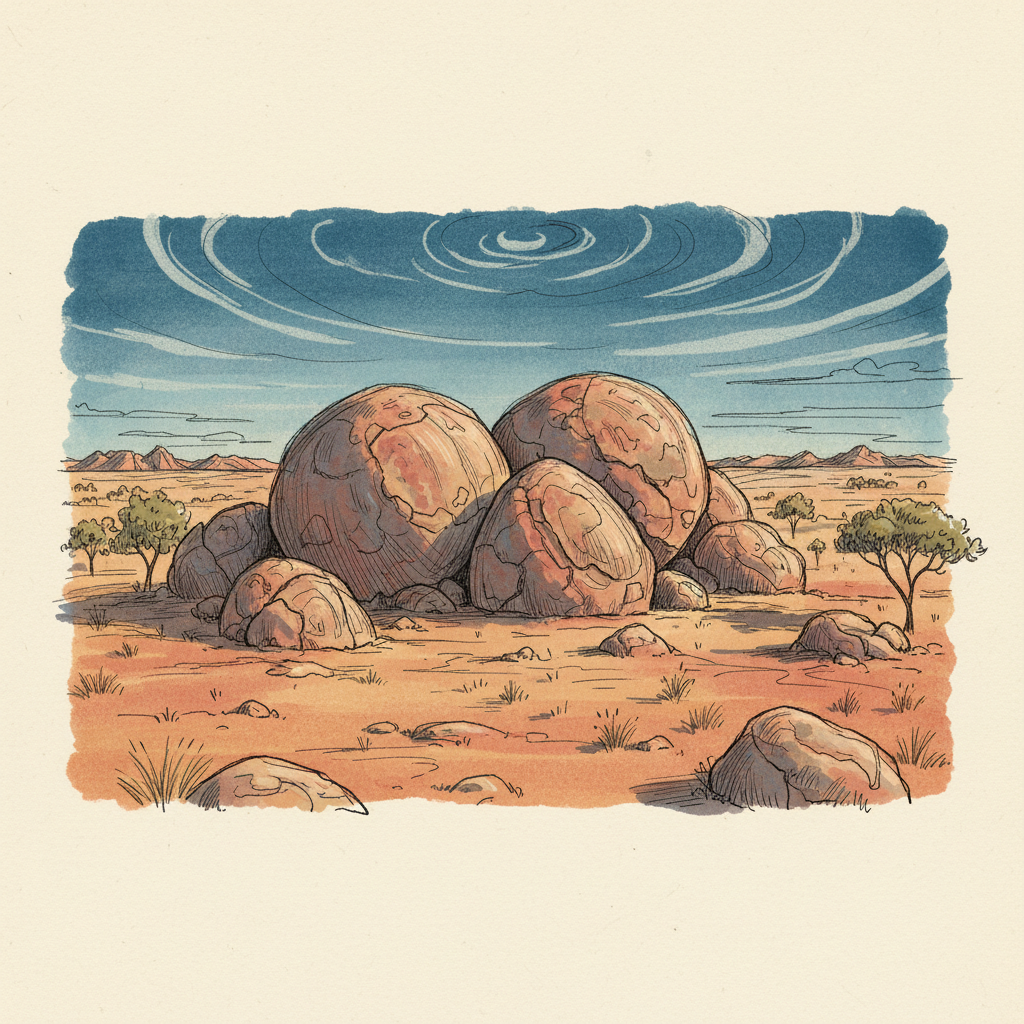
In the red dirt of the Northern Territory’s Barkly Tableland, the landscape is punctuated by clusters of granite boulders so perfectly spherical they appear to have been turned on a celestial lathe. These are the Karlu Karlu, or Devils Marbles, the weathered remnants of a massive subterranean intrusion that has spent the last 1.7 billion years resisting the slow erosion of the Australian interior.
The Plutonic Birth
The story of Karlu Karlu began deep within the Earth's crust during the Paleoproterozoic era. A massive body of felsic magma, known as the Devils Marbles Granite, pushed upward into the surrounding sedimentary rocks but never reached the surface. Instead, it cooled slowly beneath a thick insulating blanket of sandstone and soil.
This slow cooling allowed large crystals of feldspar and quartz to grow, creating a coarse-grained rock of immense structural integrity. As the magma solidified into a batholith, it contracted, developing a network of internal cracks known as joints. These joints formed a roughly cubic grid—three sets of fractures intersecting at right angles—splitting the massive granite into a subterranean stack of blocks.
The Chemistry of Rounding
For hundreds of millions of years, these blocks remained buried. Groundwater seeped into the vertical and horizontal joints, initiating a process called chemical weathering. Water reacts with the minerals in granite, particularly the feldspar, turning it into soft clay.
Because the corners of a cube have more surface area exposed to moisture than the flat faces, they weather much faster. Over eons, the sharp edges of the granite blocks dissolved away, leaving behind rounded "corestones" encased in a matrix of decayed rock and grit. This process, known as spheroidal weathering, is the secret behind the marbles’ geometry.
The rounding occurs entirely out of sight; by the time the boulders are exposed to the sky, the wind and rain are merely cleaning away the debris of a transformation that happened deep underground.
The Great Unveiling
Eventually, the softer overlying rocks were stripped away by the relentless forces of erosion, lowering the ground level and exposing the granite corestones. As the surrounding soil washed away, the boulders were left perched on top of one another in gravity-defying stacks.
The environment today continues to refine them through mechanical weathering. In the intense heat of the Australian desert, the granite expands during the day and contracts at night. This thermal stress causes the outer layers of the boulders to peel away like the skin of an onion—a process called exfoliation.
- Insolation weathering: The extreme temperature delta between day and night (often exceeding 30°C) creates stress fractures.
- Frost wedging: Rare winter rains fill cracks; the water freezes at night, expanding and prying the rock apart.
- Biological action: Lichens and mosses produce weak acids that further break down the mineral bonds on the surface.
A Landscape in Motion
Though they appear static, the Karlu Karlu are in a state of slow-motion collapse. Some boulders have split cleanly in half, cleaved by internal stresses or the sudden release of pressure as they were unearthed. Others balance on narrow points, waiting for the precise moment when erosion undermines their center of gravity.
These formations are not merely curiosities; they are a window into the deep time of the North Australian Craton. They represent the final, sculptural stage of a geological cycle that began with the cooling of a molten heart nearly two billion years ago. Today, they stand as monuments to the patient, persistent chemistry of the Earth.
More like this
- The 110-Million-Year-Old River That Runs Backwards UndergroundWestern Australia's 110-million-year-old dune system has been slowly dissolving into a labyrinth of caves where an ancient river still flows, carrying the taste of a Cretaceous desert.
- The 5,000-Year-Old Volcanoes That Still Smoke in the SouthIn Victoria's Newer Volcanics Province, 400 volcanic vents erupted as recently as 5,000 years ago—the youngest volcanic field in mainland Australia, where craters still hold blue lakes and scoria cone
- The 300-Million-Year-Old Forest That Died Standing UpIn New South Wales, a 300-million-year-old fossil forest preserves dozens of trees buried upright by a Permian volcanic eruption—an entire ecosystem frozen in ash.