8 May 2026 · 3 min read
The Fossil Cold: The Blockstreams of the Snowy Mountains
Explore the periglacial landscapes of the Snowy Mountains, where frost-shattering and stone rivers preserve the record of Australia's recent glacial past.
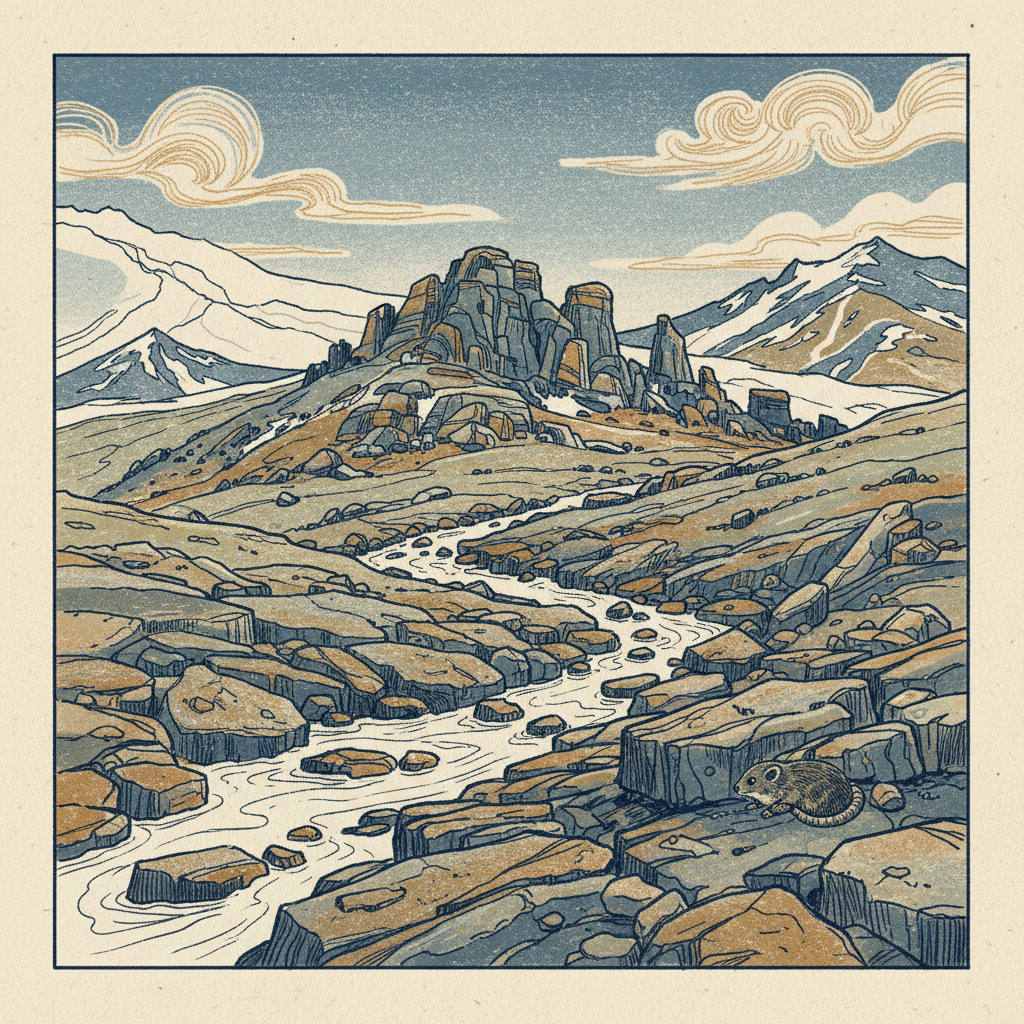
High on the wind-scoured plateaus of the Snowy Mountains, the earth is not a solid foundation but a slow-moving river of shattered stone. Here, the landscape is defined by periglacial processes—the rhythmic freezing and thawing of ground moisture that has ground the peaks of the Main Range into vast, sorted boulder fields known as blockstreams.
The Periglacial Pulse
While much of the world’s mountain-building narrative focuses on the violent uplift of tectonic plates, the current face of the Australian Alps is a story of attrition. During the Pleistocene epoch, specifically between 100,000 and 10,000 years ago, the Snowy Mountains were gripped by a climate that was cold but relatively dry. Unlike the thick ice sheets of the Northern Hemisphere, the glaciers here were small and localized, confined to high cirques like Blue Lake.
The real architect of the high country was the periglacial cycle. Every winter, water seeped into the joints of the Ordovician metasediments and Silurian granites; every night, it froze and expanded, acting as a hydraulic wedge. This process, known as frost wedging or gelifraction, shattered the bedrock into angular fragments ranging from the size of a fist to the size of a small house.
Rivers of Stone
The result of this persistent shattering is the blockstream. From a distance, these formations look like grey glaciers frozen in mid-flow, pouring down the sides of peaks like Mount Twynam and Mount Kosciuszko. They are not static piles of scree. Under the influence of gravity and the lubricating effect of seasonal meltwater, these stone rivers move through a process called solifluction.
"The landscape is a relic of a climate that no longer exists, a ghost of the cold that once held the continent's spine in a permanent grip."
Because the ground beneath these rocks remained frozen for much of the year—a condition known as permafrost—the upper layer of saturated soil and rock would slide over the icy substrate. Even today, though the deep permafrost has largely vanished, the legacy remains in the "sorted" ground. In high-altitude basins, the frost has pushed larger stones outward into rings and polygons, creating geometric patterns in the alpine herbfields that resemble primitive masonry.
The Last Ice Record
The Snowy Mountains provide the only significant record of periglacial and glacial activity on the Australian mainland. This thin slice of the continent, comprising less than one percent of its landmass, preserves features that are rare in a land defined by heat and aridity.
- Cirques: Deep, amphitheater-shaped basins carved by small glaciers, now often holding alpine tarns.
- Moraines: Ridges of unsorted debris dumped at the snout of retreating ice tongues.
- Roche Moutonnées: "Sheep-backed" rocks smoothed on one side by advancing ice and plucked jagged on the other.
- Felsenmeer: German for "sea of rock," describing the chaotic expanses of frost-shattered boulders covering the summits.
A Vulnerable Archive
The stones of the Main Range are remarkably resilient, but the processes that shaped them are disappearing. As the modern climate warms, the seasonal freeze-thaw cycles that maintain the integrity of the alpine bogs and herbfields are shifting. The blockstreams, once fluid and active, have mostly stabilized, becoming "fossil" landforms that no longer creep down the slopes.
Walking across the felsenmeer today is a traverse through a climate transition. The sharp edges of the granite blocks are being rounded by chemical weathering and colonized by slow-growing crustose lichens. These stones are the silent witnesses to the last time Australia was truly cold, standing as a testament to the brief, icy window when the Great Dividing Range mimicked the high peaks of the Andes or the Alps.
More like this
- The 110-Million-Year-Old River That Runs Backwards UndergroundWestern Australia's 110-million-year-old dune system has been slowly dissolving into a labyrinth of caves where an ancient river still flows, carrying the taste of a Cretaceous desert.
- The 5,000-Year-Old Volcanoes That Still Smoke in the SouthIn Victoria's Newer Volcanics Province, 400 volcanic vents erupted as recently as 5,000 years ago—the youngest volcanic field in mainland Australia, where craters still hold blue lakes and scoria cone
- The 560-Million-Year-Old Garden That Never Saw a PredatorIn South Australia's Flinders Ranges, 560-million-year-old Ediacara surfaces preserve entire seafloor communities of fronds, discs, and quilts — a garden of soft-bodied life that flourished before pre