10 May 2026 · 3 min read
The Sunken River: The Turbidites of the Nankai Trough
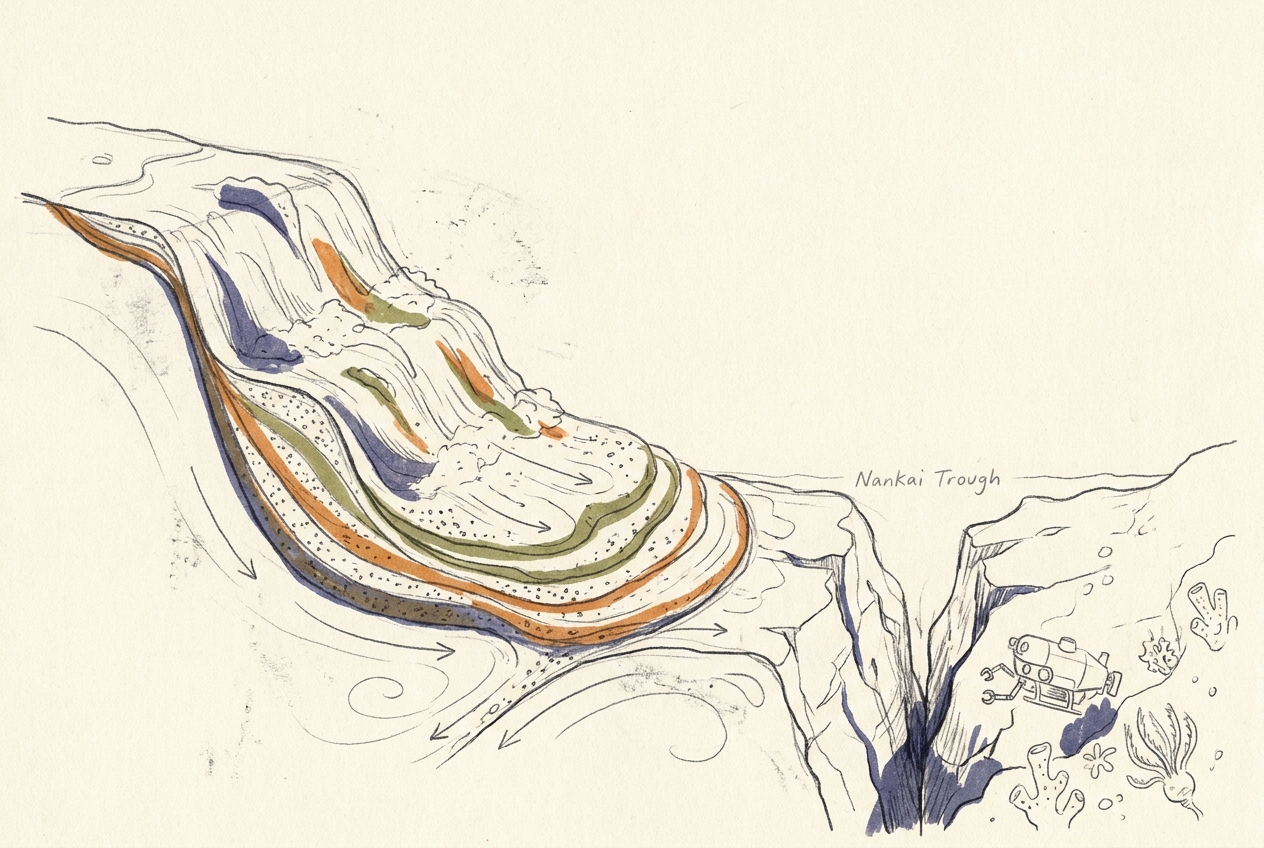
Off northwest Australia, sediment cascades from the continent into the deep Nankai Trough, building a 4-kilometre-thick fan of turbidite layers that record 15 million years of tectonic unravelling.
Off the northwest coast of Australia, something slides. Not fast—a slow, episodic collapse of sand and mud that has been underway for 15 million years. The continent's edge is shedding itself into the abyss.
The Continental Unravelling
The Northwest Shelf of Australia is one of the world's great passive margins. For 200 million years, since the breakup of Gondwana, this edge has sat quiet—no subduction, no volcanic arcs. Just slow subsidence and the steady accumulation of sediment from rivers draining the Pilbara and Kimberley.
But a passive margin is not truly still. Beneath the seabed, the crust cools, contracts, and tilts seaward. Sediment piles up until the slope becomes unstable. Then it fails.
The result is a turbidity current: a dense slurry of sand, silt, and water that accelerates down the continental slope at speeds of 20 metres per second. These currents can travel hundreds of kilometres across the seafloor, carving channels and depositing their load in deep-water fans. One such fan, the Gascoyne Fan, extends more than 600 kilometres from the shelf edge into the Gascoyne Abyssal Plain.
The Turbidite Archive
Each turbidity current leaves a distinctive layer—a turbidite. A classic turbidite begins with coarse sand at the base, grading upward into fine silt and finally clay. This graded bedding records the current's waning energy as it slows and spreads across the abyssal plain.
The Gascoyne Fan contains thousands of these layers, stacked like pages in a book. Individual turbidites range from millimetres to metres thick. The largest events, triggered by major earthquakes or catastrophic slope failures, deposit sand sheets that cover tens of thousands of square kilometres.
In 2019, scientists aboard the JOIDES Resolution drilled into the fan at Site U1475, recovering a 700-metre sediment core that spans the last 5 million years. The core reveals pulses of turbidite deposition tied to glacial-interglacial cycles. When sea levels dropped during ice ages, rivers extended across the exposed shelf, delivering sediment directly to the slope edge. The turbidite record thickened. When seas rose, the sediment supply retreated, and the fan starved.
A single core, pulled from the seafloor, contains the heartbeat of an entire climate system.
The Movement Below
The Northwest Shelf is also drifting. The Indo-Australian Plate moves northward at about 7 centimetres per year, colliding with Southeast Asia. This collision has warped the old passive margin, reactivating faults that had lain dormant for tens of millions of years.
Seismic reflection profiles across the fan show these faults cutting through the turbidite layers. Some offset the seafloor itself, evidence of ongoing deformation. The margin that seemed so still is, in fact, slowly breaking apart along its outer edge.
In 2006, a magnitude 6.3 earthquake struck near the shelf edge, triggering a turbidity current that broke submarine cables and was recorded on seismometers hundreds of kilometres away. The shaking lasted seconds; the sediment flow continued for hours.
The Invisible Landscape
The turbidite fan is invisible from the surface, buried under kilometres of water. It has no name on most maps. Yet it is one of the largest sedimentary features on the Australian continent—a sprawling, deep-sea plain built from the erosion of ancient rocks.
Every grain of sand in the fan began as part of the Australian craton. Quartz from the Pilbara, eroded 2.5 billion years after it crystallised, now rests in graded beds on the abyssal plain. The continent is slowly, grain by grain, returning to the deep Earth from which it came.
The Gascoyne Fan is not a tourist destination. It will never be photographed from the air. But it is as much a part of Australia's geology as Uluru or the Great Barrier Reef. It is the continent's shadow, written in sediment, spread across the ocean floor.
More like this
- The 110-Million-Year-Old River That Runs Backwards UndergroundWestern Australia's 110-million-year-old dune system has been slowly dissolving into a labyrinth of caves where an ancient river still flows, carrying the taste of a Cretaceous desert.
- The 5,000-Year-Old Volcanoes That Still Smoke in the SouthIn Victoria's Newer Volcanics Province, 400 volcanic vents erupted as recently as 5,000 years ago—the youngest volcanic field in mainland Australia, where craters still hold blue lakes and scoria cone
- The 560-Million-Year-Old Garden That Never Saw a PredatorIn South Australia's Flinders Ranges, 560-million-year-old Ediacara surfaces preserve entire seafloor communities of fronds, discs, and quilts — a garden of soft-bodied life that flourished before pre