10 May 2026 · 3 min read
The Blue Lake: Mount Gambier's Volcanic Crater Lake
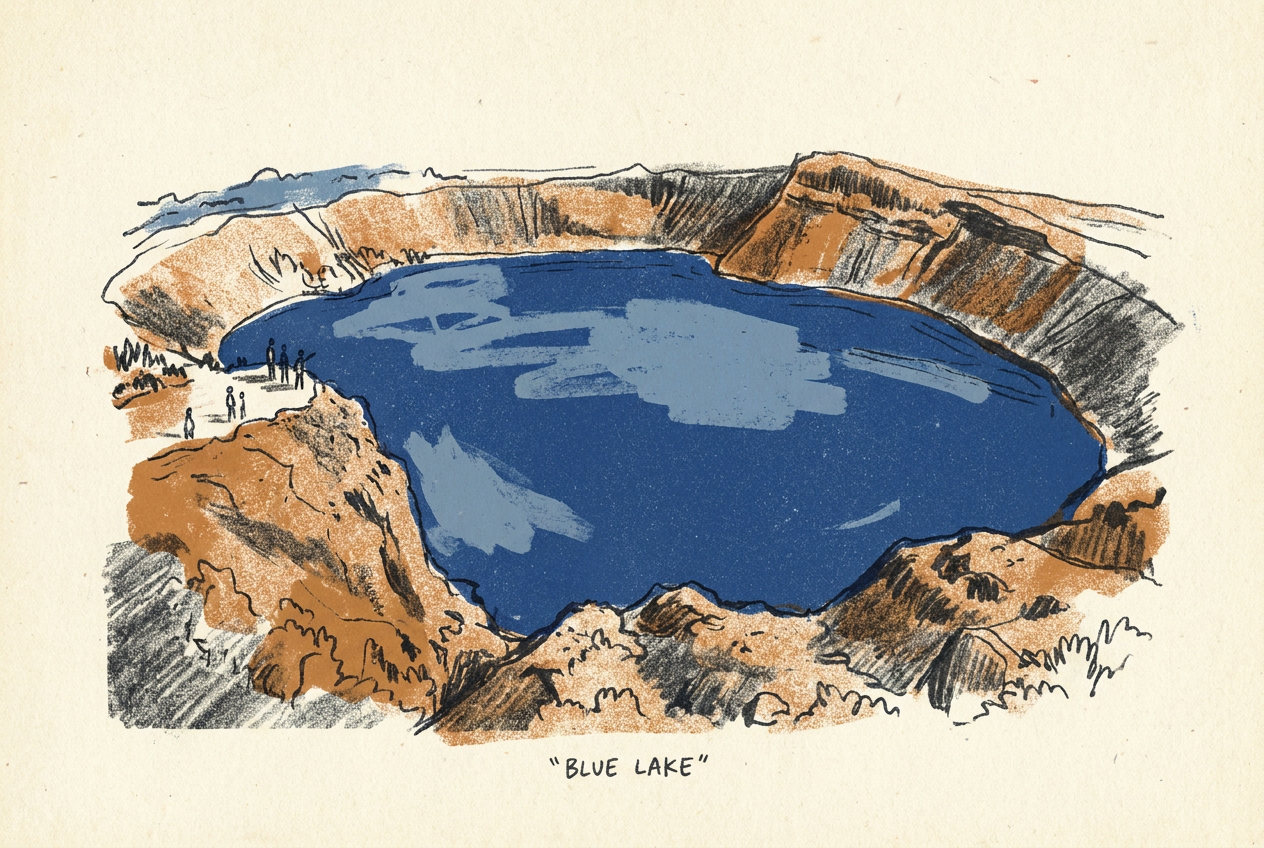
Mount Gambier's Blue Lake fills a 4,500-year-old volcanic crater, where seasonal temperature shifts turn the water a vivid cobalt each summer.
In summer, the Blue Lake of Mount Gambier turns a colour that seems impossible: a cobalt so dense and saturated that locals say the water looks dyed. By winter it fades to a dull steel grey. The shift is annual, predictable, and still not fully explained.
The lake fills the deepest crater of the Mount Gambier volcanic complex, a cluster of four maars—broad, shallow volcanic craters formed not by eruption but by explosion. Around 5,000 years ago, rising magma met groundwater beneath this patch of South Australia. The water flashed to steam, and the resulting phreatomagmatic blast excavated a bowl 70 metres deep into the limestone plain.
The Crater That Became a Lake
Mount Gambier is young by geological standards. The eruptions that built it happened between 5,000 and 4,500 years ago—recent enough that Aboriginal oral traditions may preserve the memory of the event. The Buandig people speak of the fire being thrown from the earth, and of a great water that followed.
The volcano sits on the edge of the Gambier limestone, a soft Tertiary limestone formed from the accumulated shells of marine organisms when this part of Australia lay beneath shallow seas. When the magma met the water-saturated limestone, the explosion was violent enough to hurl blocks of rock hundreds of metres. The craters left behind—Blue Lake, Valley Lake, and the dry craters of Leg of Mutton and Browne's—are among the youngest volcanic features on the Australian continent.
Three of the four craters now hold water. Blue Lake is the deepest and the most enigmatic.
The Annual Alchemy
For half the year, from about April to November, the lake is an ordinary grey-blue. Then, as the weather warms, the water begins to clarify, and by December it has transformed into its signature blue.
The mechanism appears to be seasonal calcification. The lake sits atop a limestone aquifer, and its water is rich in dissolved calcium carbonate. In summer, the surface layer warms and the calcium carbonate precipitates out as microscopic crystals—calcite particles that scatter sunlight. The shorter blue wavelengths scatter most efficiently, giving the water its intense colour. In winter, the lake turns over, the crystals dissolve, and the colour vanishes.
The colour is not pigment. It is physics: light scattered from particles smaller than a wavelength of light, the same principle that makes the sky blue.
But this explanation remains provisional. The exact trigger for the precipitation—whether temperature, biological activity, or water chemistry—is still debated. The lake keeps its secret.
A Living Clock
The Blue Lake also serves as the town's drinking water supply. Each year, as the colour shifts from grey to blue, the water becomes potable. The same calcification that produces the colour also strips suspended particles from the water, leaving it exceptionally clear.
Beneath the surface, the lake records the climate of the region. Its sediment layers preserve pollen, charcoal, and diatoms that document 5,000 years of vegetation change, fire history, and human presence. Core samples show that the Buandig people managed the landscape around the crater with fire for millennia before European arrival.
The lake is not static. Its level fluctuates with the water table. In drought years, the blue appears later and fades sooner. In wet years, it lingers.
The Silence of the Maar
Standing on the rim of the crater, looking down at that improbable blue, you feel the weight of the forces that shaped it. The explosion that created this bowl was violent enough to kill anything within kilometres. Now the crater holds water, and the water turns blue, and the town draws its drinking water from the cavity of an ancient blast.
Australia has no active volcanoes. But it has places like this—young craters that remind you the continent's volcanic past is not as distant as it seems. Mount Gambier's last eruption was 4,500 years ago. In geological time, that is a heartbeat. The lake is still settling into its crater, still finding its chemistry, still turning blue each summer as if surprised by its own existence.
More like this
- The 110-Million-Year-Old River That Runs Backwards UndergroundWestern Australia's 110-million-year-old dune system has been slowly dissolving into a labyrinth of caves where an ancient river still flows, carrying the taste of a Cretaceous desert.
- The 5,000-Year-Old Volcanoes That Still Smoke in the SouthIn Victoria's Newer Volcanics Province, 400 volcanic vents erupted as recently as 5,000 years ago—the youngest volcanic field in mainland Australia, where craters still hold blue lakes and scoria cone
- The 300-Million-Year-Old Forest That Died Standing UpIn New South Wales, a 300-million-year-old fossil forest preserves dozens of trees buried upright by a Permian volcanic eruption—an entire ecosystem frozen in ash.