10 May 2026 · 3 min read
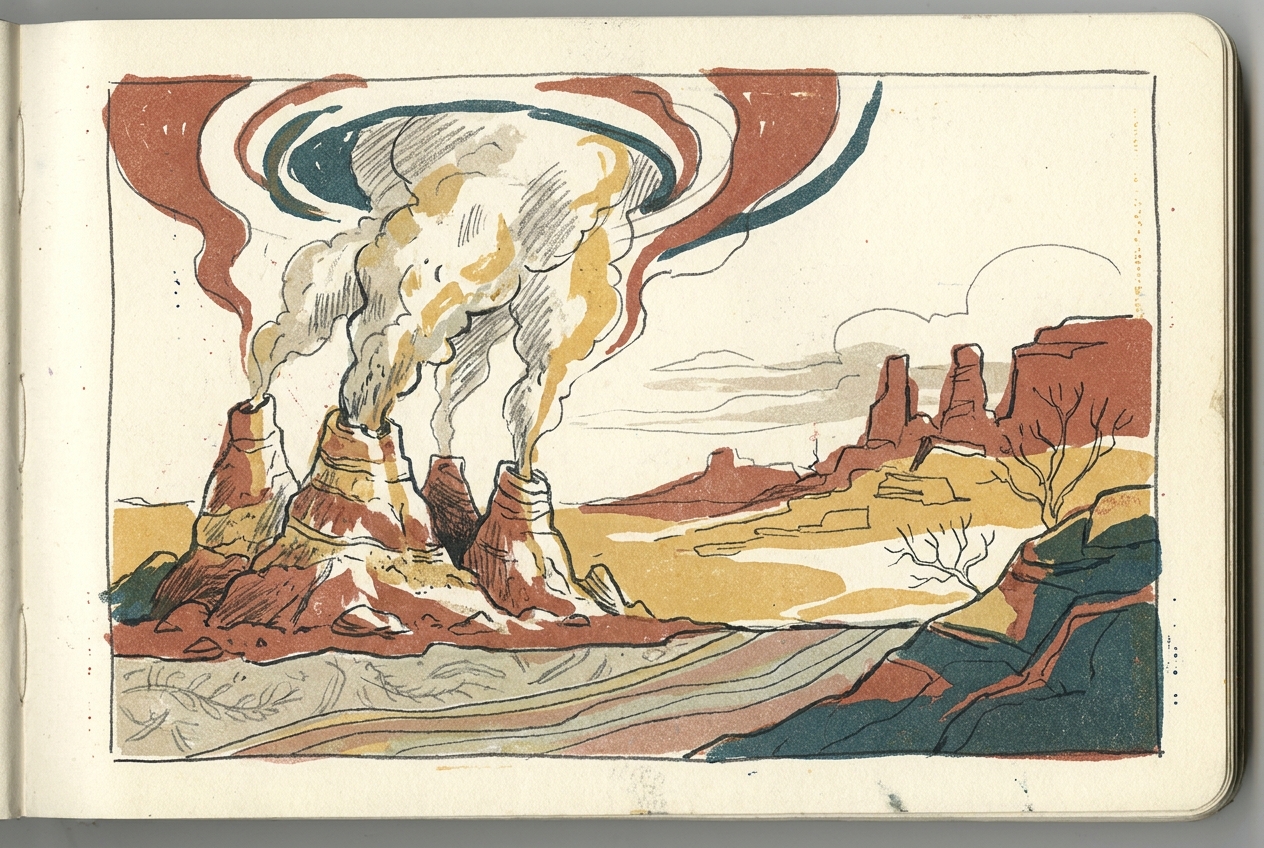
The Boiling Crater: The Hydrothermal Vents of the Panorama District
In Western Australia's Pilbara Craton, 3.24-billion-year-old hydrothermal vent deposits preserve the earliest known evidence of seafloor hot springs and the microbial life they hosted.
Three kilometres of volcanic rock stack upward from the floor of the North Pole Dome in Western Australia's Pilbara Craton. Near the top, preserved in black chert like insects in amber, sit the oldest hydrothermal vent deposits ever found—chimneys of silica and barite that once belched superheated water into an Archaean sea.
The Pillars of the Archaean Seafloor
The Panorama District lies within the 3.24-billion-year-old Sulphur Springs Group, a sequence of volcanic and sedimentary rocks that formed on the seafloor of the Pilbara's ancient crust. Here, geologists have identified at least six discrete vent fields, each marked by mounds of massive sulphide—zinc, copper, lead—precipitated when hot, mineral-laden fluids met cold seawater.
The vents themselves are preserved as silica chimneys, some still standing upright after three billion years of burial, metamorphism, and exhumation. They look nothing like the towering black smokers of the modern Pacific. These are low, squat structures, rarely more than a few metres tall, built of fine-grained quartz and barite that replaced the original sulphide minerals over time. Yet the architecture is unmistakable: concentric layers of mineral precipitation, central conduits where fluid once flowed, and surrounding halos of altered rock.
The Panorama vents are the only known Archaean examples preserved in such detail—a snapshot of the deep seafloor from a time when the Earth's crust was still thin and hot.
The Chemistry That Shaped Life
What makes the Panorama District significant is not just the preservation of the vents themselves, but what they reveal about the chemistry of early Earth. The fluids that emerged from these chimneys were rich in iron, manganese, zinc, and copper—the same suite of metals that modern hydrothermal systems supply to the deep ocean. But the Archaean ocean was different: low in oxygen, rich in dissolved iron and silica, and bathed in ultraviolet radiation that no ozone layer yet blocked.
In modern vent systems, the interface between hot, reduced fluids and cold, oxidised seawater creates a chemical gradient where chemosynthetic bacteria thrive. The same gradient existed at Panorama, and the rocks preserve its signature. Carbon isotope ratios in the cherts suggest biological activity—microbes that metabolised sulphur and carbon in the warm, mineral-rich plumes.
No fossil cells remain. But the chemical traces are consistent, repeated across multiple vent fields, and they match the patterns seen in younger vent deposits where fossilised microbes have been found. If life existed on Earth 3.24 billion years ago, this is where it likely lived.
The Inversion of Time
The Panorama District required a peculiar kind of luck to survive. The vents formed on the seafloor, but they are now exposed on land, high in the arid hills of the Pilbara. This inversion happened because the volcanic pile that buried them was itself buried, compressed, tilted, and then slowly exhumed over hundreds of millions of years.
The Pilbara Craton has been geologically quiet for the last 2.5 billion years—no major mountain building, no deep burial, no melting. The craton simply sat, weathering slowly, while the rest of the planet rearranged itself around it. The same stability that preserved the stromatolites of the nearby Strelley Pool Chert also preserved the Panorama vents.
Walking across the outcrops today, the scale is deceptive. The vent deposits are small—a few square kilometres in total extent. But they represent a window into a process that may have been common on the early Earth: hot fluids circulating through young oceanic crust, reacting with rock and seawater, and creating the chemical conditions necessary for life to begin. Most such deposits have been destroyed by subduction, metamorphism, or erosion. These survived.
The Quiet After the Boil
The Panorama vents are not famous. They lack the visual drama of the Hamersley banded iron formations or the ancient grandeur of the Jack Hills zircons. They are dark, weathered outcrops in a remote corner of a continent that has many remote corners. But they hold a rare thing: direct evidence of the kind of environment where life may have first assembled itself from non-living chemistry.
The vents are now silent. No superheated water rises through their chimneys. No microbial mats grow in their plumes. But the rock still records the moment when the Earth's internal heat met its oceans, and the two began the long conversation that led to everything else.
More like this
- The 5,000-Year-Old Volcanoes That Still Smoke in the SouthIn Victoria's Newer Volcanics Province, 400 volcanic vents erupted as recently as 5,000 years ago—the youngest volcanic field in mainland Australia, where craters still hold blue lakes and scoria cone
- The 560-Million-Year-Old Garden That Never Saw a PredatorIn South Australia's Flinders Ranges, 560-million-year-old Ediacara surfaces preserve entire seafloor communities of fronds, discs, and quilts — a garden of soft-bodied life that flourished before pre
- The 300-Million-Year-Old Forest That Died Standing UpIn New South Wales, a 300-million-year-old fossil forest preserves dozens of trees buried upright by a Permian volcanic eruption—an entire ecosystem frozen in ash.