10 May 2026 · 3 min read
The Reef That Wasn't: The Archaean Carbonates of the Steep Rock Lake
In a drained lakebed in Western Australia, 2.7-billion-year-old carbonate platforms preserve the oldest known stromatolite reefs—built by microbes before the continents had stabilised.
On a dry lakebed in the Yilgarn Craton, 50 kilometres east of Southern Cross, the oldest reefs on Earth lie exposed to the sun. They are not coral. They are not even animal. They are the work of microbes that built underwater mountains 2.7 billion years ago, when Australia was still a volcanic archipelago and the sky was the colour of rust.
The Steep Rock Lake Platform
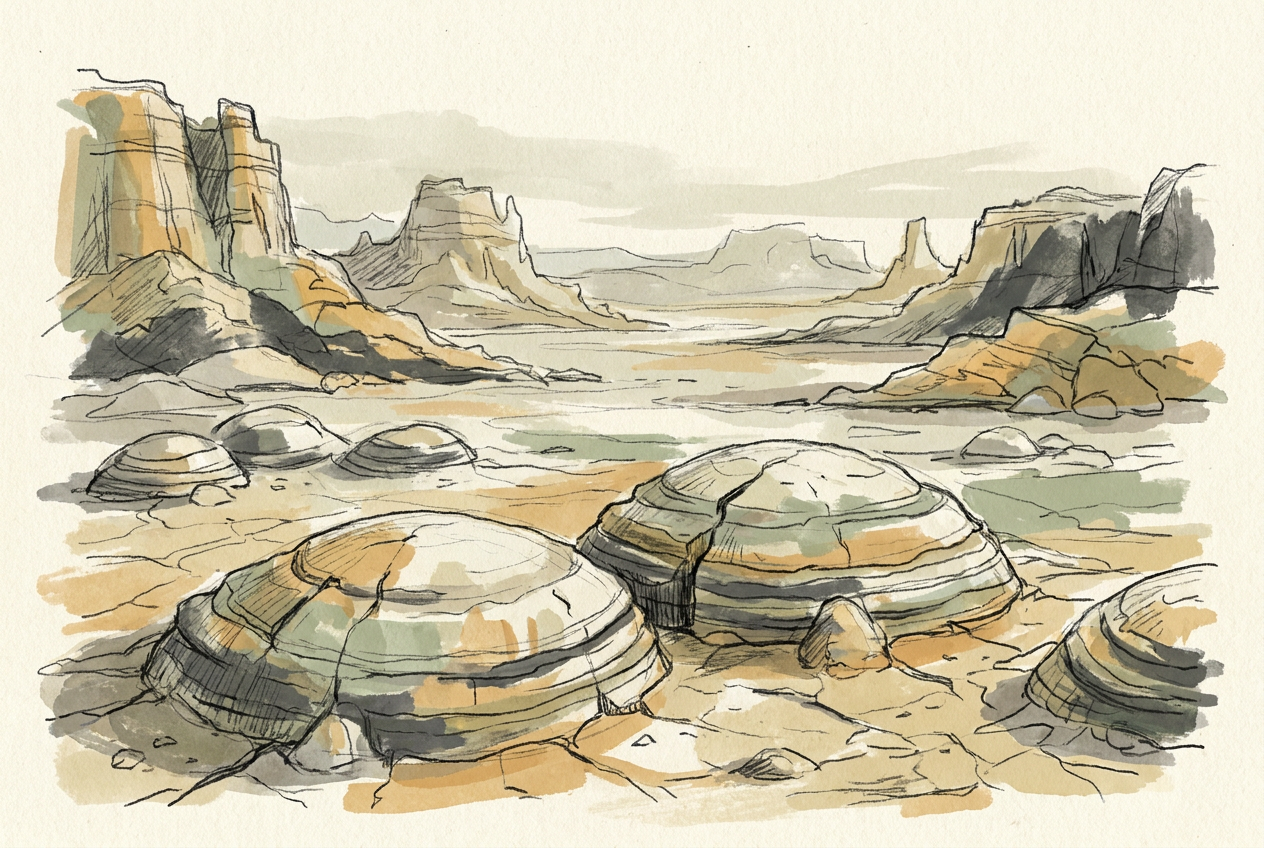
The Steep Rock Lake carbonate platform sits within the Kalgoorlie Terrane, a belt of greenstone and granite that forms the eastern core of the Yilgarn Craton. The rocks were originally buried beneath a lake—Steep Rock Lake itself—drained in the 1930s by gold miners who found iron ore instead. Beneath the iron lay something stranger: layered domes of dolomite, up to 200 metres thick, stretching across an area the size of a small town.
These are among the oldest known stromatolite reefs. The term "reef" is carefully chosen. Like modern barrier reefs, the Steep Rock structures rose from a deep basin, built a wave-resistant framework, and shed debris down their flanks. The difference is that the builders were not polyps but photosynthetic microbial mats—cyanobacteria and their relatives—that trapped sediment and precipitated carbonate in thin, sticky layers.
The World the Microbes Made
When these reefs grew, the Yilgarn Craton was still assembling. The continents we know did not exist. Instead, the Steep Rock platform lay in a shallow sea on the margin of a volcanic island arc, not far from the equator. The atmosphere contained almost no free oxygen. The oceans were rich in dissolved iron and silica.
The microbial mats worked slowly. A single stromatolite dome might take centuries to grow a metre. But over tens of thousands of years, they built structures that rose tens of metres above the seafloor. The Steep Rock platform preserves a complete reef system: a shallow lagoon behind the reef crest, a steep fore-reef slope, and a basin floor where eroded carbonate sand accumulated in graded beds.
The oldest reefs on Earth were built not by animals, but by slime.
The fossils are subtle. Unlike the flashy stromatolites of the Pilbara's 3.5-billion-year-old Dresser Formation, which look like layered pancakes, the Steep Rock structures preserve original reef geometry. You can walk along the strike of the old reef crest and see where the wave energy was highest—the domes are taller here, more widely spaced, their flanks steeper. In the lagoon, the growth forms are low and sprawling.
A Reef Without Predators
There were no fish in these waters. No trilobites, no corals, no sponges. The only animals on Earth were single-celled organisms drifting in the seas. The Steep Rock reef was built in a world without grazing, without boring, without predation. The microbial mats could grow undisturbed for millennia.
This absence is itself a fossil. The Steep Rock carbonates contain no evidence of bioerosion—no borings, no bite marks, no crushed shells. The reef grew as a pure chemical and sedimentary construction, shaped only by wave energy and water chemistry. Compare this to any Phanerozoic reef, where the rock is riddled with the traces of animals chewing, drilling, and scraping. The Steep Rock platform records a brief window in Earth history when life built large structures but had not yet evolved the means to destroy them.
The Silence Ends
The platform did not last. Around 2.68 billion years ago, the volcanic arc collided with another piece of crust, and the shallow sea was compressed, uplifted, and eroded. The reef was buried under thick sequences of basalt and sediment, then metamorphosed at low grade. The original aragonite and calcite recrystallised to dolomite. The fine microbial textures were partly obliterated.
But the shape survived. Today, the Steep Rock carbonates are quarried for iron ore—the reefs were later coated by banded iron formation, the same rock type that makes the Hamersley Range famous. The miners dig through the iron to reach the carbonate beneath. They do not always recognise what they are excavating.
The Steep Rock platform is not the oldest stromatolite on Earth—that title belongs to the Dresser Formation, also in Australia. But it is the oldest reef, in the full geological sense: a wave-resistant biological structure that once stood above the seafloor. It tells us that within a few hundred million years of life's origin, microbes had already learned to build mountains.
More like this
- The 450-Million-Year-Old Volcano That Holds the Great Barrier ReefThe Great Barrier Reef grows on the eroded stumps of a 450-million-year-old volcanic arc that forms its hidden foundation.
- The 110-Million-Year-Old River That Runs Backwards UndergroundWestern Australia's 110-million-year-old dune system has been slowly dissolving into a labyrinth of caves where an ancient river still flows, carrying the taste of a Cretaceous desert.
- The 5,000-Year-Old Volcanoes That Still Smoke in the SouthIn Victoria's Newer Volcanics Province, 400 volcanic vents erupted as recently as 5,000 years ago—the youngest volcanic field in mainland Australia, where craters still hold blue lakes and scoria cone