8 May 2026 · 2 min read
The Sky in the Silt: The Acraman Ejecta Layer
The 580-million-year-old Acraman impact in South Australia left a trail of shattered volcanic debris across hundreds of kilometers, potentially sparking a biological revolution.
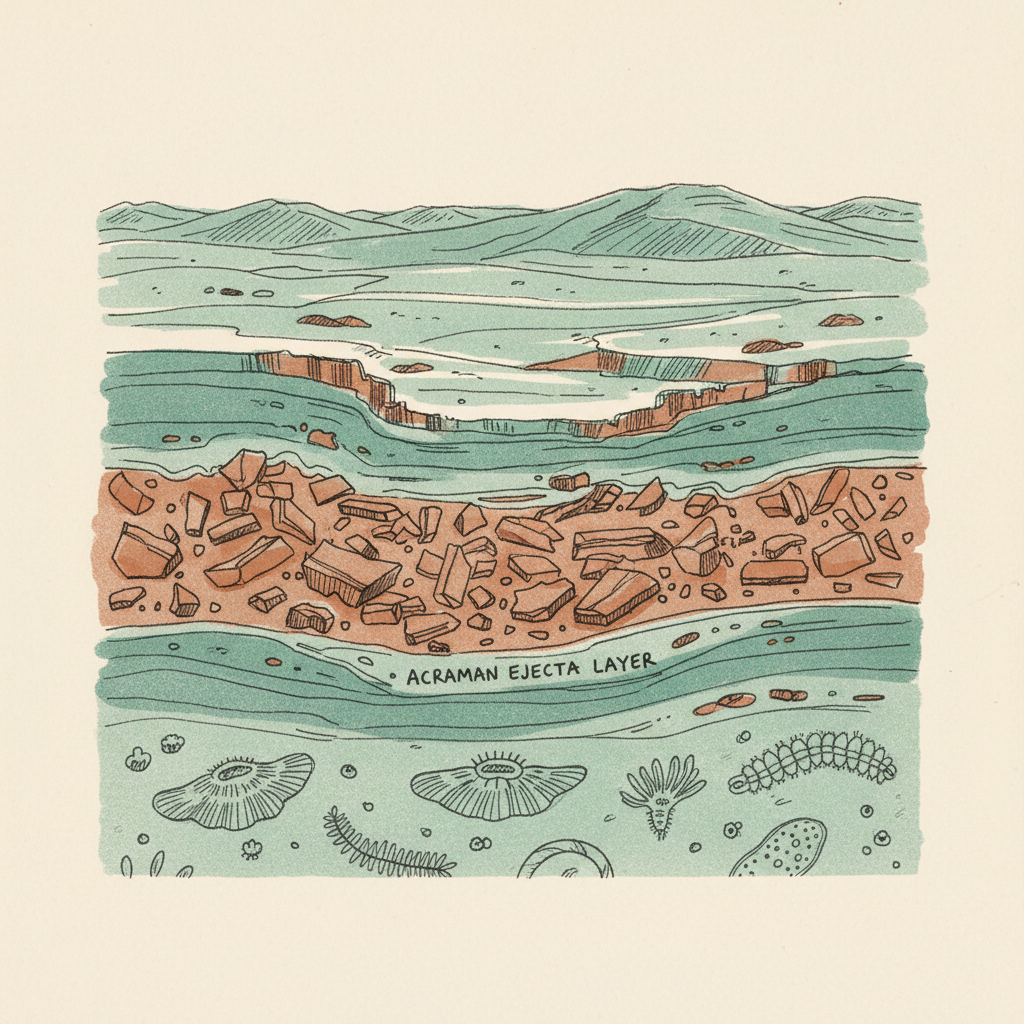
In the stark landscape of the southern Flinders Ranges, a thin band of debris sits nestled between layers of siltstone like a splinter in a wound. This layer, no thicker than a few centimeters, represents a single, violent afternoon 580 million years ago when the sky fell on South Australia.
The Acraman Impact
The evidence begins in the Gawler Ranges, where a massive circular depression marks the site of the Acraman impact. Here, a bolide roughly four kilometers in diameter slammed into the Earth at twenty kilometers per second. The energy released was equivalent to millions of Hiroshima-sized bombs, vaporizing the target rock and blasting a crater over 80 kilometers wide.
The target was the Yardea Dacite, a red volcanic rock of the Mesoproterozoic. The force of the impact shattered this ancient foundation, propelling pulverised fragments high into the stratosphere. These fragments did not just fall back into the crater; they were cast hundreds of kilometers to the east, raining down into a shallow, quiet sea that then covered the Adelaide Rift Complex.
The Ejecta Layer
Geologists tracking this event found a curious "event bed" in the Bunyeroo Formation of the Flinders Ranges, nearly 300 kilometers from the impact site. This layer consists of jagged, angular shards of red volcanic rock that are geochemically identical to the Yardea Dacite of the Gawler Ranges. The contrast is startling. The surrounding Bunyeroo shales are fine-grained, green, and muddy, representing millions of years of slow, peaceful sedimentation.
The ejecta layer interrupts this silence with a chaotic mix of sand-sized grains and pebble-sized "lapilli." It is a geological instant frozen in stone. Because the fragments were ejected through the vacuum created by the impact plume, they landed with enough force to penetrate the soft muds of the seafloor, creating small impact structures known as "dropstones."
The Acraman ejecta layer is one of the most distant and well-preserved records of a major impact event in the Precambrian, providing a rare yardstick for the violence of the early solar system.
A Catalyst for Life
The timing of the Acraman impact is more than a curiosity; it sits on the threshold of a biological revolution. The impact occurred during the Ediacaran Period, shortly before the appearance of the first complex, soft-bodied organisms. Some researchers suggest that the massive influx of nutrients—released by the pulverization of the crust—may have triggered a bloom in marine life.
The sudden change in ocean chemistry following the impact might have favored the transition from simple microbes to more complex forms. While the Acraman impact was a catastrophe of unimaginable scale, it effectively "fertilized" the Neoproterozoic oceans. The debris layer in the Flinders Ranges serves as a gritty reminder that the history of life is often written in the wreckage of celestial collisions.
- Impact Site: Lake Acraman, Gawler Ranges, South Australia.
- Ejecta Bed: Bunyeroo Formation, Flinders Ranges (approx. 300km away).
- Age: Approximately 580 million years old.
- Lithology: Shattered volcanic dacite within marine siltstone.
More like this
- The 110-Million-Year-Old River That Runs Backwards UndergroundWestern Australia's 110-million-year-old dune system has been slowly dissolving into a labyrinth of caves where an ancient river still flows, carrying the taste of a Cretaceous desert.
- The 5,000-Year-Old Volcanoes That Still Smoke in the SouthIn Victoria's Newer Volcanics Province, 400 volcanic vents erupted as recently as 5,000 years ago—the youngest volcanic field in mainland Australia, where craters still hold blue lakes and scoria cone
- The 560-Million-Year-Old Garden That Never Saw a PredatorIn South Australia's Flinders Ranges, 560-million-year-old Ediacara surfaces preserve entire seafloor communities of fronds, discs, and quilts — a garden of soft-bodied life that flourished before pre