8 May 2026 · 3 min read
The Exhumed Ocean: The Devonian Reef of the Kimberley
Explore the Devonian Reef Complex of the Kimberley, a 375-million-year-old limestone fortress that preserves a perfectly exhumed Paleozoic seafloor.
Long before the first plant took root on land, a massive barrier reef flourished in the tropical shallows of what is now the Kimberley region. Today, these Devonian structures do not sit beneath the waves, but rise as a scorched, limestone fortress above the spinifex plains of the Canning Basin.
The Devonian Barrier
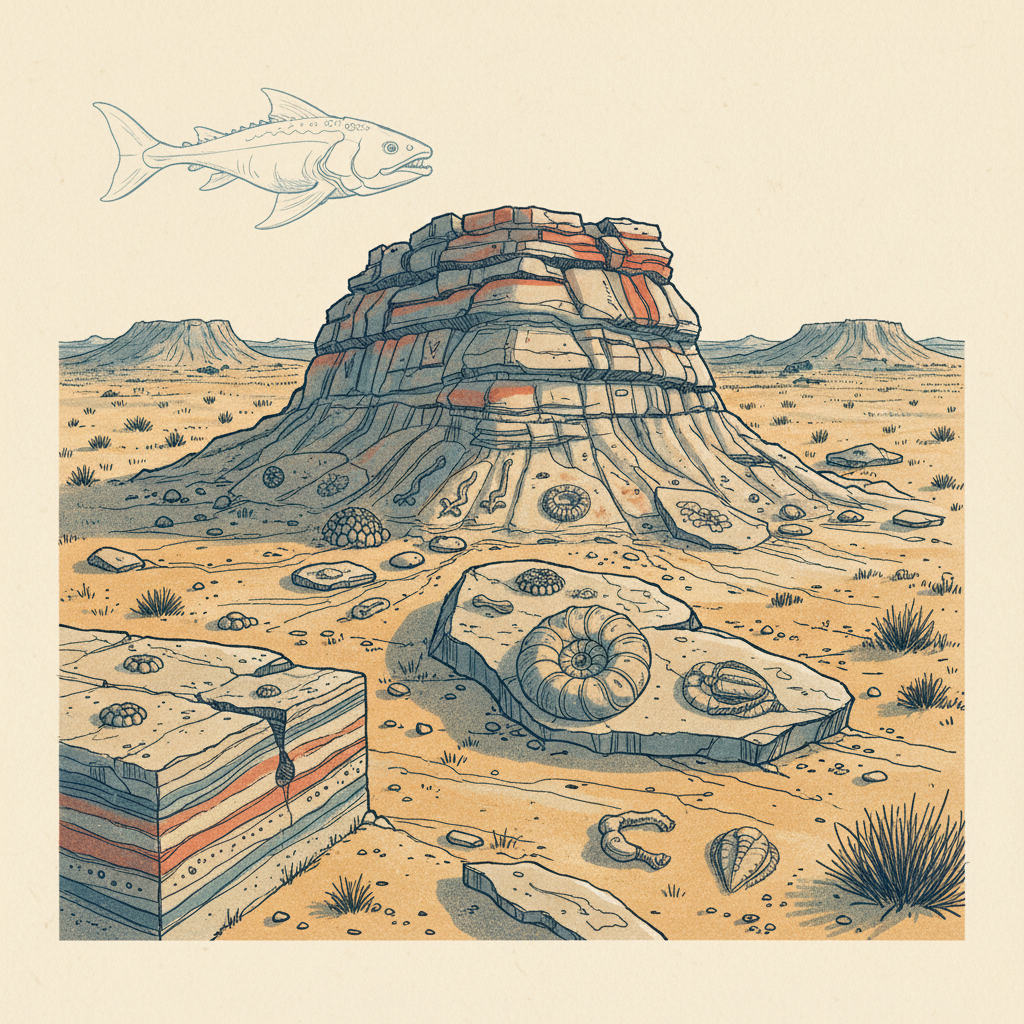
Around 375 million years ago, the northern edge of the Australian continent was a submerged shelf in a warm, equatorial sea. While modern reefs are built primarily by scleractinian corals, this Paleozoic system was engineered by extinct organisms: tabular stromatoporoids and delicate, branching tabulate corals. These calcifying pioneers constructed a massive rampart that stretched for nearly a thousand kilometers.
The reef was not a single wall but a complex architecture of fore-reef slopes, reef rims, and quiet back-reef lagoons. Over millions of years, the accumulation of skeletal debris and microbial mats created a limestone sequence up to two kilometers thick. This was a thriving ecosystem of armored placoderm fish, trilobites, and nautiloids, all operating within a calcium carbonate cathedral that would eventually be entombed by silt and sand.
The Exhumed Architecture
The Canning Basin reef system is unique because it has been perfectly preserved and then "exhumed" by erosion. Most ancient reefs are either buried deep within the crust or have been ground away by tectonic collisions. Here, the softer surrounding sediments—the muds and sands that once filled the deep basins surrounding the reef—eroded more quickly than the hard limestone.
The result is a geological ghost. At Windjana Gorge and Geikie Gorge, the ancient reef front stands vertically, rising 100 meters above the riverbeds. Walking through these canyons is a literal traverse through a fossilized sea floor. You can trace the transition from the "slope" deposits, where gravity pulled debris into deeper water, to the "crest" where the most robust organisms fought the surge of Devonian waves.
The Architecture of Porosity
The preservation of the reef is so precise that geologists use it as a surface laboratory for understanding oil and gas reservoirs. The pores and cavities within the limestone—spaces once filled with seawater—became traps for hydrocarbons as the reef was buried.
The limestone of the Windjana Gorge is more than a wall of stone; it is a frozen biological event, a three-dimensional map of a vanished ocean's energy.
The reef's geometry was shaped by several factors:
- Subsidence: The steady sinking of the continental shelf allowed the reef to grow upward for millions of years.
- Sea-level fluctuations: Periodic drops in sea level exposed the reef tops, causing karst weathering and the formation of caves.
- Microbial binding: Cyanobacteria played a crucial role in "gluing" the reef together, creating a structure strong enough to withstand the Tethys Ocean's storms.
A Limestone Wilderness
Today, the Devonian Reef Complex forms the backbone of the Napier and Oscar Ranges. The stone is jagged and grey, weathered into "tower karst" formations by the intense seasonal rains of the Kimberley. In the heat of the dry season, the limestone radiates a fierce warmth, a stark contrast to the cool, deep water that once sustained its creators.
The sheer scale of the complex remains its most humbling attribute. It represents a period of immense biological productivity that ended abruptly during the Late Devonian mass extinction. When you stand at the base of the limestone walls, you are looking at the calcified remains of an entire world that thrived and died before the first dinosaurs were born.
More like this
- The 110-Million-Year-Old River That Runs Backwards UndergroundWestern Australia's 110-million-year-old dune system has been slowly dissolving into a labyrinth of caves where an ancient river still flows, carrying the taste of a Cretaceous desert.
- The 5,000-Year-Old Volcanoes That Still Smoke in the SouthIn Victoria's Newer Volcanics Province, 400 volcanic vents erupted as recently as 5,000 years ago—the youngest volcanic field in mainland Australia, where craters still hold blue lakes and scoria cone
- The 560-Million-Year-Old Garden That Never Saw a PredatorIn South Australia's Flinders Ranges, 560-million-year-old Ediacara surfaces preserve entire seafloor communities of fronds, discs, and quilts — a garden of soft-bodied life that flourished before pre