18 June 2026 · 2 min read
The Silver That Streaked a Fossil Reef: Tasmania's Zeehan Silver Field
How 370-million-year-old granite intrusions in western Tasmania pumped silver, lead, and zinc into a fossilised Devonian reef, creating one of the world's richest silver districts.
Deep in Tasmania's wet west, a reef of coral skeletons turned to stone 370 million years ago. Then magma cooked it into a silver lode.
The Reef That Became Ore
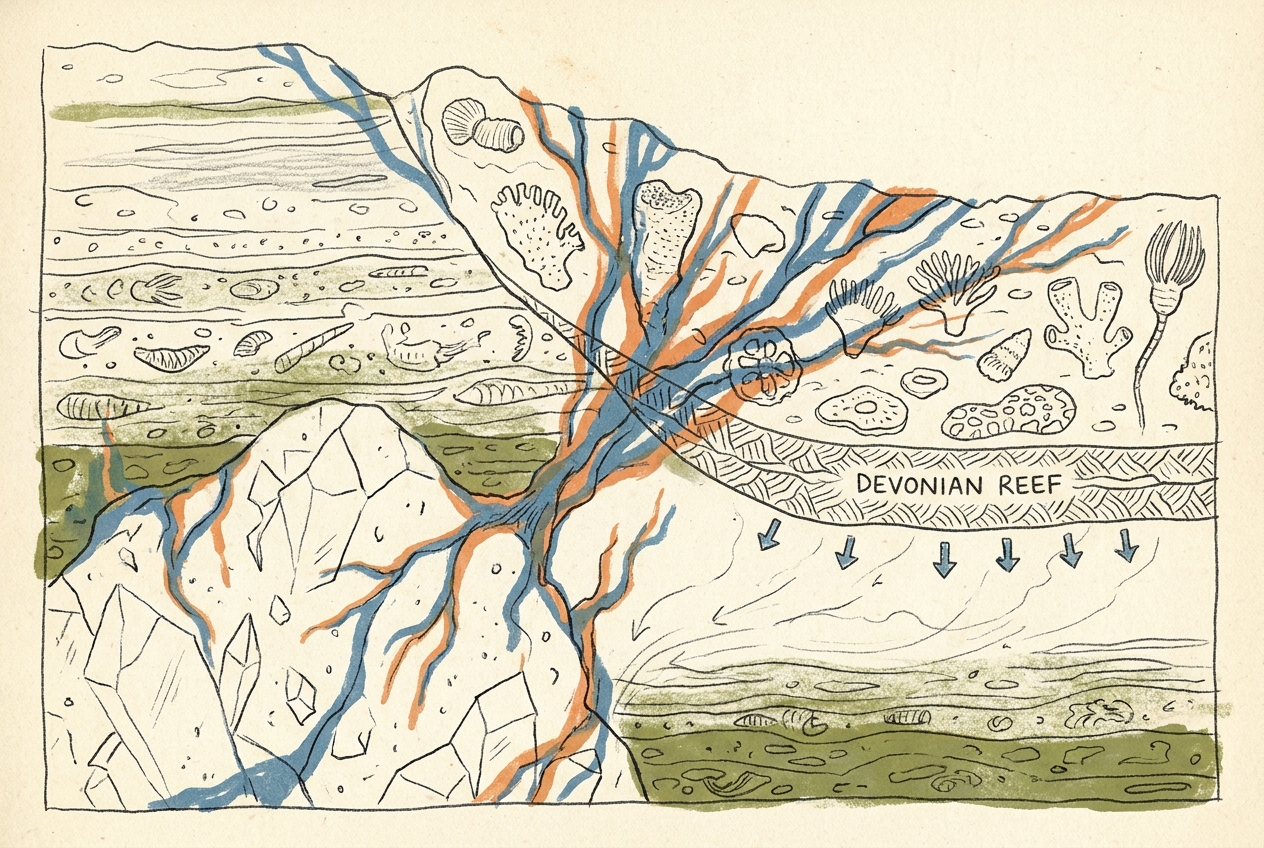
During the Devonian period, a shallow tropical sea covered what is now western Tasmania. Coral and stromatoporoid sponges built a reef system hundreds of metres thick, their calcium carbonate skeletons settling into layered limestone. When the sea withdrew and continental collision began, the reef was buried, folded, and fractured.
Into those fractures rose hot fluids from cooling granite plutons. The fluids carried dissolved metals—lead, zinc, and silver—leached from older volcanic rocks deep below. As the hydrothermal solutions hit the limestone, they reacted with the carbonate rock and precipitated galena (lead sulphide) and sphalerite (zinc sulphide), both rich in silver. The reef became a massive sulphide deposit, its original fossil structure still visible in the ore.
The silver did not arrive all at once. It came in pulses over millions of years, each new fracture reopening old veins.
The Town That Silver Built
By the 1890s, prospectors had found the outcrops. The Mount Zeehan silver-lead field erupted into one of Australia's richest silver districts. At its peak in the early 1900s, the Zeehan field produced more than 800,000 tonnes of ore, yielding 1,500 tonnes of silver and 200,000 tonnes of lead.
The town of Zeehan grew to 10,000 people. It had its own stock exchange, six newspapers, and a hotel for every 100 residents. The silver financed railways, smelters, and the careers of men who would later discover Tasmania's other great mineral deposits. But the ore veins pinched out at depth, and by the 1920s the boom was over.
The Ghost in the Limestone
Today, Zeehan is a quiet town of a few hundred. The stock exchange building is a museum. The smelter stacks stand empty. Yet the geology remains visible: the old mines expose the contact between granite and fossiliferous limestone, the reef structure still recognisable in the tunnel walls.
The deposit is what geologists call a "carbonate-replacement" system. It formed where hydrothermal fluids encountered chemically reactive rock—in this case, a Devonian reef that had not yet fully lithified. The limestone acted as both a chemical trap and a physical mould, forcing the metal-bearing fluids to deposit their load in a concentrated zone.
Similar deposits occur across the Tasman Fold Belt, the ancient mountain chain that runs down eastern Australia. But few preserve the reef architecture as clearly as Zeehan. The corals and sponges that built the reef are now replaced by silver-bearing galena, their shapes etched in ore.
A Record of Two Worlds
Zeehan records two separate chapters of Earth history. The first is a Devonian reef, built by organisms in a warm sea that no longer exists. The second is a Permian collision, when the Australian and Pacific plates squeezed the reef into a mountain belt and injected it with metal.
The silver is the trace of that collision—a chemical signature of fluids that migrated hundreds of kilometres through the crust. Every ingot of Tasmanian silver carries the memory of a coral reef that died and was transformed.
More like this
- The 560-Million-Year-Old Garden That Never Saw a PredatorIn South Australia's Flinders Ranges, 560-million-year-old Ediacara surfaces preserve entire seafloor communities of fronds, discs, and quilts — a garden of soft-bodied life that flourished before pre
- The 1.75-Billion-Year-Old Reef That Outranks the BarrierA 1.75-billion-year-old microbial reef in the Kimberley is the largest biological structure ever built by a single species, preserving a world without predators.
- The 3.5-Billion-Year-Old Cones That Still Catch LightIn the Pilbara's Dresser Formation, 3.5-billion-year-old stromatolites preserve the oldest direct evidence of life on Earth—microbial mats that built layered domes in a volcanic caldera.