18 June 2026 · 3 min read
The Crust That Recorded a Billion Years of Silence: South Australia's Gawler Craton
How South Australia's Gawler Craton, a 1.6-billion-year-old piece of continental crust, preserves the oldest known paleosol—a fossil soil that records Earth's early atmosphere before life changed it f
A billion years before the first animal crawled across dry land, rain fell on a hill in what is now South Australia. That rain reacted with the granite beneath it, turning feldspar into clay, releasing iron, and slowly building a soil. That soil—a pale layer of weathered rock just a few metres thick—still exists. It is the oldest known fossil soil on Earth, and it sits within the Gawler Craton, a vast piece of continental crust that has remained largely undisturbed for 1.6 billion years.
A Continent That Refused to Move
The Gawler Craton covers roughly 440,000 square kilometres of South Australia, from the Nullarbor Plain east to the Flinders Ranges. It is one of the few places on Earth where a single block of crust has survived without being reworked by mountain-building, rifting, or burial. The craton formed during the Proterozoic Eon, between 1.85 and 1.45 billion years ago, when a series of volcanic arcs and sedimentary basins were welded together by collision. Then, remarkably, the tectonic activity stopped. For the next billion years, the Gawler Craton sat at or near the surface, slowly eroding under a Precambrian sky.
The soil that formed on that surface is a direct chemical record of the air that touched it.
Geologists call it a paleosol—literally "ancient soil." The Gawler paleosol was first identified in the 1960s, but only in the last two decades have researchers been able to read its chemical composition with precision. What they found was unexpected.
The Chemistry of a Dead Planet
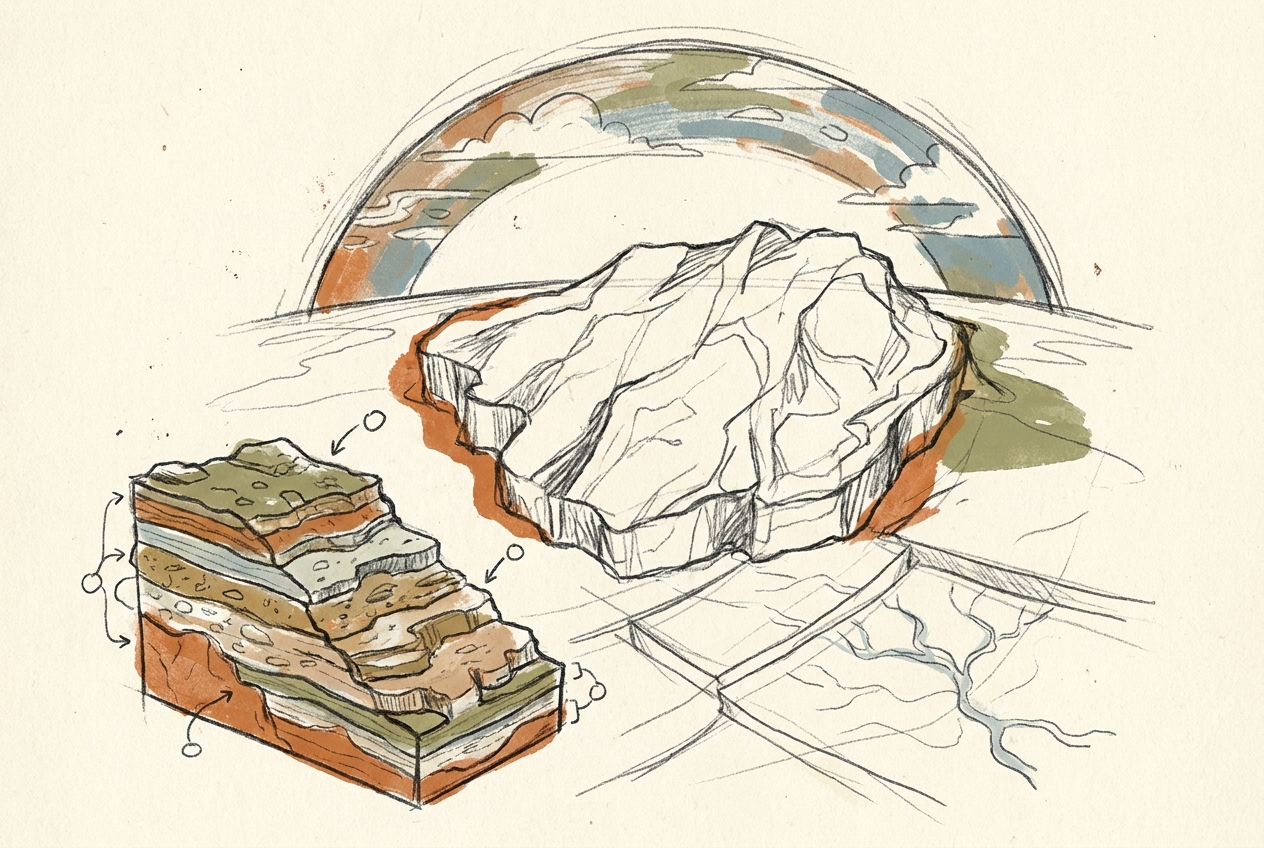
The paleosol is exposed in several places along the eastern margin of the Gawler Craton, most notably near the town of Whyalla. It appears as a reddish-brown layer, one to three metres thick, sitting directly on top of unweathered granite. Under a microscope, the original feldspar crystals have been replaced by kaolinite—a clay mineral that forms only in the presence of water and carbon dioxide. The iron minerals have been oxidised, rusted by contact with oxygen. These are signatures of weathering, but the ratios are strange.
In modern soils, the amount of iron retained relative to other elements tells us something about the oxygen content of the atmosphere. The Gawler paleosol shows very low iron retention—roughly one-tenth of what a modern soil would hold. The most likely explanation is that the atmosphere at the time contained very little oxygen. The soil formed around 1.6 billion years ago, during the "boring billion"—a long middle chapter of Earth's history when oxygen levels were low and biological evolution seemed to stall. The paleosol captures that stillness in mineral form.
A Billion Years of Quiet Weathering
What makes the Gawler Craton remarkable is not just the age of its soil, but the length of time it spent at the surface. Most ancient landscapes are buried, eroded, or melted within a few hundred million years. The Gawler Craton remained exposed for over a billion years. During that time, the soil layer thickened, hardened, and eventually became a kind of rock itself—a ferruginous duricrust, rich in iron oxides, that capped the landscape like a lid.
That caprock preserved the soil beneath it. When the craton was finally buried by younger sediments during the Cambrian and Ordovician periods, the paleosol was sealed in place. Later uplift in the Mesozoic exposed the edges of the craton again, peeling back the younger cover and revealing the ancient weathered surface exactly as it had been left.
What the Soil Still Holds
The Gawler Craton is also one of Australia's richest mineral provinces. The billion-year stillness that preserved the paleosol also allowed hydrothermal fluids to circulate through the crust, depositing copper, gold, and uranium. The Olympic Dam deposit—the largest uranium deposit on Earth and one of the largest copper deposits—lies within the Gawler Craton, buried beneath 300 metres of younger rock. The same fractures that carried those metal-rich fluids also preserved the ancient weathering profile above them.
Today, the paleosol is exposed in road cuttings and creek beds near Whyalla. It does not look dramatic—a reddish band in the dirt, easy to miss. But it is a direct measurement of a world without animals, without plants on land, without any life at all except microbial mats in shallow seas. It is a record of pure geology: the slow reaction between rock and air, undisturbed for a billion years.
More like this
- The 110-Million-Year-Old River That Runs Backwards UndergroundWestern Australia's 110-million-year-old dune system has been slowly dissolving into a labyrinth of caves where an ancient river still flows, carrying the taste of a Cretaceous desert.
- The 5-Million-Year-Old Cave Archive Beneath a Treeless PlainBeneath the treeless Nullarbor Plain, a labyrinth of limestone caves preserves five million years of Australian climate in sediment layers, fossil bones, and ancient air bubbles.
- The 825-Million-Year-Old Rift That Failed But Built a WorldA failed 825-million-year-old rift left a 650-kilometre volcanic chain and sedimentary basin in South Australia that preserved the Ediacaran fossils and still shapes the landscape today.