10 July 2026 · 3 min read
The 560-Million-Year-Old Garden That Never Saw a Predator
In South Australia's Flinders Ranges, 560-million-year-old Ediacara surfaces preserve entire seafloor communities of fronds, discs, and quilts — a garden of soft-bodied life that flourished before pre
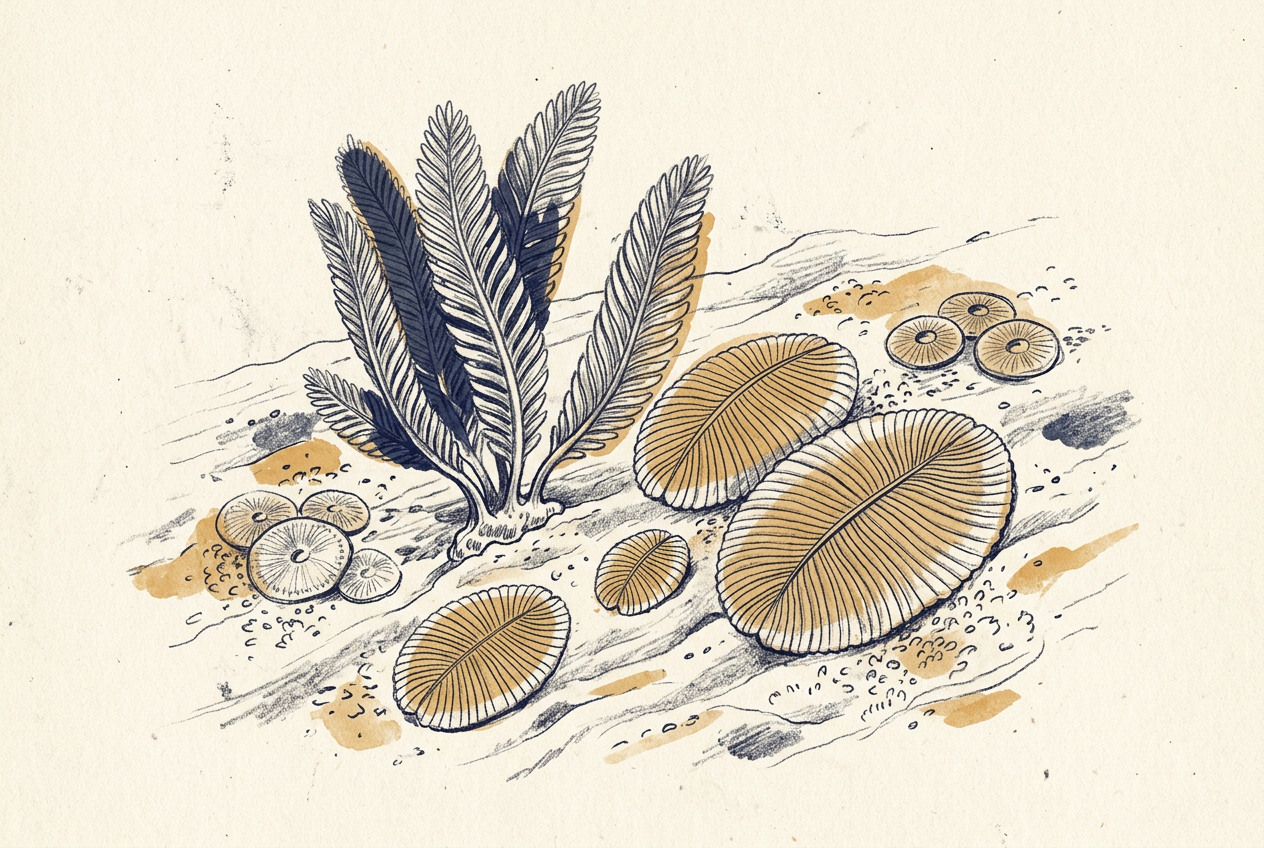
On a slab of quartzite in the Flinders Ranges, a frond lies frozen in sandstone exactly where it grew 560 million years ago. Beside it, a disc-shaped organism the size of a dinner plate. Beside that, another frond, slightly smaller, oriented at the same angle to the current. The slab is a seafloor — a single moment in the Ediacaran Period, preserved intact.
A Seafloor Without Teeth
The Ediacara Member of the Rawnsley Quartzite, near Nilpena in South Australia, is not a graveyard. It is a garden, buried in place by sudden sand events — storms or turbidity currents that smothered the seafloor in a single pulse. Unlike almost any other fossil deposit on Earth, these beds preserve entire communities as they lived: feeding positions, orientations, spacing, even the direction of ancient currents.
There are no bite marks here. No broken shells, no healed wounds, no drill holes. The Ediacaran seafloor was a world without predation. The first animals with mouths and guts — the first predators — had not yet evolved. These organisms fed by absorbing nutrients from the microbial mats that carpeted the sediment, or by filtering particles from the water. They had no need to flee, and no way to.
On a single bedding plane at Nilpena, researchers have mapped more than 1,000 individual fossils in the positions they occupied when alive — a census of a world 560 million years old.
The Architecture of Soft Bodies
The fossils are not bones or shells. They are impressions — casts and molds left in sand that hardened to quartzite. Some organisms, like Dickinsonia, appear as ribbed ovals that resemble quilted air mattresses. Others, like Tribrachidium, show three-fold symmetry, a body plan that has no modern counterpart. Spriggina looks like a segmented worm with a horseshoe-shaped head, but it is not an ancestor of anything alive today.
These forms belong to the Ediacaran biota — a radiation of soft-bodied multicellular life that flourished between 575 and 541 million years ago. Most of these organisms are so strange that paleontologists cannot agree on which kingdom they belong to. Some may be animals. Some may be lichens, or fungi, or colonies of single-celled organisms. Some may represent evolutionary experiments that left no descendants.
A Death Assemblage That Lives
The Nilpena beds were rediscovered in the 1980s after decades of neglect. Today, the site is the most productive Ediacaran locality on Earth. Researchers have excavated over 40 individual bedding planes, each one a snapshot of seafloor life from a different moment in time. The fossils are so well preserved that scientists can measure the size distribution of entire populations, track growth rates, and reconstruct feeding behaviors.
One bed, known as the "Dickinsonia Pizza," contains dozens of individuals of Dickinsonia costata at different stages of growth — from juveniles the size of a fingernail to adults spanning 30 centimeters. The spacing between individuals suggests they competed for space on the microbial mat, growing outward until they touched, then stopping. This is territorial behavior, visible in stone half a billion years later.
The Quiet Before the Cambrian
The Ediacaran world ended 541 million years ago, when the Cambrian Explosion introduced burrowing, predation, and hard skeletons. The garden was plowed under. The soft-bodied fronds and discs vanished from the fossil record, replaced by trilobites, brachiopods, and the first true animals.
But at Nilpena, the garden remains. The quartzite beds sit tilted at 30 degrees, exposed along a dry ridge where the only sound is wind. Each slab is a page from a world so different from our own that we still cannot fully read its language. The fronds swayed in currents that no longer flow. The discs absorbed food that no longer exists. And the whole community, buried in sand during a single afternoon 560 million years ago, waits for someone to turn the page.
More like this
- The 300-Million-Year-Old Forest That Died Standing UpIn New South Wales, a 300-million-year-old fossil forest preserves dozens of trees buried upright by a Permian volcanic eruption—an entire ecosystem frozen in ash.
- The 1.75-Billion-Year-Old Reef That Outranks the BarrierA 1.75-billion-year-old microbial reef in the Kimberley is the largest biological structure ever built by a single species, preserving a world without predators.
- The 3.5-Billion-Year-Old Cones That Still Catch LightIn the Pilbara's Dresser Formation, 3.5-billion-year-old stromatolites preserve the oldest direct evidence of life on Earth—microbial mats that built layered domes in a volcanic caldera.