18 June 2026 · 3 min read
The Beds That Caught the First Oxygen: Western Australia's Hamersley Banded Iron
How 2.5-billion-year-old banded iron formations in Western Australia's Hamersley Range record the moment oxygen first flooded Earth's atmosphere, creating the world's largest iron province.
In the Pilbara region of Western Australia, a 2.5-billion-year-old sequence of sedimentary rock holds more iron than any other place on Earth. The Hamersley Range's banded iron formations stretch across 80,000 square kilometres, and they contain the physical record of a planetary transformation: the moment oxygen first flooded the atmosphere.
The Chemistry of an Ancient Ocean
The banded iron formations of the Hamersley Range are chemical sediments, not clastic ones. They precipitated directly from seawater in the Archean and Proterozoic oceans, between roughly 2.6 and 2.4 billion years ago. At that time, the oceans were rich in dissolved ferrous iron that had accumulated from hydrothermal vents and the weathering of continental crust. The atmosphere contained almost no free oxygen.
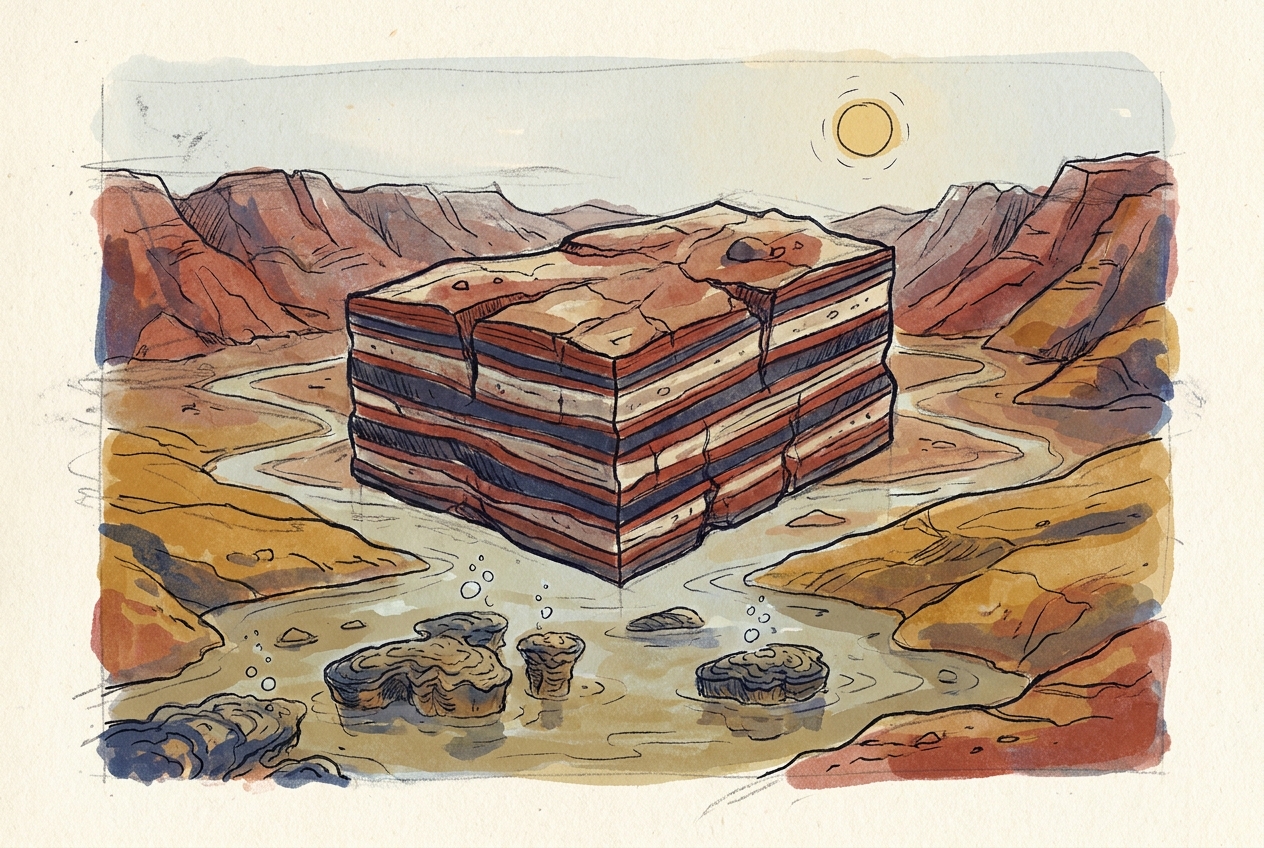
The bands alternate between two minerals. The dark layers are mostly magnetite or hematite — iron oxides. The red or white layers are chert, a microcrystalline form of silica. Each couplet represents a cycle of precipitation, and the cycles repeat hundreds of times through the formation. The total thickness of the Hamersley Group exceeds 2,500 metres.
The trigger for these cycles was the emergence of oxygenic photosynthesis. Cyanobacteria in the surface oceans released oxygen as a waste product. That oxygen reacted instantly with the dissolved iron, oxidising it to ferric iron, which is insoluble in seawater. The iron oxide particles sank to the seafloor, layer by layer, for hundreds of millions of years.
The Hamersley BIFs are not just an ore deposit. They are a chemical diary of the moment life changed the planet.
The World's Largest Iron Province
The Hamersley Range contains an estimated 64 billion tonnes of iron ore — roughly 20 percent of the world's known reserves. The iron grade averages 62 percent in the high-grade deposits, which formed when groundwater later leached out the silica and concentrated the iron oxides. The main mines — Mount Whaleback, Tom Price, Newman, Paraburdoo — are open pits visible from orbit.
The BIFs themselves are remarkably well preserved. Unlike most rocks of this age, which have been metamorphosed or deformed by tectonic activity, the Hamersley sequence lies flat, barely tilted, and largely unaltered. This preservation is why the formations can still be read as a chemical archive. The rocks have not been cooked or crushed enough to reset their isotopic signatures.
The Hamersley Group sits atop the Pilbara Craton, one of the oldest pieces of continental crust on Earth, with basement rocks dating to 3.5 billion years. The craton acted as a stable platform, allowing the BIFs to accumulate without disturbance for hundreds of millions of years.
What the Bands Tell Us
The banded iron formations record the Great Oxidation Event — the period between 2.4 and 2.3 billion years ago when atmospheric oxygen rose from near zero to about one percent of present levels. The BIFs stopped forming once the oceans had lost their dissolved iron, because all the iron had been oxidised and buried. No significant BIFs exist younger than about 1.8 billion years.
The Hamersley BIFs also contain subtle variations in iron isotopes, which geochemists use to reconstruct the activity of ancient microbes. The ratio of iron-56 to iron-54 in the oxide layers can indicate whether iron-oxidising bacteria were involved in precipitation, or whether the reaction was purely chemical.
The formations are still yielding new information. In 2023, researchers published evidence from Hamersley drill cores suggesting that oxygen production may have pulsed in short bursts, rather than rising steadily. The bands may record seasonal or decadal cycles in cyanobacterial blooms, preserved in stone for two and a half billion years.
The Hamersley Range is not a dramatic landscape. It is a low, flat-topped plateau of red rock and spinifex grass, baking under the Pilbara sun. But the ground beneath holds the story of how a planet became breathable — a story written not in words, but in alternating bands of iron and silica, stacked like pages in a book.
More like this
- The 110-Million-Year-Old River That Runs Backwards UndergroundWestern Australia's 110-million-year-old dune system has been slowly dissolving into a labyrinth of caves where an ancient river still flows, carrying the taste of a Cretaceous desert.
- The 560-Million-Year-Old Garden That Never Saw a PredatorIn South Australia's Flinders Ranges, 560-million-year-old Ediacara surfaces preserve entire seafloor communities of fronds, discs, and quilts — a garden of soft-bodied life that flourished before pre
- The 1.75-Billion-Year-Old Reef That Outranks the BarrierA 1.75-billion-year-old microbial reef in the Kimberley is the largest biological structure ever built by a single species, preserving a world without predators.