10 July 2026 · 3 min read
The 1.75-Billion-Year-Old Reef That Outranks the Barrier
A 1.75-billion-year-old microbial reef in the Kimberley is the largest biological structure ever built by a single species, preserving a world without predators.
A 1.75-billion-year-old colony of microbes built a reef 1,000 kilometres long, and it never needed oxygen to do it. Today that reef is a band of black chert and dolomite slicing through the red dust of Western Australia's Kimberley region—the preserved skeleton of a world without predators, without skeletons, without anything that could swim or crawl or bite.
The reef is called the Karijini–Earabedee thrombolite reef, and it is the largest biological structure ever built by a single species of microbe. It stretched across an ancient seafloor that lay on the northern margin of the Pilbara Craton, a crustal block that had already been stable for nearly two billion years. The builders were not corals, not sponges, not anything with cells organised into tissues. They were colonies of cyanobacteria and other single-celled organisms that secreted a sticky biofilm and trapped grains of carbonate mud.
The Reef That Never Saw a Predator
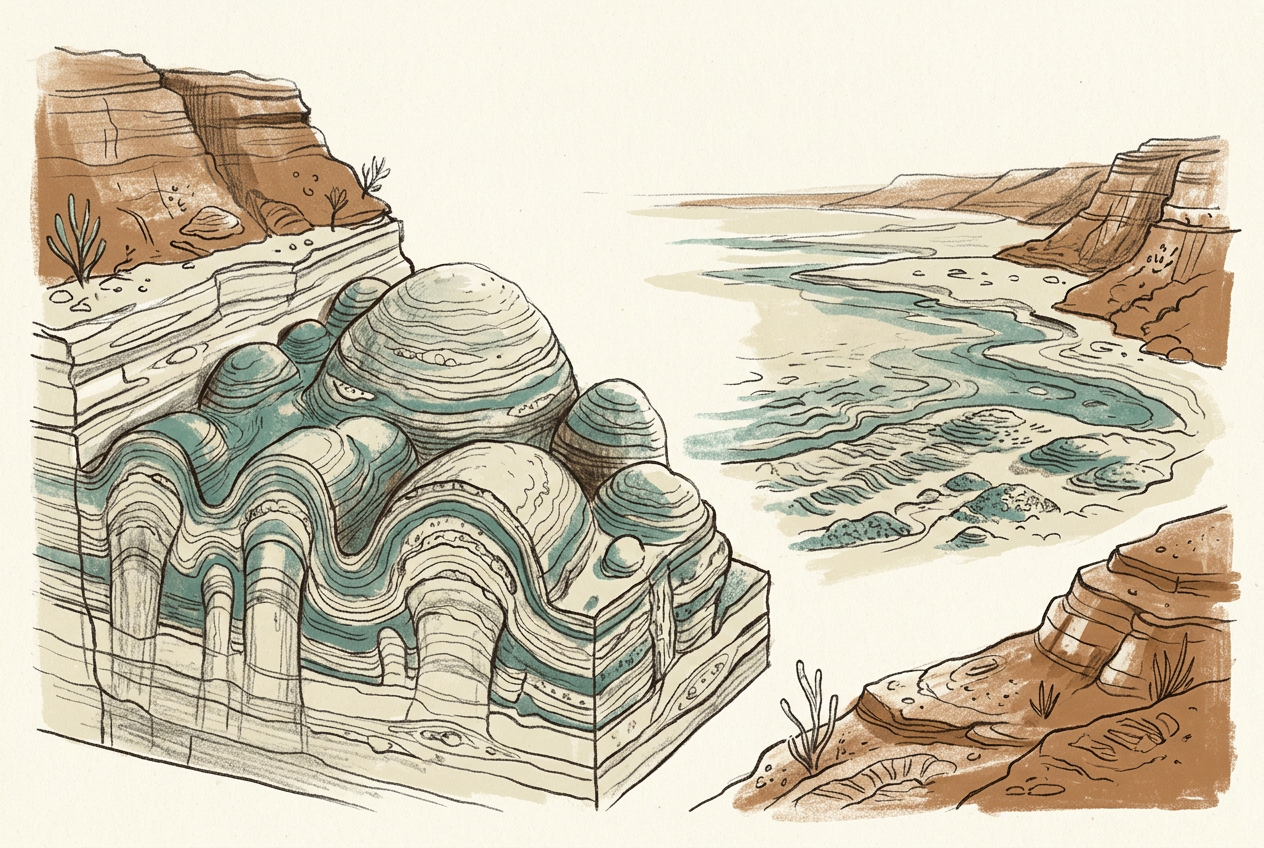
Thrombolites are like stromatolites but messier. Where stromatolites build smooth, layered domes, thrombolites form clotted, lumpy masses—a chaotic architecture that records a different kind of microbial metabolism. The Karijini–Earabedee reef grew in a shallow, hypersaline sea during the Paleoproterozoic, a time when the atmosphere still held barely two percent oxygen. No animals existed to graze on the microbial mats. No burrowers punctured the seafloor. The reef spread unbroken for 1,000 kilometres, layer upon layer of microbial slime and trapped sediment, building a platform hundreds of metres thick.
The reef's scale is almost impossible to visualise. The Great Barrier Reef, the largest living structure built by animals today, is about 2,300 kilometres long but is a mosaic of thousands of individual coral species. The Karijini–Earabedee reef was built by a single biological process—photosynthesis without oxygen—and it persisted for tens of millions of years without interruption.
A Cliff of Black Chert
Today the reef is exposed in the hills around the town of Fitzroy Crossing and along the Lennard River. The rock is the Bungle Bungle Dolomite, named for the orange-and-black banded domes of Bungle Bungle Range that are actually a younger, unrelated formation. The thrombolite reef itself appears as beds of black chert and dark dolomite, often riddled with small vugs and cavities where ancient gas bubbles or evaporite crystals once sat. In fresh cut, the rock shows the clotted texture unmistakable under a hand lens: irregular clots of dark microcrystalline silica separated by lighter carbonate, like curds in milk.
The reef grew for ten million years without a single animal ever taking a bite out of it. No reef on Earth has ever been so undisturbed since.
The reef's persistence is a geological accident. After the sea that hosted it evaporated, the carbonate platform was buried by younger sediments, then gently folded and uplifted during the assembly of the supercontinent Rodinia. It escaped the intense metamorphism that destroyed most other Paleoproterozoic carbonate platforms. It was never deeply buried, never heated above 200 degrees Celsius, never squeezed into schist or marble. The microbial textures survived essentially intact.
A Window Into a Quiet World
The Karijini–Earabedee reef matters not because it is old, though it is—1.75 billion years old, give or take fifty million years. It matters because it records a mode of life that no longer exists on any meaningful scale. Modern microbial mats survive only in extreme environments: hypersaline lagoons, hot springs, Antarctic lakes. They are refugees, pushed to the margins by animals that evolved to eat them. The Paleoproterozoic was the last time microbes ruled the seafloor without competition.
Geologists have mapped the reef across an area of 100,000 square kilometres, from the Kimberley coast eastward into the Northern Territory. In places the reef is only a few metres thick; elsewhere it reaches 300 metres. The variations record changes in sea level, salinity, and sediment supply over millions of years—a climate archive written not in oxygen isotopes but in the shape of microbial clots.
The reef stopped growing when the sea withdrew, probably due to a drop in global sea level associated with the assembly of the supercontinent Nuna. The microbes died, the platform was buried, and the reef entered a geological sleep from which it has never woken. No animal has ever walked on its living surface. No fish ever swam above it. It is a monument to a planet that was almost finished inventing life but had not yet invented hunger.
More like this
- The 560-Million-Year-Old Garden That Never Saw a PredatorIn South Australia's Flinders Ranges, 560-million-year-old Ediacara surfaces preserve entire seafloor communities of fronds, discs, and quilts — a garden of soft-bodied life that flourished before pre
- The 300-Million-Year-Old Forest That Died Standing UpIn New South Wales, a 300-million-year-old fossil forest preserves dozens of trees buried upright by a Permian volcanic eruption—an entire ecosystem frozen in ash.
- The 3.5-Billion-Year-Old Cones That Still Catch LightIn the Pilbara's Dresser Formation, 3.5-billion-year-old stromatolites preserve the oldest direct evidence of life on Earth—microbial mats that built layered domes in a volcanic caldera.