10 July 2026 · 3 min read
The 3.5-Billion-Year-Old Cones That Still Catch Light
In the Pilbara's Dresser Formation, 3.5-billion-year-old stromatolites preserve the oldest direct evidence of life on Earth—microbial mats that built layered domes in a volcanic caldera.
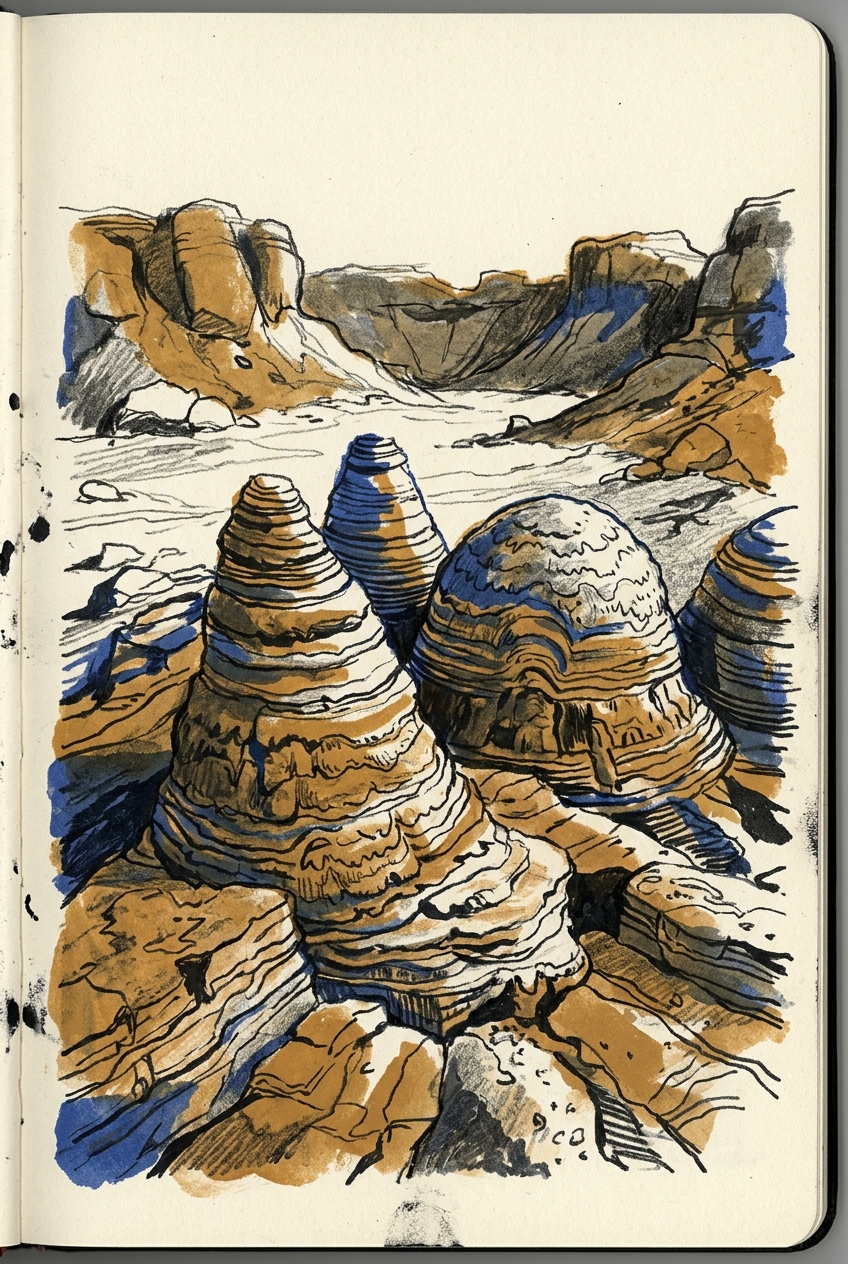
On a grey-green outcrop in Western Australia's Pilbara, the sunlight catches a pattern that looks almost deliberate: stacked domes the size of dinner plates, layered like the pages of a book. They are 3.48 billion years old. For half a century, geologists have argued about whether they are truly alive.
The Dresser Formation near North Pole (a mining town, not the Arctic) preserves the oldest widely accepted evidence of life on Earth. The domes are stromatolites—structures built by microbial mats that trapped and bound sediment in shallow water. But proving they are biological, not just chemical, has required decades of careful detective work.
The Volcano That Made a Cradle
The stromatolites did not grow in a tranquil lagoon. They grew inside the caldera of a 3.5-billion-year-old volcano, in hot, acidic springs fed by hydrothermal fluids. The same volcanic system that could have sterilised the environment instead created the conditions for life.
Hot springs circulate dissolved silica, which precipitates as chert. That chert entombed the microbial mats almost instantly, preserving their shape in three dimensions. Without this rapid silicification—a kind of flash-fossilisation—the delicate layers would have been destroyed by waves, burrowing, or simple decay.
The Dresser Formation preserves not just the domes but the springs themselves. Geyser vents, sinter terraces, and the mineral rims of ancient pools are all visible in the same outcrop. It is a complete hydrothermal landscape, frozen in stone.
The Evidence in the Layers
What makes the Dresser stromatolites convincing is not their shape alone. It is what the layers contain.
The dark laminae are rich in organic carbon, with a carbon isotope signature that matches biological photosynthesis. The lighter laminae are silica and barite, precipitated chemically. The alternation is rhythmic, like a tidal cycle or a daily growth band. Chemical experiments produce layered structures, but they do not produce this pattern of organic enrichment and isotopic fractionation.
In 2019, researchers identified preserved filaments within the chert—microscopic threads just one micrometre thick, interpreted as the remains of the microbes themselves. These filaments cluster around the stromatolite surfaces, exactly where a living mat would have grown.
The oldest argument for life on Earth rests on threads thinner than a spider's silk, preserved in rock older than any continent.
What It Means for the Search
The Dresser Formation tells us something precise about early life: it needed water, warmth, and chemical gradients. The Pilbara's volcanic calderas provided all three. But the same rocks also reveal how narrow that window was.
The stromatolites grew only in specific zones of the hot spring system—not too hot, not too acidic, not too deep. Life did not fill every available niche. It clung to the edges of a hostile world, building domes in the only places it could survive.
This matters for the search for life beyond Earth. If we find stromatolites on Mars, they will likely look like these: layered domes in ancient hot spring deposits, preserved by silica, ambiguous at first glance. The Dresser Formation is the Rosetta Stone for that search.
The Living and the Dead
Stromatolites still grow today in a handful of places—Shark Bay, Western Australia, is the most famous. But those living mats are not the same as the Dresser fossils. The modern ones are built by cyanobacteria that produce oxygen. The Dresser microbes lived before oxygen existed in the atmosphere. They were chemosynthetic, drawing energy from the volcano's hydrogen and sulfur.
The 3.5-billion-year-old domes in the Pilbara record a world without breathable air, without ozone, without continents as we know them. A world where the only life was a thin, dark film on the edge of a volcanic spring. And yet that film was already complex enough to build structures that would outlast every mountain range that followed.
Stand on that outcrop near North Pole, and you are standing on the oldest monument ever built. Not by hands, but by life itself—stacking layer on layer, year after year, for longer than any architect could imagine.
More like this
- The 560-Million-Year-Old Garden That Never Saw a PredatorIn South Australia's Flinders Ranges, 560-million-year-old Ediacara surfaces preserve entire seafloor communities of fronds, discs, and quilts — a garden of soft-bodied life that flourished before pre
- The 300-Million-Year-Old Forest That Died Standing UpIn New South Wales, a 300-million-year-old fossil forest preserves dozens of trees buried upright by a Permian volcanic eruption—an entire ecosystem frozen in ash.
- The 1.75-Billion-Year-Old Reef That Outranks the BarrierA 1.75-billion-year-old microbial reef in the Kimberley is the largest biological structure ever built by a single species, preserving a world without predators.