8 May 2026 · 3 min read
The Sandstone Citadel: The Arnhem Land Escarpment
The 1.6-billion-year-old Arnhem Land escarpment, a vast sandstone plateau shaped by ancient rivers and monsoonal rains, shelters some of Australia's oldest rock art and most isolated endemic species.
On the edge of the Arafura Sea, where the Top End monsoon meets the stone, a wall of sandstone rises two hundred metres out of the floodplains. It runs for nearly five hundred kilometres, from Kakadu to the coast of eastern Arnhem Land — not a single cliff but a labyrinth of outliers, gorges, and sheer-walled plateaus. This is the Arnhem Land escarpment, a landscape carved from one of the oldest sedimentary formations on the continent.
The Kombolgie Basin
The stone beneath your feet here was laid down in the Paleoproterozoic, around 1.6 billion years ago. What geologists call the Kombolgie Formation once covered much of northern Australia as a vast sheet of quartz-rich sand, deposited by braided rivers flowing across a low-relief landscape. There were no plants to bind the sediment, no roots to slow the erosion. The sand piled hundreds of metres thick, then hardened into quartzite under the weight of younger strata.
That overburden has since been stripped away. What remains is the resistant core: a cap of cross-bedded sandstone so pure in quartz that it glows white in full sun and bleeds ochre at sunset. The formation sits unconformably on older Archean basement rocks, a contact that represents a gap of nearly a billion years.
The Dissection
The escarpment we see today is not a fault line or a folded mountain. It is the retreating edge of the Kombolgie sandstone sheet, eaten back by the wet-season rivers that drain northward into the Timor Sea. For tens of millions of years, the monsoon has been carving this plateau into fragments.
The process is slow and violent. During the wet season, water pours off the stone in curtains that can last for hours. It exploits every joint and bedding plane, widening cracks into chasms. Over time, the plateau margin recedes, leaving behind isolated outliers — the great stone monoliths of Kakadu, the twin towers of Nourlangie Rock, the massive block of Deaf Adder Gorge. Between them lie corridors of woodland and floodplain, the former seabed of an ancient gulf.
The Archive on the Wall
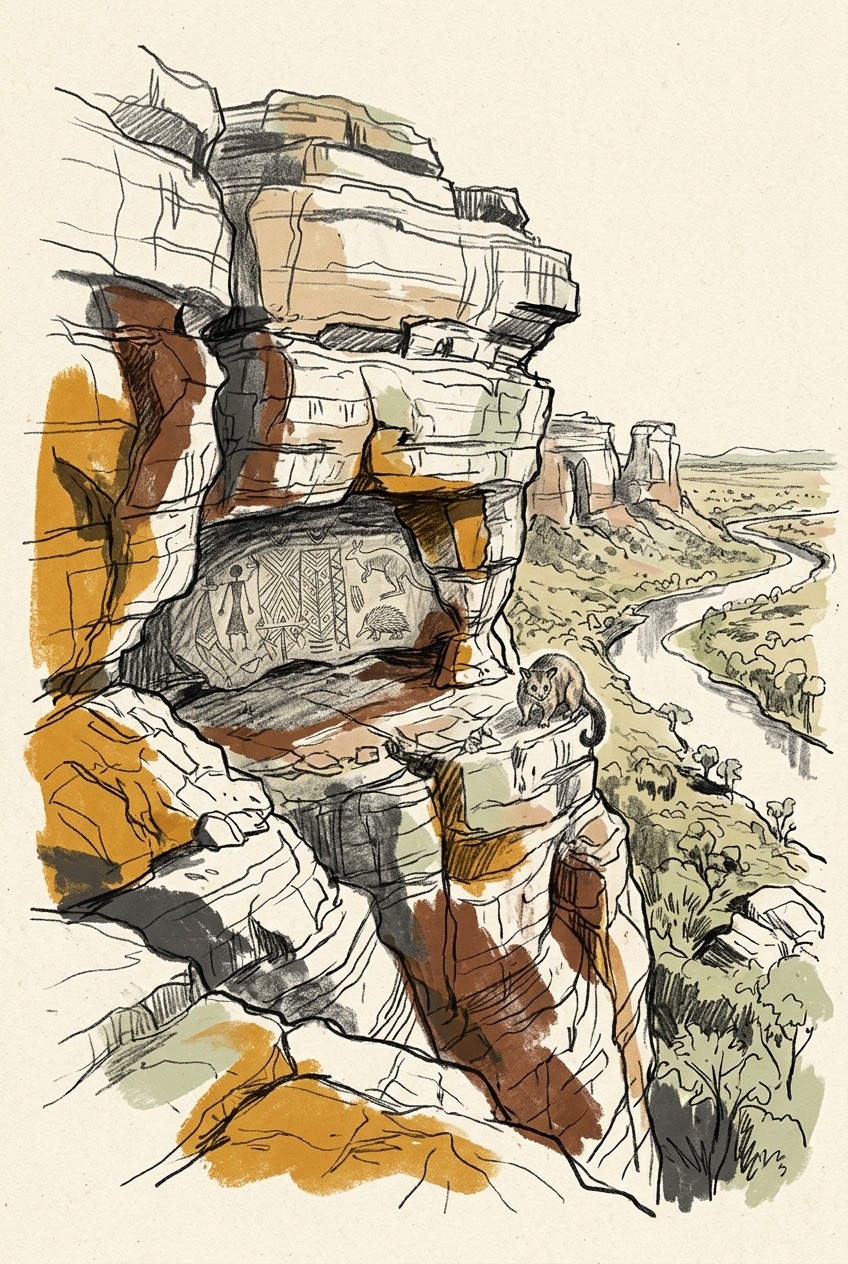
The escarpment is not only a geological archive. Its sheltered overhangs and shallow caves preserve one of the longest continuous records of human art anywhere on Earth. The oldest paintings at sites like Malakunanja and Madjedbebe have been dated to more than 60,000 years before the present — older than the cave art of Europe.
The artists used the escarpment's own geology: white kaolin clay, yellow and red ochre rich in iron oxides, and charcoal from the monsoon woodlands.
The paintings depict animals that are now extinct — the thylacine, the giant echidna — alongside species that still inhabit the plateau: the black wallaroo, the oenpelli python, the white-throated grasswren. The rock faces become a stratigraphy of memory, each generation painting over the last.
The Endemic Refuge
The escarpment's isolation has also shaped biological endemism. The Arnhem Land plateau is a sandstone island surrounded by savanna, and its fauna has evolved in confinement. The black wallaroo (Macropus bernardus), found nowhere else, lives only in the broken country of the escarpment. The oenpelli python (Morelia oenpelliensis), one of Australia's rarest snakes, hunts among the rock crevices for birds and small mammals.
Several species of land snails are restricted to single cliff faces, their entire distribution measured in hectares. The plateau's deep gorges harbour relict populations of Gondwanan rainforest plants — ferns and cycads that survived the drying of the continent in these moist, fire-protected refuges.
The escarpment is not passive. It continues to erode, to retreat, to create new habitats and destroy old ones. The sandstone that falls into the gorges today will become sand again, then sandstone, then escarpment, in the deep time of the next billion years. For now, it stands — a slow cliff of light, water, and memory.
More like this
- The 110-Million-Year-Old River That Runs Backwards UndergroundWestern Australia's 110-million-year-old dune system has been slowly dissolving into a labyrinth of caves where an ancient river still flows, carrying the taste of a Cretaceous desert.
- The 5,000-Year-Old Volcanoes That Still Smoke in the SouthIn Victoria's Newer Volcanics Province, 400 volcanic vents erupted as recently as 5,000 years ago—the youngest volcanic field in mainland Australia, where craters still hold blue lakes and scoria cone
- The 560-Million-Year-Old Garden That Never Saw a PredatorIn South Australia's Flinders Ranges, 560-million-year-old Ediacara surfaces preserve entire seafloor communities of fronds, discs, and quilts — a garden of soft-bodied life that flourished before pre