8 May 2026 · 3 min read
The Lake That Vanished: Willandra Lakes and the Mungo Landscape
At Lake Mungo in New South Wales, a dried lake system preserves 50,000 years of human history and the fossilized bones of Australia's megafauna in layered lunette dunes.
The largest lake in Australia once held 1,000 cubic kilometres of water. It had no outlet, no river to the sea, and it dried to dust more than 15,000 years ago. Today the Willandra Lakes system in western New South Wales is a chain of dry basins, their eastern shores piled high with crescent-shaped dunes of sand and clay — the lunettes — that hold one of the most detailed records of human life on this continent.
The Lake That Breathed
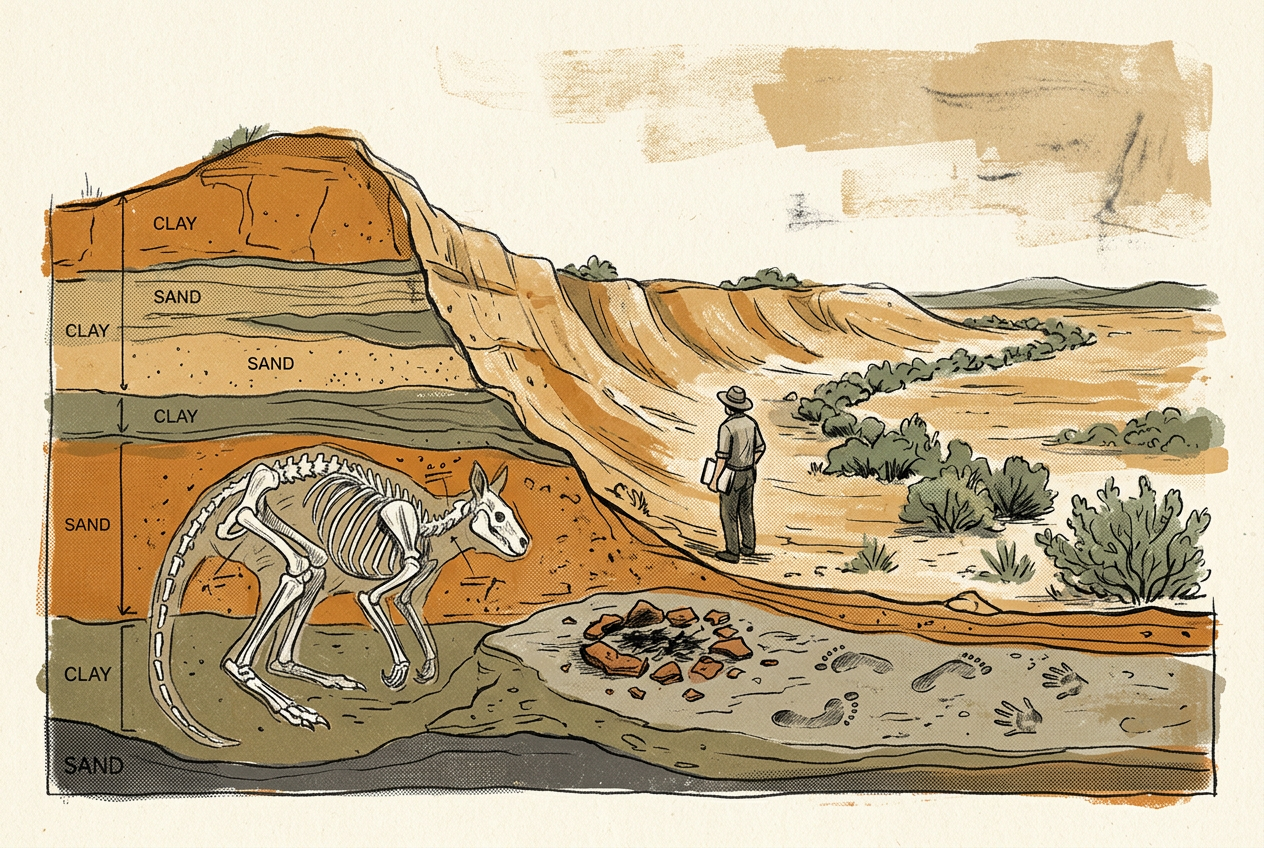
The Willandra Lakes were not fed by rain alone. They were part of a chain of overflow basins connected to the Lachlan River, which carried meltwater from the Snowy Mountains during the last glacial period. When the climate was wetter, the lakes filled; when it dried, they shrank. This pulsing cycle — fill, evaporate, fill again — deposited alternating layers of clay, sand, and organic matter on the downwind shores. Over 40,000 years, those layers built the lunettes that now rise more than 40 metres above the dry lake floors.
At Lake Mungo, the largest of the Willandra basins, the lunette is a library written in sediment. Dark clay layers mark times when the lake was full and stable. Pale sand layers record arid phases when the waterline dropped and quartz grains blew in from the exposed lakebed. Between them, thin bands of carbonate and ash preserve the footprints of ancient fires.
The Bones in the Dune
In 1969, a geologist named Jim Bowler was walking the eroded face of the Mungo lunette when he found fragments of burnt bone. They proved to be the cremated remains of a young woman, buried 42,000 years ago — the oldest known human cremation in the world. Five years later, Bowler found the skeleton of a man, also in his thirties, buried nearby with his hands clasped. The Mungo Lady and Mungo Man rewrote the timeline of Aboriginal occupation of Australia, pushing it back to a time when the continent was still connected to New Guinea and Tasmania by dry land.
The bones lay in the clay of a lake that no longer exists, under a sky that had not changed.
The same sediments that preserved the burials also held the remains of the animals that shared that world. Giant wombats the size of hippopotamuses. Sthenurine kangaroos that walked on one toe. The marsupial lion, Thylacoleo, with its bolt-cutter teeth. The megafauna of the Willandra were already disappearing when humans arrived, but the lake beds record their last millennia in fine detail.
The Sandblasted Archive
The lunette at Lake Mungo is now eroding faster than at any time in the last 10,000 years. Wind and rain carve gullies into the soft sediment, exposing bones, hearth stones, and stone tools. This is both a gift and a loss: each storm reveals new artefacts, but each storm also carries them away. Archaeologists have been racing the weather since the 1970s, sampling the exposed stratigraphy before it scatters.
The erosion has cut cross-sections through the lunette that can be read like a core sample. A walk along the Walls of China — the formal name for the Mungo lunette — is a walk through 50,000 years of climate history. The oldest layers, near the base of the dune, hold the bones of Diprotodon and the tools of the first people. Higher up, the sediment shifts to fine grey clay, marking the final permanent filling of the lake around 20,000 years ago. Above that, the sand layers grow thicker and coarser, recording the last drying and the abandonment of the shore.
The Dry Heart
The Willandra Lakes will not fill again. The climate that sustained them — cooler, wetter, with persistent westerly winds — ended with the last ice age. The Lachlan River still flows, but irrigation and dams have cut its ancient connection to the lake basins. The water that once spread across 1,000 square kilometres now seeps into the ground or evaporates before it reaches the old shorelines.
Yet the landscape is not dead. The dry lake beds are among the most productive sources of palaeontological and archaeological information in Australia. Each layer of the lunette is a single frame in a long film: the arrival of humans, the extinction of megafauna, the collapse of the lake system, the slow transformation of the interior into the driest inhabited continent on Earth.
Mungo is a place defined by absence — of water, of ice, of the animals that once walked the shore. But the record remains, written in clay and bone, waiting for the next storm to uncover it.
More like this
- The 110-Million-Year-Old River That Runs Backwards UndergroundWestern Australia's 110-million-year-old dune system has been slowly dissolving into a labyrinth of caves where an ancient river still flows, carrying the taste of a Cretaceous desert.
- The 5,000-Year-Old Volcanoes That Still Smoke in the SouthIn Victoria's Newer Volcanics Province, 400 volcanic vents erupted as recently as 5,000 years ago—the youngest volcanic field in mainland Australia, where craters still hold blue lakes and scoria cone
- The 560-Million-Year-Old Garden That Never Saw a PredatorIn South Australia's Flinders Ranges, 560-million-year-old Ediacara surfaces preserve entire seafloor communities of fronds, discs, and quilts — a garden of soft-bodied life that flourished before pre