8 May 2026 · 3 min read
The Black Reef: The Proterozoic Manganese of Groote Eylandt
On Groote Eylandt in the Gulf of Carpentaria, 1.5-billion-year-old manganese beds were concentrated into ores by Cretaceous seas, forming one of the world's richest manganese deposits.
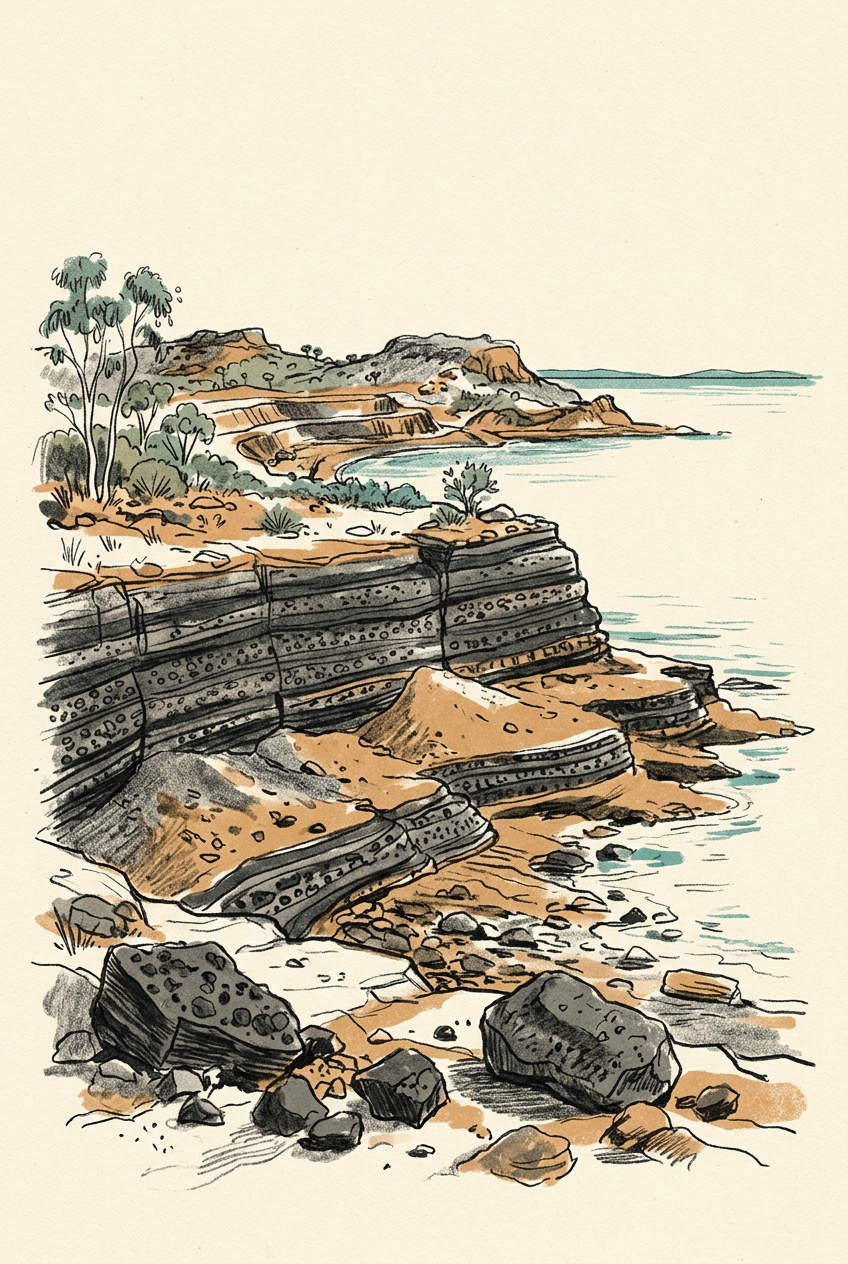
On the western edge of Groote Eylandt, the cliffs are not red or yellow or sandstone-grey. They are black — a deep, sooty black that stains the hands and the shoreline and the shallow sea. This is manganese, one of the densest concentrations of the element on Earth, laid down slowly over millions of years and then buried, forgotten, and re-exposed by the slow machinery of the continent.
The Ancient Seafloor
Groote Eylandt sits in the Gulf of Carpentaria, off the coast of Arnhem Land in the Northern Territory. The island is low and flat, fringed by mangroves and white sand, but its geology is anything but simple. The manganese deposits here are hosted in Cretaceous sediments — sandstones, siltstones, and clays deposited between 100 and 120 million years ago, when shallow seas covered much of northern Australia.
But the manganese itself is older. The source rock belongs to the Proterozoic McArthur Basin, formed around 1.5 billion years ago in a shallow marine basin where chemical precipitation concentrated manganese into thin beds. During the Cretaceous, rising sea levels eroded these ancient beds and transported the manganese into nearshore environments. There, in lagoons and estuaries, the element precipitated out again — this time as nodules, crusts, and pisoliths (small, pea-sized concretions) within the sediment.
The process was not dramatic. No volcanism, no tectonic collision. Just the patient geochemical sorting of seawater, over tens of millions of years, concentrating a trace element into rock.
The Black Ore
The manganese ore of Groote Eylandt occurs in two main forms. The first is a hardened, massive ore — dense black layers that form the caprock of the island's low plateaus. The second is a softer, earthy ore, rich in manganese dioxide, that fills pockets and lenses within the Cretaceous sand. Both are almost pure manganese oxides — pyrolusite, cryptomelane, and romanechite — minerals that form only under specific oxidizing conditions.
What makes the deposit exceptional is its purity and its accessibility. The ore sits close to the surface, often within a few meters of the ground. Mining here requires no deep shafts or underground tunnels. The black earth is simply scraped away, crushed, washed, and shipped. Since mining began in the 1960s, Groote Eylandt has produced tens of millions of tonnes of manganese ore — much of it exported for steel production, where manganese acts as a desulfurizer and hardener.
The island's manganese is not a rare mineral. It is a rare concentration of a common one — the difference between a pinch of salt in the ocean and a salt flat.
The Island as Archive
Groote Eylandt is also, in a quieter way, a geological archive. The Cretaceous sediments that host the manganese contain fossils of marine reptiles — plesiosaurs and ichthyosaurs — that swam in the same shallow seas where the ore formed. The sediments record a time when Australia was still connected to Antarctica, when the climate was warm and the seas were rich in life.
But the Proterozoic source rocks are the deeper story. The McArthur Basin, which supplied the manganese, is one of the oldest sedimentary basins on the continent. Its rocks preserve evidence of early life — stromatolites, microbial mats, the slow chemical experiments of a planet still learning to breathe oxygen. The manganese that now stains the cliffs of Groote Eylandt was first concentrated in those ancient seas, by processes that no longer operate in the same way.
The Human Layer
The Anindilyakwa people have lived on Groote Eylandt for thousands of years. The island's name comes from their language — Kurdungwa — though the Dutch explorer Abel Tasman gave it the European name in 1644. The manganese mine, operated by the South32 group, is jointly managed with the Anindilyakwa Land Council, and royalties fund community development.
The landscape bears the marks of both histories. The black cliffs, the open pits, the crushed ore stockpiles, the mangroves, the white sand beaches — they coexist uneasily. The manganese that took 1.5 billion years to form will be exhausted in a few more decades. When the mining ends, the island will remain, its geology still legible in the dark seams that run through the Cretaceous sand.
The black reefs will still be there — the hard, oxidized caprock that resists erosion. They are the slowest thing on the island, and the most permanent.
More like this
- The 110-Million-Year-Old River That Runs Backwards UndergroundWestern Australia's 110-million-year-old dune system has been slowly dissolving into a labyrinth of caves where an ancient river still flows, carrying the taste of a Cretaceous desert.
- The 5,000-Year-Old Volcanoes That Still Smoke in the SouthIn Victoria's Newer Volcanics Province, 400 volcanic vents erupted as recently as 5,000 years ago—the youngest volcanic field in mainland Australia, where craters still hold blue lakes and scoria cone
- The 560-Million-Year-Old Garden That Never Saw a PredatorIn South Australia's Flinders Ranges, 560-million-year-old Ediacara surfaces preserve entire seafloor communities of fronds, discs, and quilts — a garden of soft-bodied life that flourished before pre