17 June 2026 · 2 min read
The Sand That Trapped a 100-Million-Year-Old River: Queensland's Winton Formation Dinosaur Trackways
How 100-million-year-old river sands in Queensland's Winton Formation preserved Australia's richest dinosaur tracks, recording a Cretaceous landscape of giant sauropods and polar predators.
In the baked channel sands of western Queensland, a river that ran 100 million years ago is still legible. The Winton Formation, a 300-metre-thick slab of sandstone and mudstone that stretches from Longreach to the Northern Territory border, records the final act of Australia's Cretaceous—a time when the continent was still attached to Antarctica and dinosaurs walked beneath polar skies.
A River in Stone
The Winton Formation began as sediment shed from a mountain range that no longer exists. To the east, the Great Dividing Range was rising, and rivers carried sand and silt westward across a vast floodplain dotted with meandering channels and shallow lakes. Seasonal rains—monsoonal, like northern Australia today—alternated with dry periods that left mudcracks and footprints.
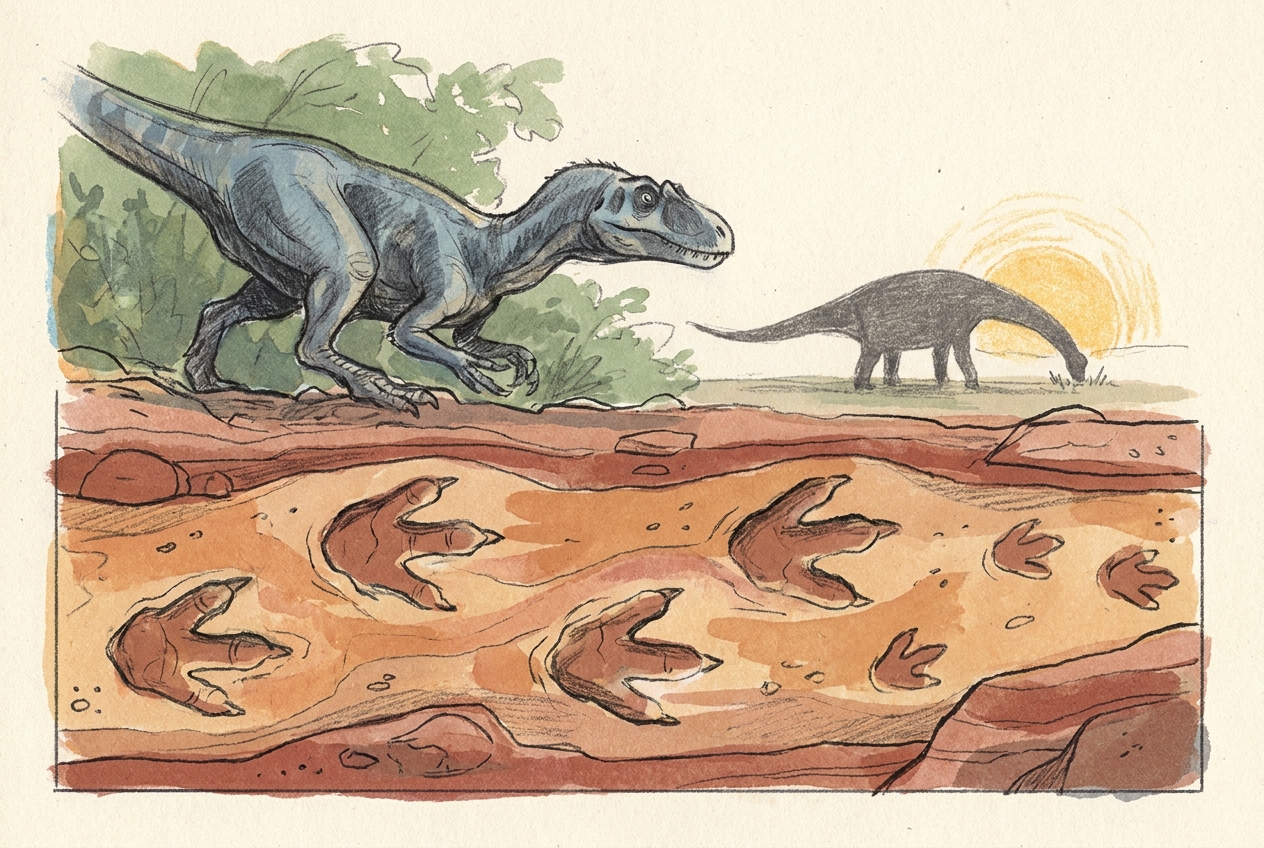
What makes the Winton Formation exceptional is the sheer density of its tracks. At Lark Quarry, near Winton, more than 3,300 individual footprints are preserved on a single bedding plane—the densest concentration of dinosaur tracks in Australia. The site records a stampede: small ornithopods and coelurosaurs fleeing a larger predator, their feet pressing into soft mud that later hardened to sandstone.
The Antarctic Connection
During the mid-Cretaceous, Australia was still connected to Antarctica, and the continent lay at latitudes comparable to present-day Patagonia. The climate was cool and wet, with long winter nights and summer days. Dinosaurs living here had to endure months of darkness and temperatures that dropped below freezing.
The Winton dinosaurs were polar animals. They lived in a world without ice sheets, but with seasons of light and dark that no living reptile experiences.
Fossil bones from the formation include Australovenator, a medium-sized theropod with serrated teeth and grasping hands, and Diamantinasaurus, a 15-metre-long sauropod with a barrel chest and pillar-like legs. These were not tropical giants; they were adapted to a temperate, seasonal world.
The Track That Changed Australian Palaeontology
For decades, Australian dinosaur fossils were rare. The Winton Formation changed that. Since the 1990s, systematic exploration has yielded not just tracks but bones, teeth, and eggshell fragments. The formation's iron-rich sandstones preserve fine details—skin impressions, claw marks, and the drag of tails.
At the Australian Age of Dinosaurs Museum near Winton, thousands of bones are still being prepared. The formation continues to yield specimens that fill gaps in the global dinosaur record: how polar dinosaurs grew, what they ate, and how they survived the long Cretaceous night.
The Edge of a Lost World
The Winton Formation ends abruptly. Above it lies the Mackunda Formation—marine sediment laid down when the sea returned, drowning the floodplain. The rivers that carried sand and footprints were replaced by a shallow inland sea that stretched across central Australia.
What remains is a frozen moment: the last glimpse of a dinosaur ecosystem that evolved in isolation, at the bottom of the world, before the sea rose and the continent drifted north into warmer latitudes.
More like this
- The 560-Million-Year-Old Garden That Never Saw a PredatorIn South Australia's Flinders Ranges, 560-million-year-old Ediacara surfaces preserve entire seafloor communities of fronds, discs, and quilts — a garden of soft-bodied life that flourished before pre
- The 300-Million-Year-Old Forest That Died Standing UpIn New South Wales, a 300-million-year-old fossil forest preserves dozens of trees buried upright by a Permian volcanic eruption—an entire ecosystem frozen in ash.
- The 1.75-Billion-Year-Old Reef That Outranks the BarrierA 1.75-billion-year-old microbial reef in the Kimberley is the largest biological structure ever built by a single species, preserving a world without predators.