10 July 2026 · 3 min read
The 300-Million-Year-Old Forest That Died Standing Up
In New South Wales, a 300-million-year-old fossil forest preserves dozens of trees buried upright by a Permian volcanic eruption—an entire ecosystem frozen in ash.
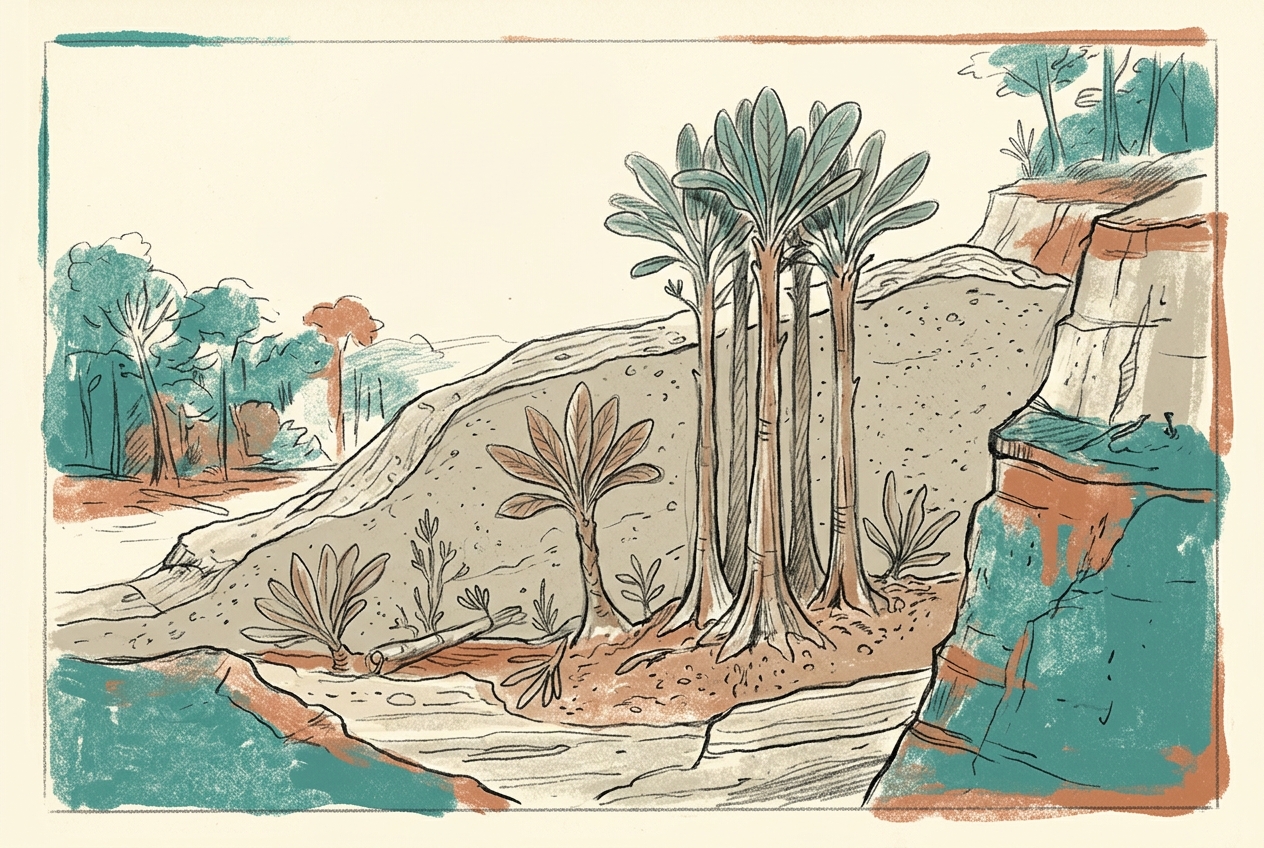
Near the New South Wales town of Gulgong, a 300-million-year-old forest stands exactly where it grew. The trees are not petrified in the usual sense—they were buried upright, entombed in volcanic ash, their trunks still rooted in the same soil that nourished them before the Permian began. Dozens of them. Standing.
The Ash That Fell Like Snow
The forest belonged to the genus Glossopteris, a seed fern that dominated the southern supercontinent Gondwana. These were not towering conifers but woody trees with tongue-shaped leaves, adapted to the cool, wet conditions of a landmass still locked near the South Pole. They grew in swampy lowlands along the edge of a shallow sea.
Then a volcano erupted. The precise source is unknown—the nearest Permian volcanic centres lie hundreds of kilometres east, in what is now the New England region. But the ash fall was thick enough, and sudden enough, to bury the forest while the trees were still alive. The ash preserved them in growth position, exactly as they stood.
The site, known as the Gulgong fossil forest, was discovered in the 1990s during open-cut coal mining. Miners uncovered upright stumps rooted in a dark claystone, capped by a pale layer of tuff—compacted volcanic ash. Palaeontologists counted over fifty trees in a single exposure, some with trunks still attached to root systems that spread through the ancient soil.
What the Roots Reveal
The preservation is unusually fine. Not only the trunks but the root networks survive, radiating outward through the buried ground surface. In some specimens, the internal wood structure remains visible under a microscope—cells, growth rings, the architecture of Permian life.
One stump preserves the moment of death so faithfully that its bark still shows the pattern of the living tree.
The roots tell a story the trunks cannot. They spread wide and shallow, typical of trees growing in waterlogged soil. The forest floor was a peat swamp, the same kind of environment that would later compress into the coal seams that miners were chasing when they stumbled upon the buried grove.
The ash that killed the forest also preserved it. Without that sudden burial, the trees would have rotted, their organic matter recycled into the swamp. Instead, the ash sealed them from oxygen, halting decay and locking their shapes into stone.
A Continent Adrift
The Gulgong forest grew during the Permian, a time when Australia was still part of Gondwana. The continent sat at high southern latitudes, close to 70 or 80 degrees south. Glaciers had scoured the land only a few million years earlier. The climate was warming, the ice retreating, and Glossopteris forests spread across the newly exposed ground.
These trees were the architects of a world that no longer exists. Their leaves fell into swamps and accumulated as peat, later compressed into the coal that powered Australia's industrial age. The Gulgong region sits within the Sydney Basin, one of the world's great coal provinces, and the same Glossopteris forests that fed the Permian swamps now fuel power stations.
But the upright forest is different. It was not slowly buried by swamp growth over millennia. It was killed in a single event, instantaneously, and preserved as a snapshot of a living ecosystem—a Pompeii of the Permian, frozen in ash rather than pumice.
The Fire That Came After
There is a second layer to the story. Above the ash that entombs the standing trees lies another deposit: charcoal. The volcanic eruption that buried the forest was followed by wildfires, likely ignited by the same eruption. The charcoal layer records a landscape on fire, then buried in its turn.
This sequence—living forest, ash fall, fire, more ash—captures a single catastrophic event in the Permian. It is a rare window into how volcanic eruptions interacted with the Gondwanan landscape, killing forests directly and then burning what remained.
Only a handful of such upright fossil forests are known anywhere on Earth. The Gulgong site is one of the finest, preserving not just individual trees but an entire community: the spacing of the stumps suggests a natural forest density, not a random scatter. You can walk the exposure and see the same pattern you would find in a living woodland.
Three hundred million years later, the trees still stand in the ground that held them.
More like this
- The 560-Million-Year-Old Garden That Never Saw a PredatorIn South Australia's Flinders Ranges, 560-million-year-old Ediacara surfaces preserve entire seafloor communities of fronds, discs, and quilts — a garden of soft-bodied life that flourished before pre
- The 1.75-Billion-Year-Old Reef That Outranks the BarrierA 1.75-billion-year-old microbial reef in the Kimberley is the largest biological structure ever built by a single species, preserving a world without predators.
- The 1.85-Billion-Year-Old Caldera That Still Feeds the FurnaceIn South Australia's Middleback Ranges, a 1.85-billion-year-old volcanic caldera collapsed and later became one of the world's richest iron ore deposits.