17 June 2026 · 3 min read
The Sand That Became a Mountain of Light: South Australia's Coober Pedy Opal Fields
:
Ninety-seven million years ago, a shallow inland sea stretched across what is now South Australia. Its bed became a desert, and the desert became the world's richest source of opal—a stone that is not a mineral but a fossilised arrangement of light.
The Sea That Left a Desert of Silica
The Cretaceous inland sea of central Australia was shallow, warm, and slow. Rivers carried fine sediment—silt and sand—into its waters, where they settled in layers that would become the Bulldog Shale and the Marree Formation. In these sediments, the skeletons of marine creatures—belemnites, ammonites, plesiosaurs—accumulated on the seafloor.
When the sea retreated, around 60 million years ago, the exposed sediments began to weather. Groundwater percolated through the porous rock, dissolving silica from the surrounding minerals. Over millions of years, that silica-rich water seeped into cavities left by decaying organic matter: the hollows of bones, the chambers of shells, the gaps between sediment grains.
As the water evaporated during long dry periods, the silica precipitated out of solution. It did not form crystals. Instead, it arranged itself into tiny, closely packed silica spheres, each about 150 nanometres in diameter. When light enters these spheres, it diffracts—splitting into the colours of the spectrum. This is what gives opal its fire.
The Bones That Became Gems
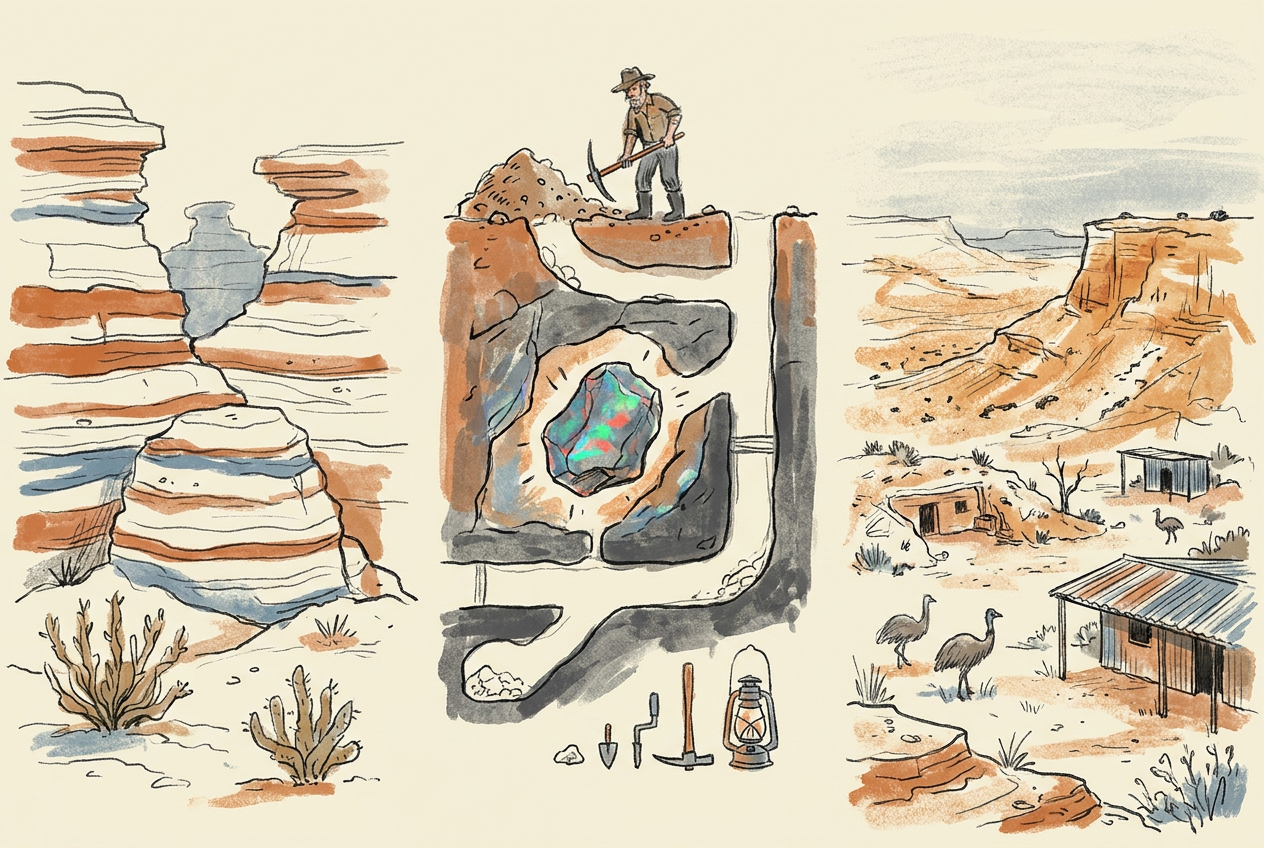
Coober Pedy lies in the Stuart Range, a low ridge of Cretaceous sedimentary rock. Here, the opal-bearing layer is the 'opal dirt'—a zone of weathered, iron-stained sandstone and shale that sits about 20 metres below the surface. The opal itself forms in seams, nodules, and pseudomorphs: opal after wood, opal after shell, opal after bone.
Some of the most spectacular opals are those that replaced the bones of Cretaceous marine reptiles. A plesiosaur vertebrae, once solid calcium phosphate, is now solid silica—and flashes blue and green under a desert sun. These specimens are rare because the organic matter must decay just slowly enough to leave a cavity, and the silica must arrive before the cavity collapses. The timing is precise, almost improbable.
The miners of Coober Pedy have pulled opalised fossils from the ground for a century: the jaw of a lungfish, the shell of an ammonite, the tooth of a shark. Each one is a double fossil—both the shape of the original creature and the record of the water that replaced it.
The Miners Who Live Underground
Coober Pedy is a town built by opal. The first miners arrived in 1915, after a gold prospector discovered the stone while looking for water. By the 1920s, hundreds of men were burrowing into the Stuart Range with picks, shovels, and later, tunnelling machines. The heat of the desert drove them underground not only for mining but for housing: the town's famous underground homes maintain a constant 23 degrees Celsius while surface temperatures exceed 45.
The town is named from a Kokatha Aboriginal phrase, kupa piti—'white man's hole.'
Today, the mines are a warren of shafts and tunnels stretching beneath the town. Miners work with small blasts and hand tools, following the 'opal level'—a thin band of rock that holds the gem. The work is solitary, speculative, and dangerous. Cave-ins and tunnel collapses are common. The reward is a stone that can fetch tens of thousands of dollars per carat.
The Light That Outlasts the Rock
Opal is soft—about 5.5 on the Mohs scale, similar to window glass. It contains up to 20 percent water. Over geological time, it dries out, cracks, and crazes. The play of colour that makes it precious is a temporary arrangement of spheres, held together by hydrogen bonds and luck.
Yet the opal fields of South Australia will continue to produce for millions of years to come. The silica is still moving through the groundwater, still filling cavities, still arranging itself into spheres. The desert is still making gems, one nanometre at a time.
More like this
- The 110-Million-Year-Old River That Runs Backwards UndergroundWestern Australia's 110-million-year-old dune system has been slowly dissolving into a labyrinth of caves where an ancient river still flows, carrying the taste of a Cretaceous desert.
- The 560-Million-Year-Old Garden That Never Saw a PredatorIn South Australia's Flinders Ranges, 560-million-year-old Ediacara surfaces preserve entire seafloor communities of fronds, discs, and quilts — a garden of soft-bodied life that flourished before pre
- The 1.75-Billion-Year-Old Reef That Outranks the BarrierA 1.75-billion-year-old microbial reef in the Kimberley is the largest biological structure ever built by a single species, preserving a world without predators.