17 June 2026 · 3 min read
The Ice That Ground a Continent into Gold Dust: Western Australia's Yilgarn Paleoplacers
How 2.7-billion-year-old river systems in Western Australia's Yilgarn Craton concentrated gold into paleoplacer deposits, later buried beneath ancient glacial till and preserved as a record of Earth's
At the bottom of a drill core pulled from the red dust of Western Australia's Yilgarn Craton, geologists found a layer of rounded gold particles, water-worn and flattened, mixed with pebbles of jasper and quartzite. The gold had not grown in place. It had been carried there by rivers that stopped flowing more than two and a half billion years ago.
Rivers That Ran Before Life Left Tracks
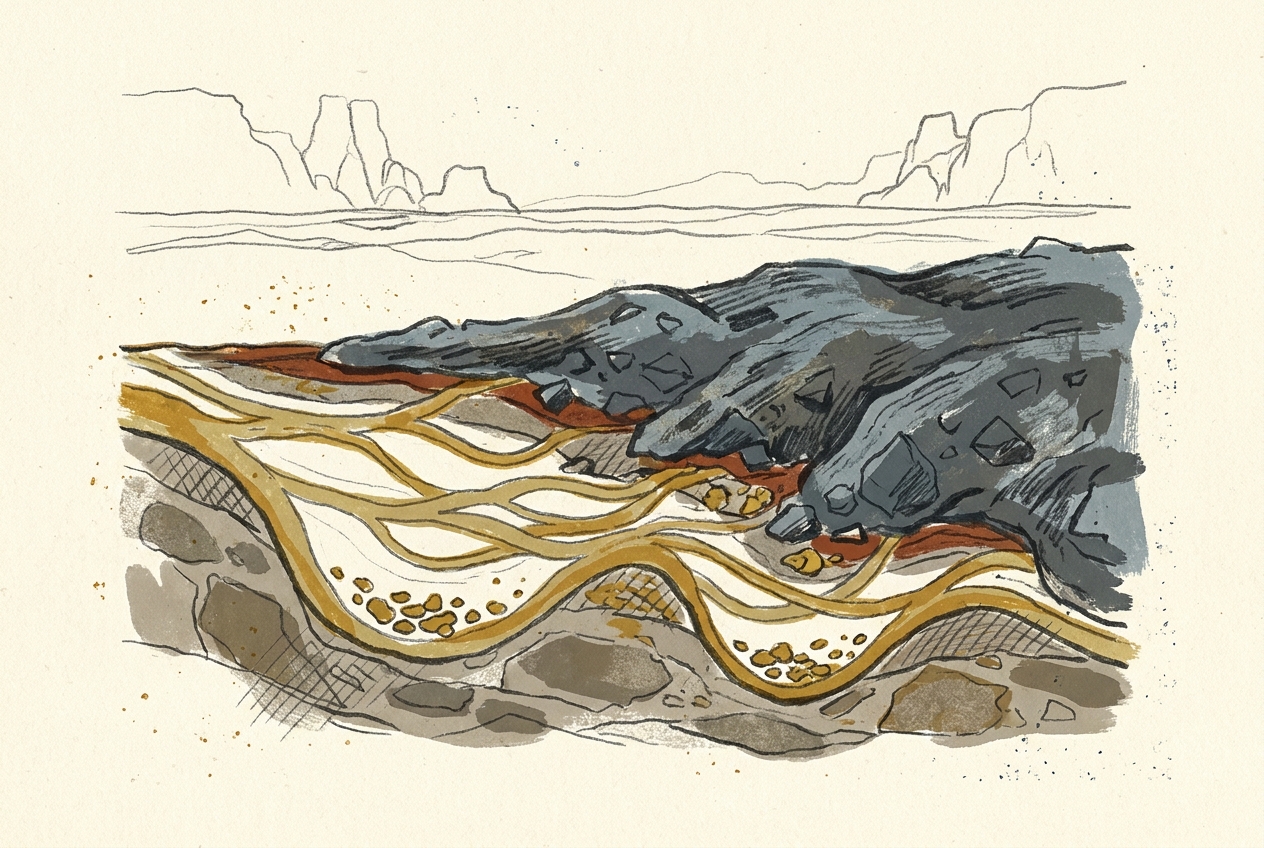
The Yilgarn Craton is one of the oldest surviving pieces of continental crust on Earth, a block of granite and greenstone that stabilised around 2.7 billion years ago. At that time, the landscape looked nothing like the flat, salt-pan desert of today. It was a highland of volcanic arcs and rising mountains, drained by braided rivers that cut through gold-bearing greenstone belts. As those rivers slowed on the floodplains, they dropped their heaviest load: grains and nuggets of gold, settled alongside pebbles of chert and banded iron formation.
These are paleoplacers — ancient river deposits, preserved in the rock record. The Yilgarn holds some of the oldest known examples on Earth. Unlike the younger placer gold of Victoria's 19th-century rushes, which formed in shallow Tertiary channels, the Yilgarn paleoplacers were laid down in the Archean, buried, and then re-exposed by a billion years of erosion.
A Blanket of Ice Across the Archean
Then came the ice. Around 2.4 billion years ago, during the Huronian glaciation — Earth's first known ice age — the Yilgarn Craton sat at low latitude but was still covered by continental glaciers. Tillites, the lithified rubble of glacial till, overlie the paleoplacer deposits in several locations across the craton. The ice scoured the landscape, stripping away weathered rock and redepositing it as a gritty, poorly sorted blanket.
In places, the glacial till actually protected the gold-bearing gravels beneath it. The ice acted as a seal, capping the ancient river channels and preventing them from being eroded away during the intervening eons. At the Tropicana gold mine, near the craton's eastern edge, geologists have mapped paleoplacer horizons preserved directly beneath tillite units — a frozen moment of Archean hydrology, locked under a glacial lid.
The gold in these deposits is fine-grained and well-rounded, distinct from the angular, vein-hosted gold found in the greenstone belts themselves. It had travelled, sometimes hundreds of kilometres, before coming to rest.
Reading the Gravels
Not all paleoplacers are economic. Most are too thin, too patchy, or too deeply buried. But a few, like those at Tropicana and the historic Golden Mile at Kalgoorlie, contain enough gold to mine. The key is the source rock. The Yilgarn's greenstone belts — deformed belts of metamorphosed volcanic rock — contain abundant gold-quartz veins. When those belts eroded, the gold was released into the river systems, concentrated by the same hydraulic processes that sort sand from silt on any streambed.
A grain of gold is 19 times denser than quartz. In moving water, it sinks first and stays put. The river does the sorting; the geologist only has to find the pile.
The paleoplacers also carry a secondary signal. The pebbles mixed with the gold — jasper, banded iron formation, vein quartz — are clues to the composition of the Archean highlands that have since vanished. By tracing the pebble types, geologists can reconstruct the direction of ancient river flow and the location of long-eroded mountain ranges.
A Landscape Written in Gold
Today, the Yilgarn Craton is a low-relief, deeply weathered surface, the ancient hills planed down by ice and time. The paleoplacer deposits are exposed only where recent erosion has cut through the glacial till and the younger cover rocks — or where drill rigs punch through the red dirt in search of the next Tropicana.
Every rounded gold grain pulled from the ground is a message from a world before oxygen, before land plants, before anything had crawled onto shore. It tells of rivers that ran under a fainter sun, carrying the debris of mountains that no longer exist, and of ice that spread across a continent without a single blade of grass to slow it down.
The gold is not the story. The gold is just the punctuation.
More like this
- The 110-Million-Year-Old River That Runs Backwards UndergroundWestern Australia's 110-million-year-old dune system has been slowly dissolving into a labyrinth of caves where an ancient river still flows, carrying the taste of a Cretaceous desert.
- The 560-Million-Year-Old Garden That Never Saw a PredatorIn South Australia's Flinders Ranges, 560-million-year-old Ediacara surfaces preserve entire seafloor communities of fronds, discs, and quilts — a garden of soft-bodied life that flourished before pre
- The 1.75-Billion-Year-Old Reef That Outranks the BarrierA 1.75-billion-year-old microbial reef in the Kimberley is the largest biological structure ever built by a single species, preserving a world without predators.