18 June 2026 · 3 min read
The Sand That Preserved a 100-Million-Year-Old Polar Forest: Victoria's Koonwarra Fossil Beds
How 100-million-year-old lake sediments in Victoria's Koonwarra fossil beds preserved leaves, insects, and even dinosaur feathers from a polar forest that grew within the Antarctic Circle.
On a cool morning in South Gippsland, a slab of grey mudstone splits open to reveal the outline of a feather—not a bird's feather, but a dinosaur's. The rock is 100 million years old. The feather belonged to a creature that lived inside the Antarctic Circle.
A Lake That Buried a Forest
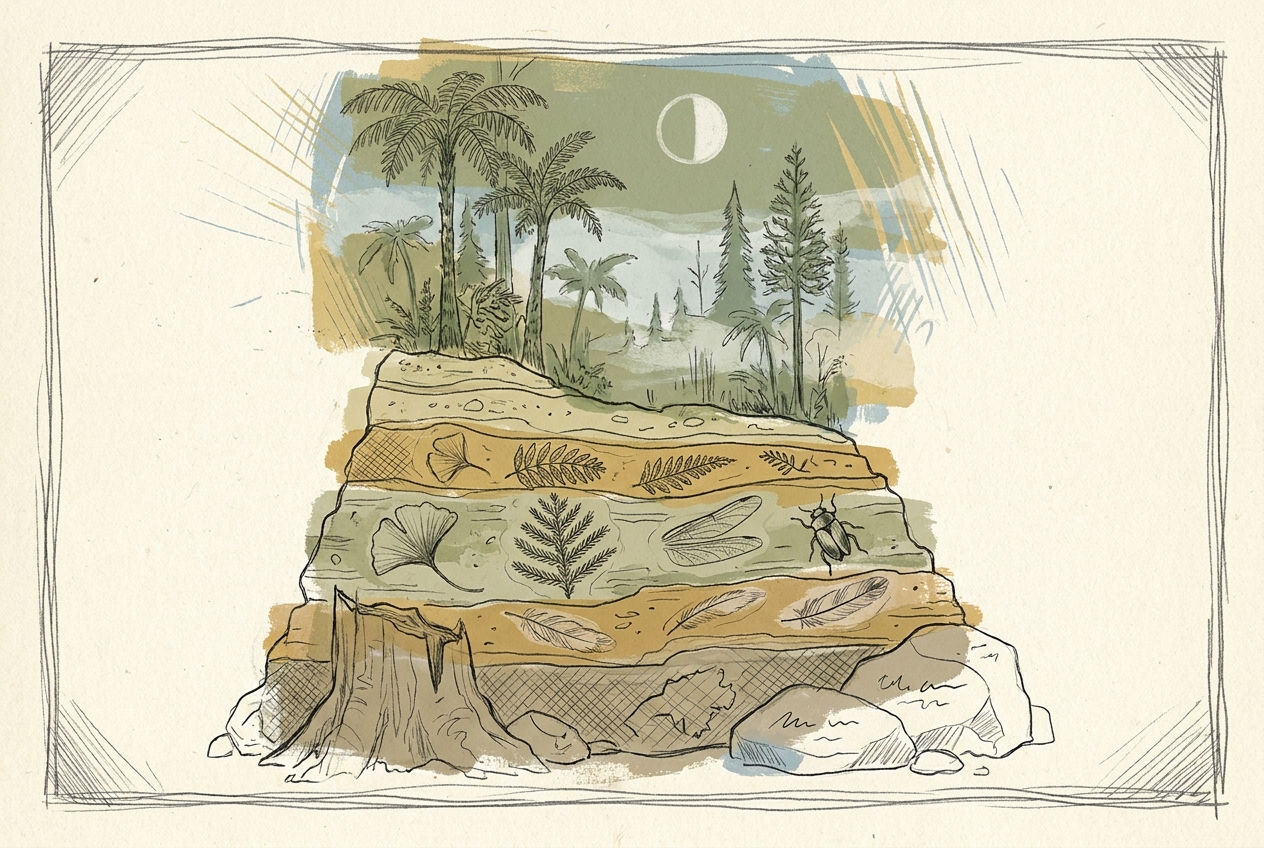
During the early Cretaceous, Australia was still attached to Antarctica. The continent sat at about 70 degrees south latitude, well within the polar circle. Winters lasted months in total darkness. Yet fossilised tree stumps, leaves, and pollen from the Koonwarra fish beds show that a lush forest of conifers, ginkgoes, and ferns grew there.
The sediments that entombed this forest accumulated in a shallow freshwater lake. Layer after layer of fine silt and clay settled on the lakebed, burying whatever fell in—leaves, insects, fish, and occasionally the remains of terrestrial animals. The water was still, the sediment fine-grained. The combination created one of Australia's richest Konservat-Lagerstätten, a deposit that preserves soft tissues as well as bones.
What the Mudstone Holds
The Koonwarra fossil beds, located near the town of Leongatha in Victoria's Strzelecki Ranges, have yielded more than 4,000 fossil specimens since their discovery in the 1960s. The list of finds is unusual for a single deposit:
- Complete fish skeletons with scales and fin rays intact
- Feathers from both birds and non-avian dinosaurs, showing barb and rachis structure
- Insects with wing venation preserved, including mayflies, beetles, and flies
- Freshwater crustaceans such as conchostracans and isopods
- Plant fronds, cones, and seeds in carbonaceous compression
Insect fossils from Koonwarra are especially significant. They record ancient behaviours: mating swarms of mayflies, the emergence of aquatic larvae, and the presence of predators that hunted in the lake shallows. One specimen preserves a mass mortality event of thousands of tiny crustaceans, killed by a sudden change in water chemistry and buried in a single layer.
Life in the Dark
How did a forest survive polar winters with months of continuous night? The fossil leaves offer clues. Many are small, thick, and needle-like—adaptations that reduce water loss and protect against frost. Tree rings in fossilised wood from equivalent Antarctic deposits show narrow growth bands, suggesting slow growth during short, cool summers.
The Koonwarra forest was not a tropical jungle. It was a temperate conifer woodland, similar in structure to today's Tasmanian rainforest but growing at a latitude where no forest exists today. Winter temperatures likely hovered near freezing; summer temperatures were mild. The trees dropped their leaves in autumn and regrew them in spring, much like deciduous trees today.
The Koonwarra beds preserve the only known dinosaur feathers from Australia, and among the very few from anywhere in the Southern Hemisphere.
A Window into a Lost World
The Koonwarra fossil beds are a rare glimpse of a polar ecosystem before the breakup of Gondwana. When Australia finally separated from Antarctica around 45 million years ago, it drifted north into warmer latitudes. The forests that once covered the southern continent were replaced by open woodlands and eventually by the arid landscapes of modern Australia.
But the evidence of that polar forest remains buried in the grey mudstones of South Gippsland. Each split slab reveals another fragment of a world that existed in the dark, where dinosaurs shed feathers into quiet lakes and ginkgo leaves drifted down through months of twilight.
More like this
- The 560-Million-Year-Old Garden That Never Saw a PredatorIn South Australia's Flinders Ranges, 560-million-year-old Ediacara surfaces preserve entire seafloor communities of fronds, discs, and quilts — a garden of soft-bodied life that flourished before pre
- The 300-Million-Year-Old Forest That Died Standing UpIn New South Wales, a 300-million-year-old fossil forest preserves dozens of trees buried upright by a Permian volcanic eruption—an entire ecosystem frozen in ash.
- The 1.75-Billion-Year-Old Reef That Outranks the BarrierA 1.75-billion-year-old microbial reef in the Kimberley is the largest biological structure ever built by a single species, preserving a world without predators.