18 June 2026 · 3 min read
The Lava That Became a Fossil Reef of Silver and Lead: New South Wales' Broken Hill Deposit
: How 1.7-billion-year-old volcanic sediments in far-western New South Wales created the world's largest silver-lead-zinc deposit, a mound of metal that built an industry and still defies easy explana
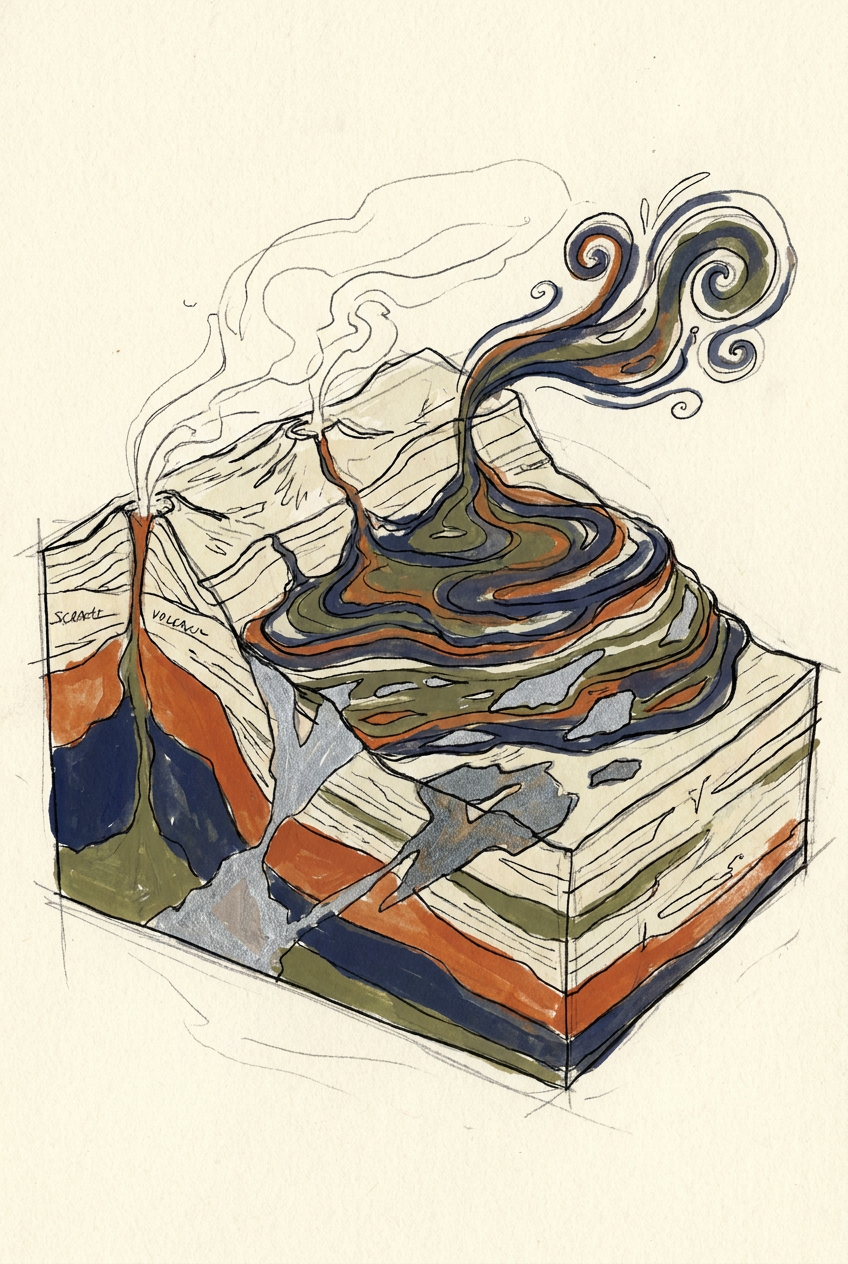
From a distance, the Broken Hill line of lode looks like a dark scar across a red desert. Up close, it is a mountain of metal: 300 million tonnes of ore that yielded more than 30,000 tonnes of silver, 5 million tonnes of lead, and 6 million tonnes of zinc. This is not a vein or a pipe. It is a fossilised submarine volcano—a mound of hot ash and metal-rich brine that accumulated on an ancient seafloor 1.7 billion years ago, then lay buried for most of Earth's history before being exhumed by erosion.
The World Before Oxygen
When the Broken Hill deposit formed, the Earth was a different planet. The atmosphere held barely a trace of oxygen. Continents were small and restless. And in a shallow sea in what is now far-western New South Wales, a chain of hydrothermal vents was pumping superheated water into the ocean.
The vents were fed by volcanic activity deep beneath the seafloor. As seawater circulated through hot volcanic rock, it dissolved metals—silver, lead, zinc, copper—and carried them upward. When the metal-rich fluid hit cold seawater, the metals precipitated out, falling as fine particles that built a mound on the seafloor.
This process is not unique. Similar deposits form today at hydrothermal vents along mid-ocean ridges. But Broken Hill is extraordinary in scale. The original mound was at least 7 kilometres long and up to 250 metres thick—a single pile of metal that dwarfs almost every other known deposit of its type.
The Rock That Refuses to Explain Itself
Geologists have studied Broken Hill for more than a century, but the deposit remains stubbornly enigmatic. The ore is not a simple chemical precipitate. It has been metamorphosed—cooked and squeezed—at least twice since it formed, first during a mountain-building event 1.6 billion years ago and again 500 million years later.
This metamorphism recrystallised the ore into coarse, glittering aggregates of galena (lead sulphide) and sphalerite (zinc sulphide), laced with silver-rich minerals. It also created a distinctive suite of manganese-rich garnets that give the waste rock a deep red colour—the "broken hill" that gave the deposit its name.
The ore body was so rich that early miners could pick up chunks of nearly pure galena from the ground. One specimen, now in a museum, weighs 70 kilograms and contains 90 per cent lead.
The metamorphism also scrambled the deposit's original structure. The ore body was folded, faulted, and stretched into a complex geometry that still resists simple models. Some geologists argue that the metals were concentrated by hot brines circulating through the sedimentary basin, not by direct volcanic activity. Others insist the deposit is a true volcanogenic massive sulphide, formed entirely on the seafloor. The debate has lasted decades, and neither side has convincingly won.
A City Built on Metal
The discovery of Broken Hill in 1883 transformed Australia. Within a decade, the deposit was producing more silver and lead than any mine on Earth. The BHP company—Broken Hill Proprietary—was founded to work the lode and eventually grew into one of the world's largest mining corporations.
The mine also created a city. Broken Hill, population 17,000, still stands in one of the most arid regions of the continent, sustained entirely by the ore body beneath it. The line of lode runs directly under the town's main street. From the air, the open cuts and tailings dumps are visible as a long, pale scar winding through the red desert soil.
Today the mine is deeper than ever, reaching more than 1.5 kilometres below the surface. The richest ore has been exhausted, but the deposit still holds significant reserves of zinc, lead, and silver. Geologists continue to drill and sample, trying to understand how such a colossal pile of metal formed—and where the next one might be hiding.
More like this
- The 5,000-Year-Old Volcanoes That Still Smoke in the SouthIn Victoria's Newer Volcanics Province, 400 volcanic vents erupted as recently as 5,000 years ago—the youngest volcanic field in mainland Australia, where craters still hold blue lakes and scoria cone
- The 300-Million-Year-Old Forest That Died Standing UpIn New South Wales, a 300-million-year-old fossil forest preserves dozens of trees buried upright by a Permian volcanic eruption—an entire ecosystem frozen in ash.
- The 1.85-Billion-Year-Old Caldera That Still Feeds the FurnaceIn South Australia's Middleback Ranges, a 1.85-billion-year-old volcanic caldera collapsed and later became one of the world's richest iron ore deposits.