18 June 2026 · 3 min read
The Fault That Opened a 2.5-Billion-Year-Old Window: Western Australia's North Pole Dome
How 3.5-billion-year-old seafloor in Western Australia's Pilbara Craton preserves Earth's oldest known fossils, stromatolites built by microbes before the continents had stabilised.
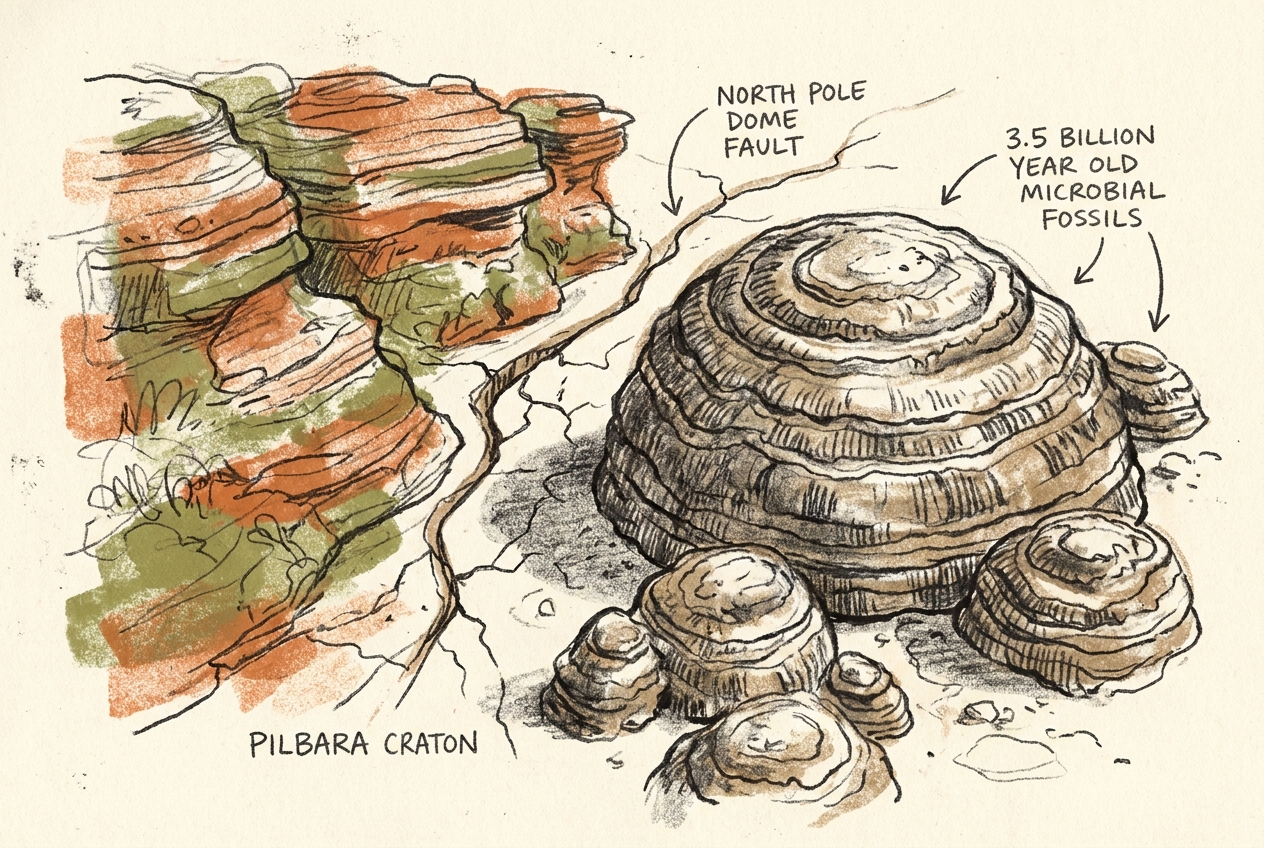
On the eastern flank of the North Pole Dome in Western Australia's Pilbara Craton, a ridge of grey-green chert contains the oldest direct evidence of life on Earth. The rock is 3.49 billion years old. It looks unremarkable—layered, knobbly, veined with quartz—but embedded in its surface are the fossilised remains of microbial mats that grew before the planet's crust had fully cooled.
The Dome That Survived the Archaean
The North Pole Dome is not a volcanic crater. It is a structural dome, a tectonic uplift that exposed some of the oldest intact crust on Earth. The Pilbara Craton, which covers roughly 60,000 square kilometres of northwestern Australia, formed between 3.6 and 2.8 billion years ago during the Archaean eon. Unlike younger crust that has been recycled by plate tectonics, large sections of the Pilbara have remained undisturbed for billions of years.
The dome's name comes from the North Pole mining centre, a small asbestos and gold settlement that operated in the early twentieth century. Prospectors were looking for minerals, not fossils. They walked past the oldest record of life on Earth without knowing it.
The Mats That Built the First Reefs
The fossils preserved in the North Pole chert are stromatolites—layered sedimentary structures built by colonies of cyanobacteria. These microbes did not leave bones or shells. They left textures: wrinkled, cabbage-like mounds that formed as sediment grains were trapped and bound by sticky microbial films.
What makes the North Pole stromatolites extraordinary is their complexity. They are not simple laminations. They show branching columns, linked domes, and evidence of phototaxis—the organisms oriented themselves toward sunlight. This suggests the microbes were already sophisticated, using photosynthesis to harvest energy from a sun that shone through a methane-rich atmosphere with no ozone layer.
The environment was a shallow, silica-saturated sea. Hot springs vented iron-rich fluids into the basin, precipitating the chert that entombed the microbial mats. Without that rapid silicification, the delicate structures would have decomposed. The chert acted as a chemical photograph, freezing the shape of the mats in stone.
The North Pole stromatolites are not the oldest rocks on Earth. They are the oldest rocks that contain unambiguous evidence of life.
A World Without Predators
To understand the North Pole fossils, you have to imagine an Earth without grazing animals, without burrowing worms, without any organism that could disrupt a microbial mat. The stromatolites grew undisturbed for thousands of years, layer by layer, in seas that contained no visible life larger than a grain of sand. The water was warm, rich in dissolved minerals, and free of oxygen.
These conditions persisted for nearly two billion years. The same kind of microbial mats that built the North Pole stromatolites eventually produced the banded iron formations that would later supply the world's steel. They also slowly transformed the atmosphere, pumping oxygen as a waste product of photosynthesis until the planet's chemistry tipped.
The Modern Counterpart
Stromatolites still exist today, but they are rare. The best-known living examples grow in Shark Bay, about 800 kilometres southwest of the North Pole Dome. There, hypersaline water excludes predators, allowing microbial mats to persist in a modern echo of the Archaean world. But Shark Bay's stromatolites are small and scattered. They are survivors, not rulers.
In the Pilbara, the fossilised mats stretch across entire bedding planes. Some individual structures are a metre across. They are not curiosities—they are the remains of a biosphere that covered the planet, a living film that drove Earth's first great environmental transformation.
The North Pole Dome is now a protected site, listed on the Australian National Heritage List. Access is restricted. The chert ridges erode slowly in the dry heat, and each rainstorm washes a few more grains of 3.5-billion-year-old seafloor into the creeks. The oldest portrait of life on Earth is fading, grain by grain.
More like this
- The 110-Million-Year-Old River That Runs Backwards UndergroundWestern Australia's 110-million-year-old dune system has been slowly dissolving into a labyrinth of caves where an ancient river still flows, carrying the taste of a Cretaceous desert.
- The 560-Million-Year-Old Garden That Never Saw a PredatorIn South Australia's Flinders Ranges, 560-million-year-old Ediacara surfaces preserve entire seafloor communities of fronds, discs, and quilts — a garden of soft-bodied life that flourished before pre
- The 1.75-Billion-Year-Old Reef That Outranks the BarrierA 1.75-billion-year-old microbial reef in the Kimberley is the largest biological structure ever built by a single species, preserving a world without predators.