17 June 2026 · 3 min read
The Bone That Buried a Lake of Giant Marsupials: Queensland's Darling Downs Megafauna
How 500,000-year-old sediment in Queensland's Darling Downs preserves the richest concentration of Ice-Age marsupial fossils in Australia, recording the extinction of giant wombats and marsupial lions
In 1843, a grazier named Henry Stuart Russell was digging a well on his property near the Darling Downs when his shovel struck something that rang like stone. It was a femur—but one the size of a man's torso. The bone belonged to a creature no European had ever seen alive.
The Gravel That Held a Menagerie
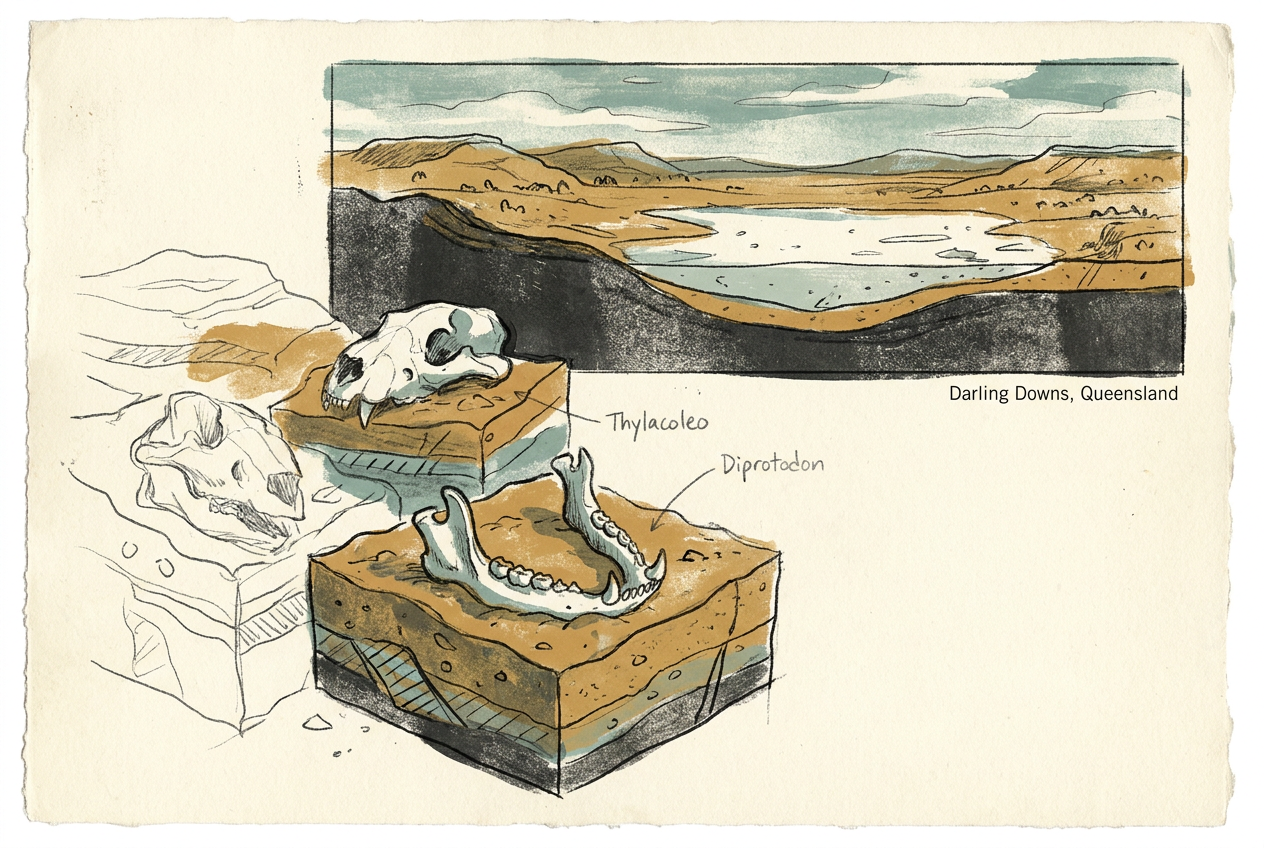
Russell's well sat on a deposit of alluvial gravel and clay known today as the Chinchilla Sand. This formation, laid down roughly 500,000 to 300,000 years ago, was once the bed of a vast ancient river system that drained the eastern highlands of Queensland into the Condamine River.
As the river meandered, it left behind layers of sand, silt, and gravel that acted like a slow-motion trap. Animals that died on the floodplain were buried by seasonal floods before scavengers could scatter their bones. The result is a fossil deposit that has yielded more than 40 species of megafauna—the highest concentration of Pleistocene marsupials anywhere on the continent.
Among them is Diprotodon optatum, the largest marsupial that ever lived. A full-grown diprotodon stood two metres at the shoulder and weighed as much as a small car. Its closest living relative is the wombat.
The Teeth That Tell a Story of Diet and Climate
Fossil teeth are the most abundant finds on the Darling Downs, and they carry a hidden archive. The enamel preserves microscopic patterns of wear that reveal what an animal ate in its final days. Grazers show fine scratches from silica in grass; browsers show broader pits from leaves and twigs.
Analysis of diprotodon teeth from the Chinchilla Sand shows that these giants were mixed feeders—they ate both grass and browse, shifting their diet as the landscape changed. During glacial periods, when the climate was cooler and drier, the grasslands expanded and diprotodons grazed more. During interglacials, they turned to shrubs and trees.
The bones of the Darling Downs are not simply a record of death. They are a record of how a continent's largest animals adapted to climate change—until they could no longer adapt at all.
The Predator That Lurked in the Same Gravel
Not all the bones belong to herbivores. In the same deposits that yield diprotodon skeletons, palaeontologists have found the skull of Thylacoleo carnifex, the marsupial lion. It was no lion in the modern sense—it was a carnivorous marsupial with bolt-cutter teeth and a thumb claw that could slash through hide.
Thylacoleo was the apex predator of Pleistocene Australia. It hunted diprotodons and giant kangaroos, and its bones turn up in the same gravel beds because it died on the same floodplains. The Darling Downs preserve entire ecosystems, not isolated species.
The Extinction That Remains a Question
The youngest megafauna fossils from the Darling Downs date to around 40,000 years ago. That places their disappearance squarely within the window of human arrival on the continent. The debate continues: did people hunt them to extinction, or did climate change shrink their habitat until the populations could no longer sustain themselves?
What is certain is that the Chinchilla Sand records a world that no longer exists. A world where a wombat weighed two tonnes and a kangaroo stood three metres tall. A world that ended, as all worlds do, in a slow unraveling that left only bones in the gravel beneath a grazier's well.
More like this
- The 560-Million-Year-Old Garden That Never Saw a PredatorIn South Australia's Flinders Ranges, 560-million-year-old Ediacara surfaces preserve entire seafloor communities of fronds, discs, and quilts — a garden of soft-bodied life that flourished before pre
- The 300-Million-Year-Old Forest That Died Standing UpIn New South Wales, a 300-million-year-old fossil forest preserves dozens of trees buried upright by a Permian volcanic eruption—an entire ecosystem frozen in ash.
- The 1.75-Billion-Year-Old Reef That Outranks the BarrierA 1.75-billion-year-old microbial reef in the Kimberley is the largest biological structure ever built by a single species, preserving a world without predators.