10 July 2026 · 3 min read
The 110-Million-Year-Old River That Runs Backwards Underground
Western Australia's 110-million-year-old dune system has been slowly dissolving into a labyrinth of caves where an ancient river still flows, carrying the taste of a Cretaceous desert.
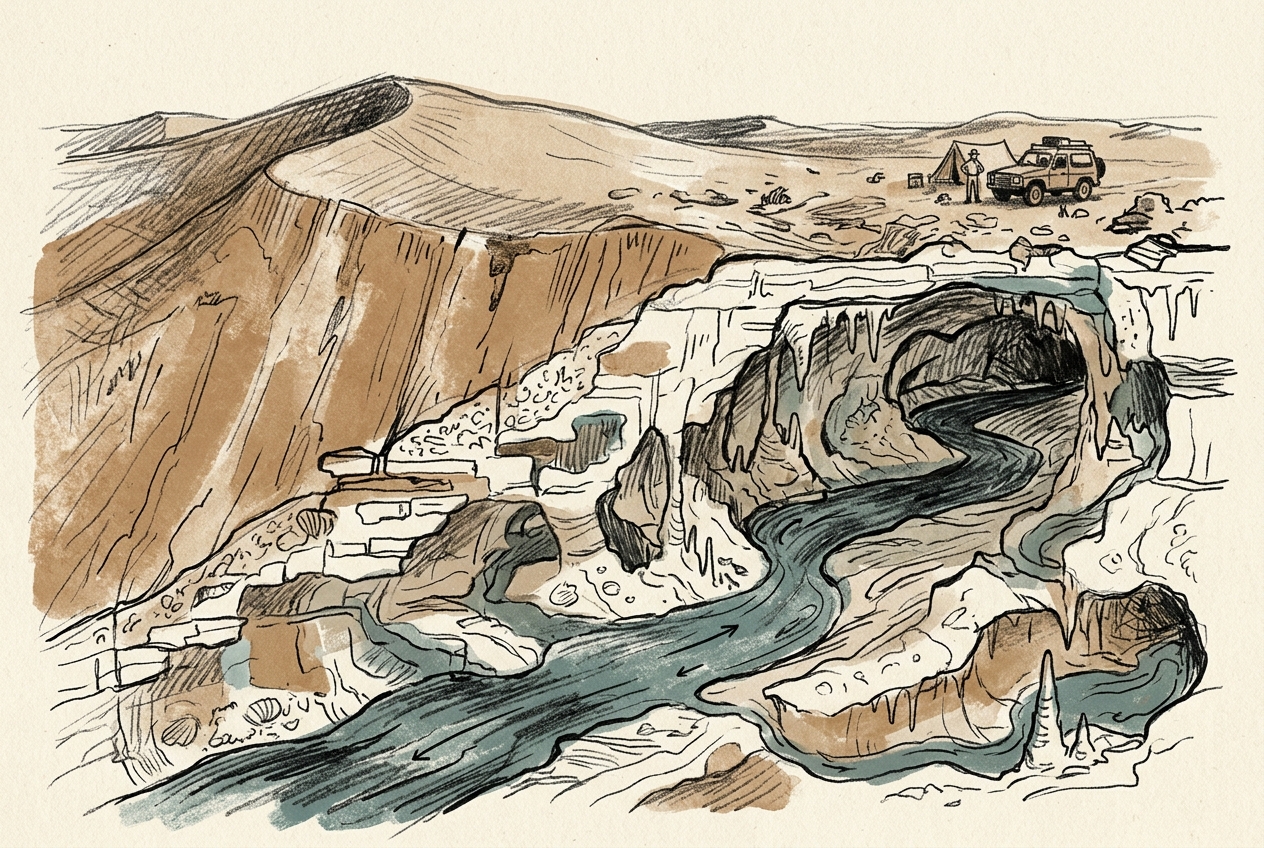
In Western Australia's far southwest, the world's longest underwater cave system runs through limestone that was once a desert of sand dunes. The river inside it flows backwards — toward the interior, not the sea — and has been doing so for millions of years.
The Dune That Turned to Stone
Between 110 and 130 million years ago, when Australia was still attached to Antarctica, a vast desert stretched across what is now the Margaret River region. Wind-blown sand piled into dunes hundreds of metres high, the same way dunes accumulate in the Sahara today. Over time, those dunes were buried, compressed, and cemented into a soft, porous limestone called calcarenite.
The rock is almost pure calcium carbonate — the compressed shells and skeletons of marine organisms that lived in the shallow seas that once covered the area. But the original dune shapes remain. The entire landscape is a fossilised desert, its ancient contours still visible in the rolling hills.
The Dissolving
Rainwater, slightly acidic from dissolved carbon dioxide, began to eat into the calcarenite as soon as it was exposed. The process is called solution weathering — water seeps through cracks, widens them into passages, and eventually carves out chambers and tunnels. Over tens of millions of years, this slow chemical erosion created one of the most complex cave systems on Earth.
More than 700 caves have been mapped beneath the Leeuwin-Naturaliste Ridge, a 100-kilometre-long spine of limestone that runs between Cape Naturaliste and Cape Leeuwin. Some chambers are cathedral-sized: the Jewel Cave is 42 metres high and contains crystal formations that have grown for over a million years. Others are narrow, water-filled tunnels that divers have only recently begun to explore.
The caves are not empty. They contain stalactites, stalagmites, helictites, and a rare formation called a "shawl" — delicate, translucent sheets of calcite that hang like frozen fabric. Many of these formations are still growing, adding a few millimetres every century.
The River That Refused the Sea
Most rivers flow downhill to the ocean. But the groundwater system beneath the Leeuwin-Naturaliste Ridge moves inland, away from the coast. This happens because the limestone ridge acts as a giant sponge. Rain falls on the ridge, soaks through the porous rock, and encounters a layer of granite beneath that is far less permeable. The water pools on top of the granite and flows along the path of least resistance — which, due to the tilt of the rock layers, is eastward, toward the interior.
The result is a network of underground rivers that run counter to every surface stream. The water emerges kilometres inland, in low-lying areas where the limestone meets the older granite basement rock. It carries with it the dissolved calcium carbonate that has been slowly stripped from the ancient dunes above.
The water that falls on these hills today is the same rainwater that has been dissolving this landscape since the Cretaceous — a single, uninterrupted chemical reaction that has lasted longer than most mountain ranges.
What the Caves Remember
The caves preserve evidence of a much wetter past. During the Pleistocene ice ages, when sea levels dropped by over 100 metres, the water table fell and the caves drained. Animals took shelter inside: the bones of giant marsupials — a 2-metre-tall kangaroo called Procoptodon, a marsupial lion, a wombat the size of a hippopotamus — have been found in the cave sediments, along with charcoal from ancient fires.
The oldest human remains in southwest Australia were discovered in one of these caves — a partial skeleton from the Wardandi people, buried 6,000 years ago in a chamber that had already been dissolving for 100 million years.
The caves are still active. Water still drips. The river still flows backwards, carrying the dissolved memory of a Cretaceous desert toward the interior of a continent that has drifted thousands of kilometres since those dunes first formed. Nothing has stopped — the process continues, slower than we can perceive, but as relentless as gravity.
More like this
- The 5,000-Year-Old Volcanoes That Still Smoke in the SouthIn Victoria's Newer Volcanics Province, 400 volcanic vents erupted as recently as 5,000 years ago—the youngest volcanic field in mainland Australia, where craters still hold blue lakes and scoria cone
- The 1.75-Billion-Year-Old Reef That Outranks the BarrierA 1.75-billion-year-old microbial reef in the Kimberley is the largest biological structure ever built by a single species, preserving a world without predators.
- The 5-Million-Year-Old Cave Archive Beneath a Treeless PlainBeneath the treeless Nullarbor Plain, a labyrinth of limestone caves preserves five million years of Australian climate in sediment layers, fossil bones, and ancient air bubbles.