9 May 2026 · 3 min read
The Salt That Bends: The Halite Diapirs of the Canning Basin
Beneath the Kimberley's desert plains, ancient salt layers have flowed upward through 400 million years of rock, forming domes that trap oil, distort strata, and reshape the land above.
The desert floor near Broome looks ordinary—spinifex, red soil, the heat shimmer. A kilometre below, something is moving. Columns of salt, buried since the Devonian, are rising through the crust like slow bubbles in cold honey.
The Buried Evaporite
In the Canning Basin of northwestern Australia, a thick sequence of Devonian salt—halite and anhydrite, deposited around 380 million years ago—lies buried beneath younger sediments. The salt accumulated in a restricted marine basin, much like the modern Mediterranean's Messinian evaporites, as seawater repeatedly flooded and evaporated under a Devonian sun.
Salt is mechanically weak. Under the weight of overlying rock—sometimes four or five kilometres of it—it behaves as a fluid. Given a trigger, it flows. In the Canning Basin, that trigger was tectonic stress during the Carboniferous and Permian, when the crust stretched and tilted, allowing the salt to mobilise.
The Rise of the Diapir
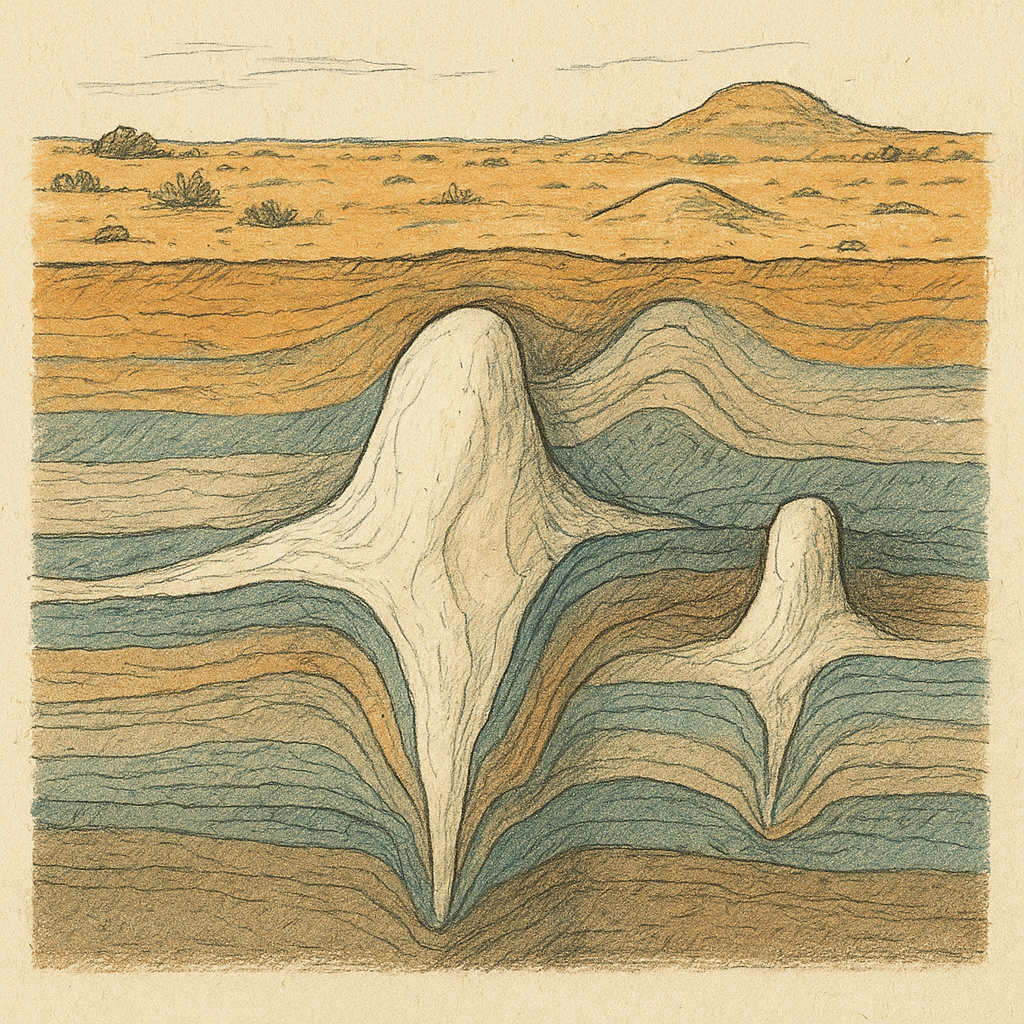
Once mobilised, the salt sought the path of least resistance. It pushed upward through fractures and weak zones, piercing the overlying sediments like a blunt needle. These structures are called diapirs—from the Greek diapeirein, to pierce through. Some rose as narrow spines; others spread into mushroom-shaped domes hundreds of metres across.
As the salt ascended, it dragged surrounding rocks upward, folding and faulting them into complex structures. The sedimentary layers adjacent to a diapir often tilt steeply, sometimes standing vertical. Seismic imaging reveals these distorted beds wrapping around the salt core like fabric stretched over a fist.
The salt does not erode. It flows, folds, and seals—a plastic memory of an ancient sea.
The Trap and the Treasure
The same properties that make salt mobile also make it impermeable. As a diapir rises, it deforms the surrounding strata into traps—anticlines and fault seals where oil and gas can accumulate. The Canning Basin's halite diapirs are intimately linked to its petroleum systems. Organic-rich Devonian shales, buried and heated, generated hydrocarbons that migrated upward until they met the salt seal.
The diapirs also concentrate minerals. Along their flanks, groundwater circulates through fractured rock, depositing lead, zinc, and other metals. The Lennard Shelf, on the basin's northern margin, hosts Mississippi Valley-type zinc-lead deposits whose formation is tied to the same tectonic events that mobilised the salt.
The Surface Signature
At the surface, salt diapirs are subtle. They rarely breach the ground in the Canning Basin; instead, they create gentle topographic highs or circular drainage patterns visible only from the air. Occasionally, a diapir pierces the surface as a salt plug, but in this arid climate, the halite quickly dissolves, leaving a collapse depression filled with gypsum and clay.
The real evidence lies underground, in seismic sections and drill cores. A single core from a Canning Basin diapir can contain folded halite, anhydrite nodules, and fragments of entrained wall rock—a chaotic record of kilometres of vertical travel. Uranium-lead dating of associated calcite veins suggests the diapirs have been active intermittently for over 200 million years.
The Slow Engine
The Canning Basin's salt diapirs are not unique—similar structures occur in the Gulf of Mexico, the North Sea, and the Persian Gulf. But they are among the oldest actively moving salt structures on Earth. While most ancient salt basins have been completely buried or dissolved, the Canning Basin's diapirs continue to rise, driven by the slow, relentless buoyancy of halite.
They remind us that the crust is not static. Beneath the stillest landscape, deep time still moves.
More like this
- The 110-Million-Year-Old River That Runs Backwards UndergroundWestern Australia's 110-million-year-old dune system has been slowly dissolving into a labyrinth of caves where an ancient river still flows, carrying the taste of a Cretaceous desert.
- The 5,000-Year-Old Volcanoes That Still Smoke in the SouthIn Victoria's Newer Volcanics Province, 400 volcanic vents erupted as recently as 5,000 years ago—the youngest volcanic field in mainland Australia, where craters still hold blue lakes and scoria cone
- The 560-Million-Year-Old Garden That Never Saw a PredatorIn South Australia's Flinders Ranges, 560-million-year-old Ediacara surfaces preserve entire seafloor communities of fronds, discs, and quilts — a garden of soft-bodied life that flourished before pre