9 May 2026 · 3 min read
The Basalt Staircase: The Cooling Columns of the Tasmanian Coast
At Cape Raoul on Tasmania's southeast coast, 60-metre-high basalt columns record a 55-million-year-old lava flow that cooled into perfect hexagonal prisms, now sculpted by Southern Ocean storms.
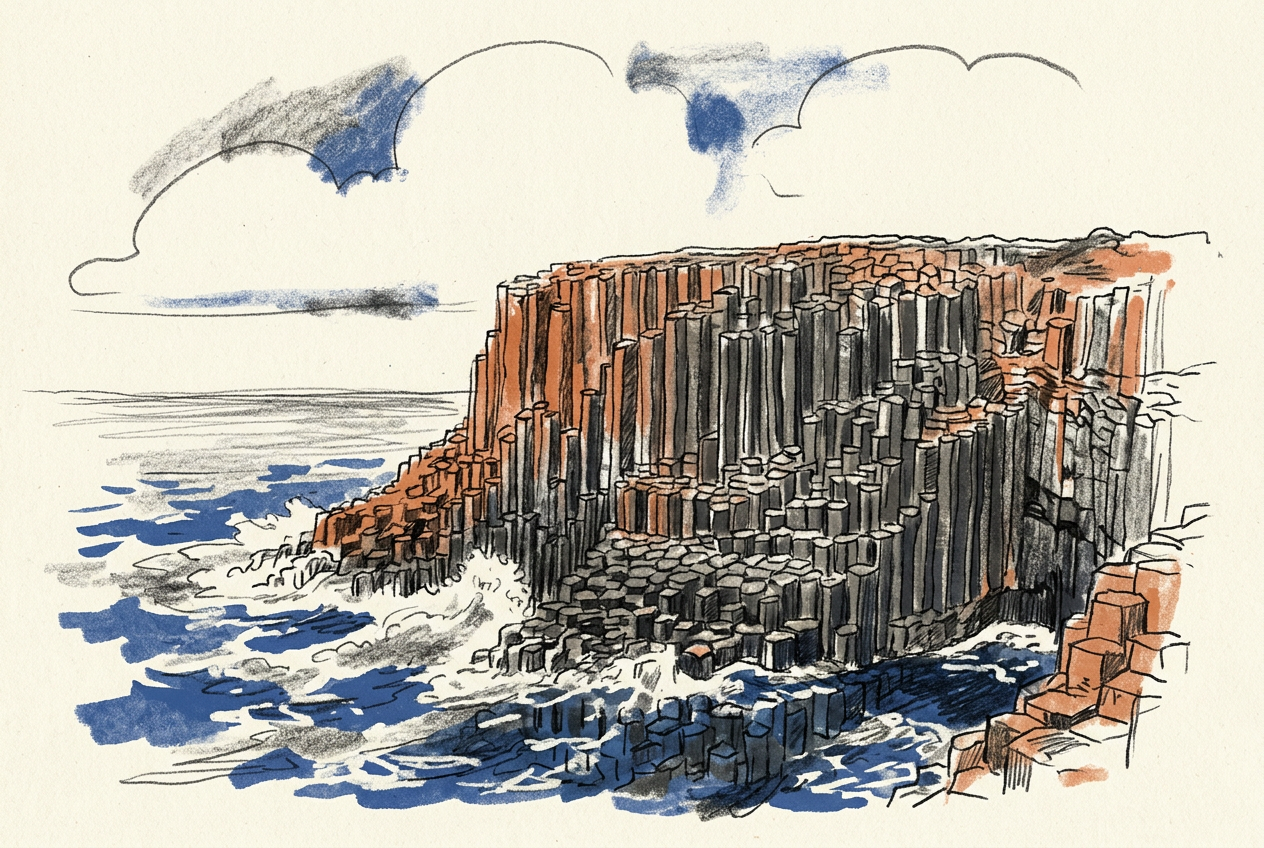
At Cape Raoul, on the Tasman Peninsula, the cliffs do not crumble. They stand in ranks, each face a near-perfect hexagon, stacked like organ pipes sixty metres high. The Southern Ocean drives against them at the same angle it has for millennia, and the basalt columns answer with silence.
This is not the work of a slow, patient uplift. It is the aftermath of a single, sustained event: a flood basalt eruption that buried this corner of Tasmania some 55 million years ago, near the boundary of the Paleocene and Eocene.
The Cooling Geometry
When basalt lava pours out across a landscape, it does not cool evenly. The surface chills first, forming a brittle crust. Beneath, the still-molten interior contracts as it solidifies, and contraction creates stress. In a homogenous body of cooling basalt, that stress distributes itself at 120-degree angles—the most efficient way to release tension in a plane. The result is a network of hexagonal fractures that propagate downward as the rock cools, like mud cracks in a dry lake bed but scaled to the height of buildings.
At Cape Raoul, those columns are among the tallest in Australia. They are not unique—similar formations occur at the Giant's Causeway in Ireland, at Devil's Tower in Wyoming, and along the Organ Pipes in Victoria. But Tasmania's coastal setting gives them a particular clarity. The sea has undercut the cliff base, exposing columns from their pedestal upward, so that the full vertical register of the cooling process is visible in a single glance.
The Rift That Delivered the Lava
The eruption that produced these columns was not an isolated event. It belonged to a broader episode of volcanism that affected southeastern Australia during the early Cenozoic, as the Australian plate began its northward drift after separating from Antarctica. The Tasmanian flood basalts are part of the same province that built the Barrington Tops shield volcanoes and the basalt plains of western Victoria.
Geologists classify these as intraplate basalts—magma that rose through fractures in the continental crust rather than at a plate boundary. The source lay deep, in mantle plumes that welled up as the continent stretched and thinned. At Cape Raoul, the lava filled an existing river valley, then cooled in place. The valley walls acted as a mould, concentrating the cooling stresses into the vertical columns we see today.
The columns are not carved by wind or water. They are the fossilised geometry of heat leaving stone.
Weathering Into Architecture
Once the columns formed, the work of exposure began. Over tens of millions of years, the softer sedimentary rocks that once surrounded the basalt eroded away. The columns, harder and more resistant, remained as a rampart against the sea.
But basalt is not immune to weathering. The same columnar joints that make the cliffs so visually striking also provide pathways for water. Rain seeps into the cracks; winter frost expands them. Salt spray from the Southern Ocean corrodes the rock face grain by grain. In some sections, entire columns have toppled, their fractured ends lying in the surf like felled timber.
At the base of the cliffs, where wave action has scoured a platform, the columns end abruptly in a smooth pavement. Walking on that pavement is to walk on the horizontal cross-section of an ancient cooling front—a surface that was once the interface between molten rock and solid stone.
The Living Edge
The Tasman Peninsula is one of the few places in Australia where columnar basalt meets a temperate rainforest climate. Above the cliffs, the plateau supports stands of blue gum and stringybark, their roots gripping the shallow soil that has accumulated in the joints between columns. Below, the intertidal zone hosts a different kind of life: bull kelp, abalone, and the slow grazing of sea urchins on the encrusting algae that stain the basalt green.
The contrast is sharp. The columns themselves are among the most rigid structures in nature—cooling fractures fixed in stone fifty million years ago. But the life that clings to them is in constant motion, responding to tides, storms, and the slow creep of the Australian plate northward at about seven centimetres per year.
At Cape Raoul, the columns do not move. But the continent they are anchored to is still travelling, and the Southern Ocean is still cutting at their base. The geometry will hold for a while yet.
More like this
- The 110-Million-Year-Old River That Runs Backwards UndergroundWestern Australia's 110-million-year-old dune system has been slowly dissolving into a labyrinth of caves where an ancient river still flows, carrying the taste of a Cretaceous desert.
- The 5,000-Year-Old Volcanoes That Still Smoke in the SouthIn Victoria's Newer Volcanics Province, 400 volcanic vents erupted as recently as 5,000 years ago—the youngest volcanic field in mainland Australia, where craters still hold blue lakes and scoria cone
- The 300-Million-Year-Old Forest That Died Standing UpIn New South Wales, a 300-million-year-old fossil forest preserves dozens of trees buried upright by a Permian volcanic eruption—an entire ecosystem frozen in ash.