9 May 2026 · 3 min read
The Diamond Sands: The Zircon Grains of the Jack Hills
In Western Australia's Jack Hills, 4.4-billion-year-old zircon crystals—the oldest known terrestrial material—preserve a record of Earth's first continents and a cool, wet surface only 150 million yea
In the Murchison district of Western Australia, a low range of folded quartzite and conglomerate rises from red dust and spinifex. Nothing about the Jack Hills looks extraordinary. But within these ancient sediments are sand grains older than any rock on Earth—crystals that formed before the planet had continents, before the moon had fully settled into its orbit.
The grains are zircons. Each one is smaller than a grain of rice, dense, durable, and nearly indestructible. They have survived four billion years of erosion, burial, metamorphism, and exhumation, carried like messages in bottles through deep time.
The Oldest Thing on Earth
In 2001, a team led by Simon Wilde of Curtin University extracted a single zircon crystal from a conglomerate bed in the Jack Hills. Uranium-lead dating gave it an age of 4.404 billion years—plus or minus eight million years. That crystal formed just 160 million years after the solar system's own birth, when Earth was still a molten body colliding with planetesimals.
The crystal itself is unremarkable to look at: a stubby prism, translucent, about the width of a human hair. But its oxygen isotope ratios tell a startling story. The ratio of oxygen-18 to oxygen-16 in that grain matches what geochemists expect from rocks that have interacted with liquid water at low temperatures. This suggests that by 4.4 billion years ago, Earth already had oceans and a cool crust—not the hellish steam-bath that earlier models assumed.
One zircon, two hundred micrometres long, and the entire narrative of the Hadean Eon had to be rewritten.
How to Survive an Eon
Zircon (ZrSiO₄) is a nesosilicate mineral that forms in cooling granite magmas. Its crystal structure readily incorporates uranium atoms while excluding lead—a property that makes it an ideal natural clock. Over time, uranium decays to lead at a known rate, and by measuring the ratio, geochronologists can calculate the crystal's age with remarkable precision.
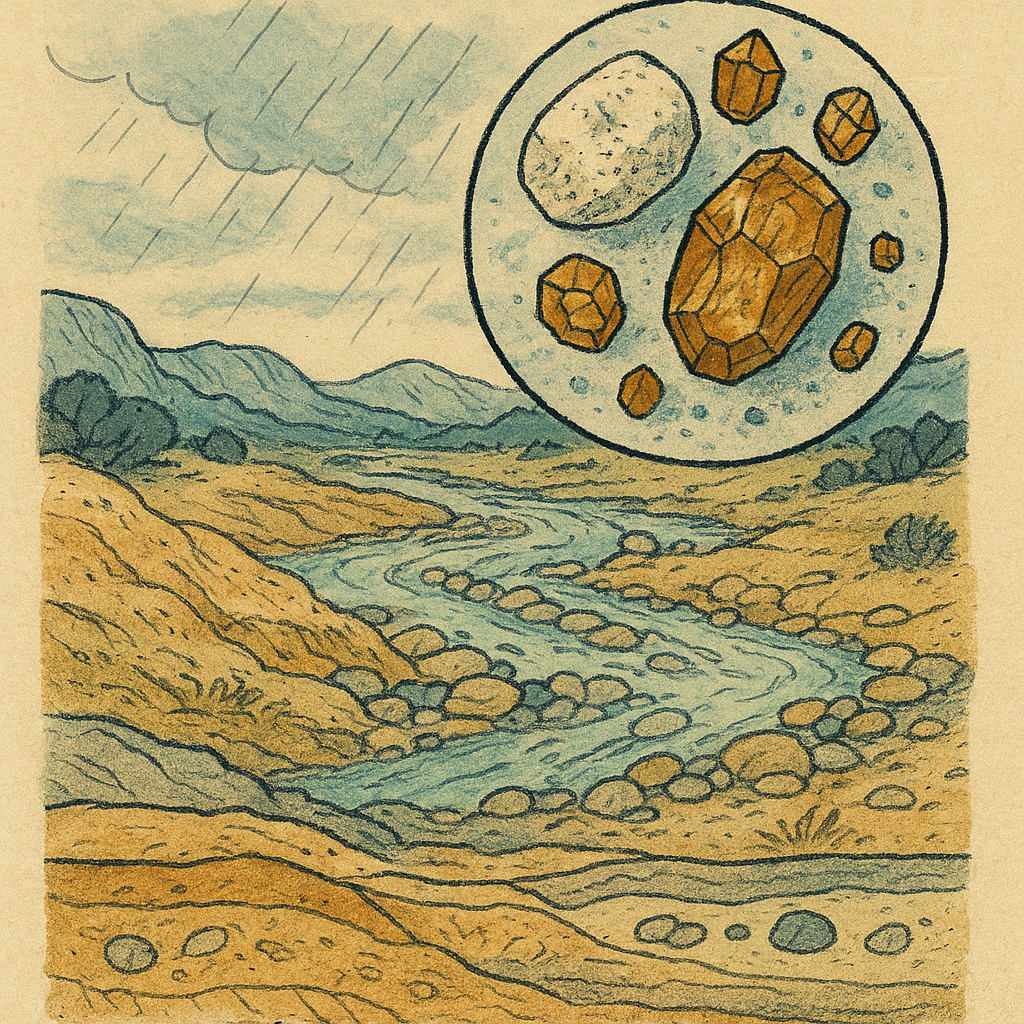
What makes the Jack Hills zircons exceptional is not just their age but their survival. The host rock—the Jack Hills belt itself—is a metasedimentary sequence folded and metamorphosed during the Archean, roughly 3.0 to 2.6 billion years ago. The zircons were eroded from even older granites, deposited as sand grains in ancient riverbeds, then buried, heated, squeezed, and eventually exhumed again. A less durable mineral would have recrystallised or dissolved. Zircon simply endured.
What the Grains Reveal
The Jack Hills zircons have been studied intensively for two decades, and each analysis adds a new detail to the portrait of early Earth. Trace element compositions suggest the parent magmas were granitic—the kind of rock that forms when wet oceanic crust melts above a subduction zone. That implies plate tectonics, or something like it, was operating within the first half-billion years of Earth's history.
Some zircons contain tiny inclusions of other minerals: quartz, feldspar, even muscovite mica. These inclusions are the only surviving fragments of Earth's first continental crust, a crust that has since been completely recycled into the mantle. The Jack Hills grains are its last witnesses.
Not all the data is straightforward. Some zircons show evidence of metamictisation—radiation damage that can disturb the isotopic clock. Others may have been reworked, their ages reset by later thermal events. The scientific literature is thick with debate over how much confidence to place in any single crystal. But the broad picture is now widely accepted: Earth had a cool, wet surface and possibly even continents far earlier than anyone suspected before 2001.
A Broader Archive
The Jack Hills are not the only source of ancient zircons in Australia. Similar grains have been found in the Mount Narryer region, about 60 kilometres to the south, and in the Yilgarn Craton's older metasedimentary belts. But the Jack Hills remain the type locality—the place where the oldest known terrestrial material was found, and where the search continues.
Each wet season, rain washes fresh grains from the quartzite conglomerates into the gullies. Geologists return year after year, sieving the gravel, picking through the heavy mineral concentrates under binocular microscopes, looking for the next grain that might push the record back another million years.
The Jack Hills themselves will not last. The range is eroding, slowly planing down toward the peneplain that awaits all old mountains. But the zircons it releases will survive that erosion, too. They will settle into new sediments, be buried again, and wait. They have been waiting for four billion years already. A few million more makes no difference.
More like this
- The 560-Million-Year-Old Garden That Never Saw a PredatorIn South Australia's Flinders Ranges, 560-million-year-old Ediacara surfaces preserve entire seafloor communities of fronds, discs, and quilts — a garden of soft-bodied life that flourished before pre
- The 1.75-Billion-Year-Old Reef That Outranks the BarrierA 1.75-billion-year-old microbial reef in the Kimberley is the largest biological structure ever built by a single species, preserving a world without predators.
- The 3.5-Billion-Year-Old Cones That Still Catch LightIn the Pilbara's Dresser Formation, 3.5-billion-year-old stromatolites preserve the oldest direct evidence of life on Earth—microbial mats that built layered domes in a volcanic caldera.