17 June 2026 · 3 min read
The Reef That Rose from a Drowned Continent: Western Australia's Ningaloo Coast
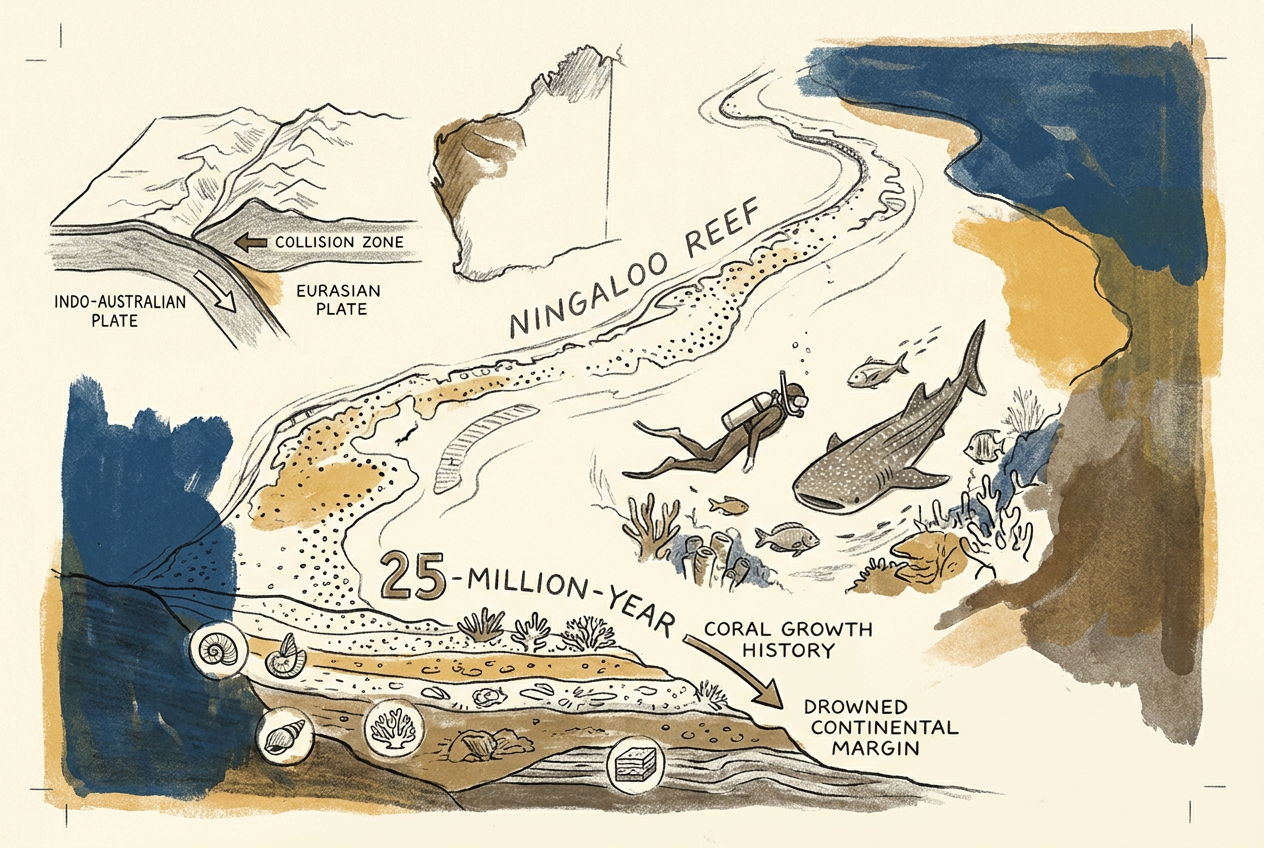
How a 250-kilometre fringing reef along Western Australia's Cape Range records the collision of the Indo-Australian plate and a 25-million-year history of coral growth on a drowned continental margin.
From the air, the colour shift is abrupt: the deep indigo of the Indian Ocean gives way to turquoise, then to white foam breaking over calcified ramparts. This is Ningaloo Reef, a 250-kilometre-long fringing reef that hugs the western edge of Australia's Cape Range peninsula. Unlike the Great Barrier Reef, which sits on a submerged continental shelf far from land, Ningaloo grows directly against the shore—a living veneer on a drowned landscape.
The Drowned Edge of a Continent
The Cape Range itself is a remnant of an older Australia. The limestone that forms its spine was laid down as marine sediment during the Miocene, between 25 and 5 million years ago, when sea levels were higher and the continent's western margin lay underwater. As the Indo-Australian Plate moved northward, it rode over a bulge in the Earth's mantle—the Cape Range Anticline—tilting the ancient seabed upward. What had been ocean floor became a limestone ridge, and what had been the continental slope became a shelf just offshore.
That shelf is shallow, warm, and nutrient-poor—ideal conditions for coral growth. But Ningaloo's position is unusual: the continental shelf here is almost nonexistent. In most places, the seafloor drops steeply into the abyss within a few kilometres of the beach. The reef clings to this narrow margin, its outer edge falling away into water hundreds of metres deep. This proximity to deep ocean is what makes Ningaloo ecologically distinct; it brings cold, nutrient-rich currents close enough to feed the reef without overwhelming it.
A Fossil Record in Living Tissue
Coral reefs are among the most information-dense geological archives on Earth. Each coral colony lays down annual growth bands, like tree rings, that record sea-surface temperature, salinity, and turbidity. Ningaloo's living corals contain a continuous record of the past several centuries, but the reef sits atop a much older foundation. Beneath the living polyps lies a platform of Pleistocene reef limestone, built during the last interglacial period, around 125,000 years ago, when sea levels were several metres higher than today.
The reef is both a living organism and a fossil, its present generation growing on the skeletons of ancestors that died before modern humans left Africa.
Drill cores taken from the reef flat have revealed layers of ancient coral that grew during earlier warm periods, then were exposed and eroded when sea levels dropped during glacial maxima. The reef has been built, destroyed, and rebuilt many times over the past half-million years, each cycle recorded in the limestone beneath the sand.
The Point of Contact
Ningaloo's most dramatic geological feature is not the reef itself but the contact between the reef and the continent. At the northern end of the peninsula, the Cape Range meets the sea in a series of steep cliffs and wave-cut platforms. Here, the limestone of the range is directly overlain by the reef—a rare exposure of the boundary between ancient and modern.
Walking along the shore at low tide, one can see the unconformity: the tilted, eroded surface of Miocene limestone, with its fossils of seashells and foraminifera, capped by the porous, honeycombed limestone of the Holocene reef. The gap in time between the two layers is about 5 million years—a missing chapter that records the uplift of the range, the drying of the continent, and the arrival of the modern ocean circulation.
The Slow Machinery of Reef Building
Ningaloo's corals grow slowly, about one to two centimetres per year for the massive Porites colonies that form the reef's structural backbone. Over centuries, these colonies build into microatolls—doughnut-shaped structures that record sea-level changes in their growth rings. Geologists have used these microatolls to reconstruct relative sea-level changes along the Western Australian coast over the past 6,000 years, finding that the land has been slowly rising as the continental margin adjusts to the weight of the reef.
That adjustment is ongoing. The Indo-Australian Plate continues its northward drift at about seven centimetres per year, and the Cape Range Anticline is still rising. The reef responds to these movements by growing upward and outward, maintaining its position in the narrow zone where light, temperature, and water chemistry permit coral growth. It is a dynamic equilibrium between biology and tectonics—a living formation that records, in its skeleton, the slow dance of a continent with the planet's shifting climate.
More like this
- The 110-Million-Year-Old River That Runs Backwards UndergroundWestern Australia's 110-million-year-old dune system has been slowly dissolving into a labyrinth of caves where an ancient river still flows, carrying the taste of a Cretaceous desert.
- The 5,000-Year-Old Volcanoes That Still Smoke in the SouthIn Victoria's Newer Volcanics Province, 400 volcanic vents erupted as recently as 5,000 years ago—the youngest volcanic field in mainland Australia, where craters still hold blue lakes and scoria cone
- The 560-Million-Year-Old Garden That Never Saw a PredatorIn South Australia's Flinders Ranges, 560-million-year-old Ediacara surfaces preserve entire seafloor communities of fronds, discs, and quilts — a garden of soft-bodied life that flourished before pre