17 June 2026 · 4 min read
The Ash That Buried a Garden of Giants: Tasmania's Mount Read Volcanic Belt
How 500-million-year-old submarine volcanoes in western Tasmania built a massive deposit of copper, lead, zinc, gold, and silver—one of Earth's richest volcanic-hosted massive sulphide systems.
On the west coast of Tasmania, a ridge of dark volcanic rock runs north–south for about 200 kilometres. It looks unremarkable—scrubby hills and steep gullies, rain-soaked and quiet. But inside that rock is one of the densest concentrations of metal on the planet: copper, lead, zinc, gold, and silver, all deposited by a chain of submarine volcanoes that erupted half a billion years ago.
A Seafloor Chimney System
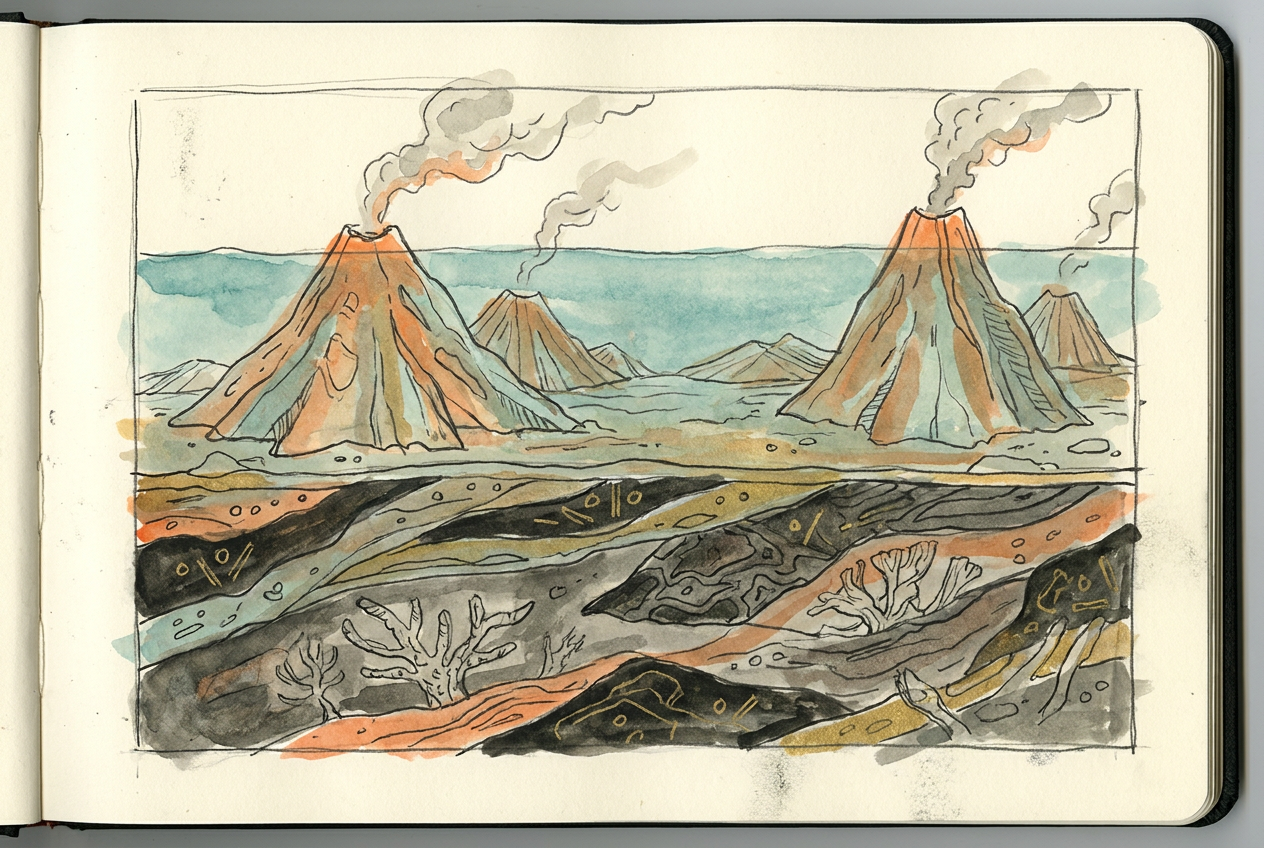
In the Cambrian Period, around 500 million years ago, Tasmania did not exist as an island. It was a fragment of volcanic arc, a chain of underwater volcanoes similar to today's Tonga–Kermadec system, sitting in a deep ocean off the edge of the Gondwana supercontinent.
Seawater seeped into the hot volcanic crust, was heated by magma, and rose back toward the seafloor as superheated brine. When that brine met cold ocean water, the dissolved metals precipitated instantly—forming chimneys of sulphide minerals, black smokers that built up into mounds and sheets on the seafloor. Layer after layer, eruption after eruption, the system grew.
Today, those ancient seafloor deposits are known as the Mount Read Volcanic Belt. They include some of the richest volcanic-hosted massive sulphide (VHMS) deposits ever found: the Rosebery mine, the Hellyer deposit, the Que River, and the Mount Lyell copper field.
The Rosebery deposit alone has produced more than 20 million tonnes of ore, with grades that would make most modern miners weep.
A Landscape of Rust and Rain
The Mount Read Volcanic Belt is not a single mountain but a complex of altered volcanic rocks—rhyolite, dacite, andesite, and basalt—all metamorphosed and deformed by later tectonic collisions. The original minerals have been recrystallised, the sulphide bodies folded and sheared. Yet the metal remains.
At Mount Lyell, on the southern end of the belt, copper was mined for more than a century. The open pit at Queenstown is a scar of orange and grey, the surrounding hills stripped of vegetation by acid rain from smelter emissions. It is an ugly landscape, but an honest one: it shows exactly what it cost to extract the metal.
Further north, the Rosebery mine operates underground, extracting zinc, lead, copper, gold, and silver from a sulphide lens that dips steeply into the earth. The ore is fine-grained, banded, and dark—what miners call "black ore." It was deposited as a seafloor sediment, layer by layer, in the quiet intervals between volcanic eruptions.
The Long Journey to the Surface
What makes the Mount Read belt remarkable is not just the quantity of metal, but the variety. A single deposit can contain economic grades of five or six different metals. This is because the hydrothermal system that fed the chimneys was not uniform: as the brine circulated through different rock types, it dissolved different elements, and as it cooled, they precipitated in sequence.
The metals came from the volcanic arc itself—from the leaching of fresh volcanic glass and the breakdown of minerals in the surrounding crust. The gold and silver were carried as chloride complexes; the copper, zinc, and lead as sulphide complexes. When the brine hit cold seawater, the temperature dropped, the complexes broke apart, and the metals fell out as solid sulphides.
It is a process that still happens today, on the mid-ocean ridges. But the Mount Read belt preserves a record of that process from a time when multicellular life was just beginning to diversify on Earth.
A Fragment of a Lost Ocean
The Mount Read Volcanic Belt did not stay on the seafloor. During the final assembly of Gondwana, around 490 million years ago, the volcanic arc was thrust onto the edge of the continent. It was folded, faulted, and uplifted, becoming part of what is now western Tasmania.
Erosion has since stripped away the upper parts of the volcanic pile, exposing the deeper sections where the sulphide deposits are richest. The chimneys themselves are gone, but the massive sulphide lenses remain—compressed, recrystallised, but still carrying the chemical signature of that ancient hydrothermal system.
Today, the belt is one of the most studied volcanic-hosted massive sulphide districts in the world. Geologists use it as a model for exploring similar deposits on other continents, and even on Mars, where ancient volcanic rocks may preserve evidence of hydrothermal activity.
But for the casual observer, the Mount Read belt offers something simpler: a reminder that the ground beneath our feet is not solid and still, but a frozen moment of a planet that was once molten, mobile, and alive with chemical energy. The metal in a smartphone, the copper in a wire, the gold in a wedding band—some of it may have come from a black smoker on a Cambrian seafloor, 500 million years ago, in a place that is now a wet, quiet ridge in western Tasmania.
More like this
- The 5,000-Year-Old Volcanoes That Still Smoke in the SouthIn Victoria's Newer Volcanics Province, 400 volcanic vents erupted as recently as 5,000 years ago—the youngest volcanic field in mainland Australia, where craters still hold blue lakes and scoria cone
- The 300-Million-Year-Old Forest That Died Standing UpIn New South Wales, a 300-million-year-old fossil forest preserves dozens of trees buried upright by a Permian volcanic eruption—an entire ecosystem frozen in ash.
- The 1.85-Billion-Year-Old Caldera That Still Feeds the FurnaceIn South Australia's Middleback Ranges, a 1.85-billion-year-old volcanic caldera collapsed and later became one of the world's richest iron ore deposits.