18 June 2026 · 2 min read
The Coal That Burned for 6,000 Years: New South Wales' Burning Mountain
How a smouldering coal seam beneath Mount Wingen in New South Wales has been on fire for 6,000 years, creating one of the world's oldest known natural coal fires.
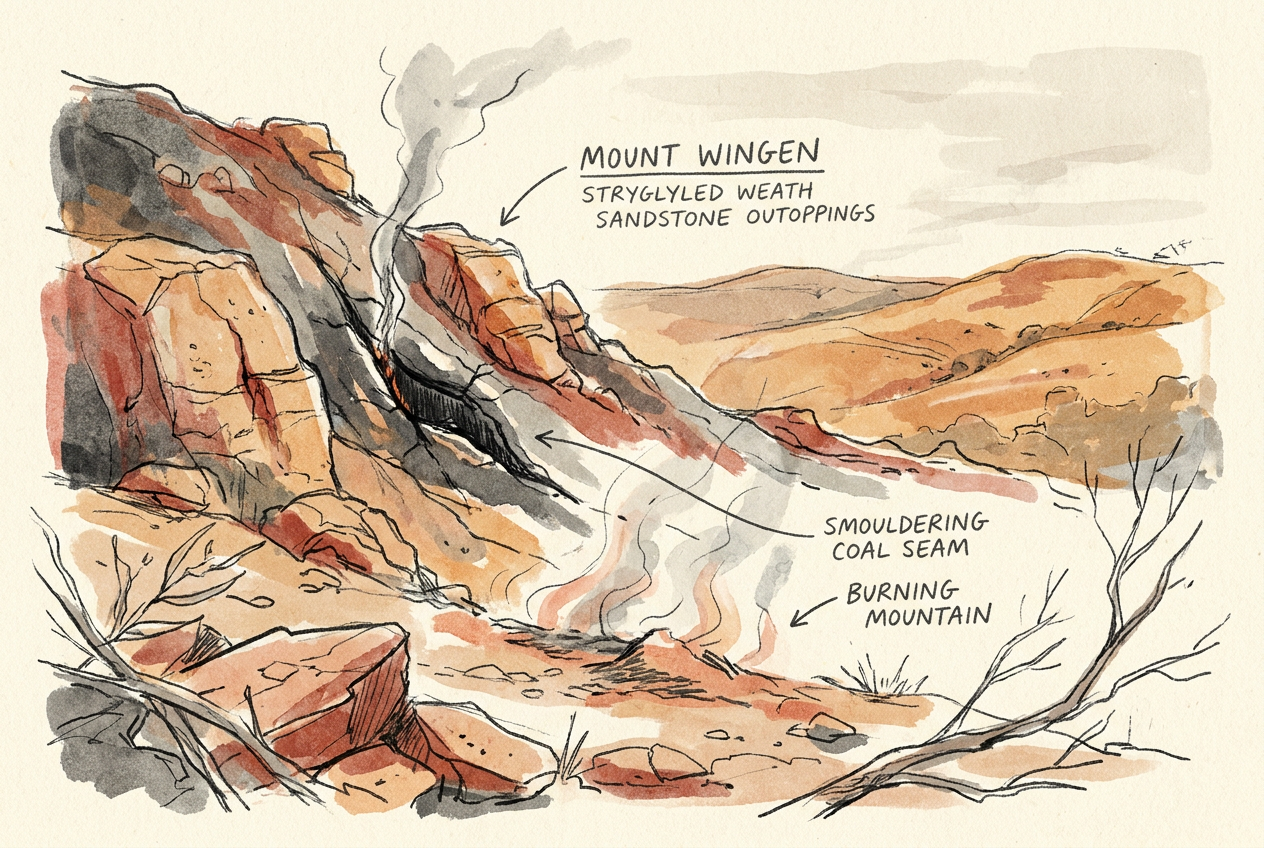
Forty kilometres north-west of Singleton, New South Wales, a mountain has been on fire for 6,000 years. Smoke seeps from fissures in the hillside. The ground is hot to the touch. Below, a coal seam three metres thick has been smouldering since before the pyramids were built.
A Fire That Moves Underground
Mount Wingen—Wonnarua for "fire"—sits above a Permian coal seam that ignited around 4,000 BCE. The fire advances roughly one metre per year through the seam, burning at temperatures between 1,000 and 1,200 degrees Celsius. As the coal is consumed, the overlying sandstone collapses into the void, creating a slow, deliberate subsidence that reshapes the ridge.
The smoke that rises from the fissures is not ordinary woodsmoke. It carries sulphur, arsenic, and mercury—elements the coal absorbed from ancient peat swamps 250 million years ago, when Australia lay near the South Pole. The Permian coal measures of the Sydney Basin were laid down in cold-climate swamps, not tropical ones. This is Antarctic coal, baked by an accidental fire.
The combustion is sustained by oxygen drawn through cracks in the rock. Rainwater percolating into the hot zone turns to steam. The steam accelerates the burn. It is a positive feedback loop that has operated for six millennia.
The Geology of a Slow Explosion
The coal seam at Burning Mountain belongs to the Greta Coal Measures, deposited during the Permian when eastern Australia was part of the supercontinent Gondwana. The seam is remarkably pure—low in ash, high in carbon—which is why it burns so steadily. Impure coal would choke on its own residue.
As the fire consumes the seam, it bakes the surrounding rock into a brick-red material called clinker. The sandstone above is metamorphosed into a natural ceramic, hard as tile. Walking across the mountain, you crunch over this fired rock. It looks like pottery waste.
The mountain is a kiln. Its walls are the vessels. The fire has been firing them for 6,000 years.
Sintered rock, fused glass, and crystallised minerals line the vents. Sulphur crystals bloom yellow at the fumaroles. Realgar—a red arsenic sulphide—forms where the gases cool. The mineral assemblage is identical to that of an active volcanic fumarole, but the heat source is a coal seam, not magma.
A Record of Unnatural Fire
Natural coal fires are rare. Most require a specific trigger: lightning strike, bushfire, spontaneous combustion in a thick seam exposed by erosion. Burning Mountain is one of perhaps a dozen such fires known worldwide, and one of the oldest. The Centralia mine fire in Pennsylvania has burned since 1962; this one has burned for 6,000 years.
The Wonnarua people knew the mountain was burning long before Europeans arrived. They used the ochre from the fired clays for ceremonial painting and avoided the hot ground. When European settlers came in the 1820s, they mistook the smoke for a volcanic eruption. It took geologists decades to understand that the heat came from coal, not magma.
Today the fire continues its slow advance. Monitoring boreholes measure temperature gradients. Satellite imagery tracks the subsidence. But no one can stop it. The seam is too deep, the fire too old, the mountain too patient. Burning Mountain will keep burning until the coal runs out—perhaps for another 10,000 years.
More like this
- The 110-Million-Year-Old River That Runs Backwards UndergroundWestern Australia's 110-million-year-old dune system has been slowly dissolving into a labyrinth of caves where an ancient river still flows, carrying the taste of a Cretaceous desert.
- The 5,000-Year-Old Volcanoes That Still Smoke in the SouthIn Victoria's Newer Volcanics Province, 400 volcanic vents erupted as recently as 5,000 years ago—the youngest volcanic field in mainland Australia, where craters still hold blue lakes and scoria cone
- The 1.75-Billion-Year-Old Reef That Outranks the BarrierA 1.75-billion-year-old microbial reef in the Kimberley is the largest biological structure ever built by a single species, preserving a world without predators.