10 July 2026 · 3 min read
The 5,000-Year-Old Volcanoes That Still Smoke in the South
In Victoria's Newer Volcanics Province, 400 volcanic vents erupted as recently as 5,000 years ago—the youngest volcanic field in mainland Australia, where craters still hold blue lakes and scoria cone
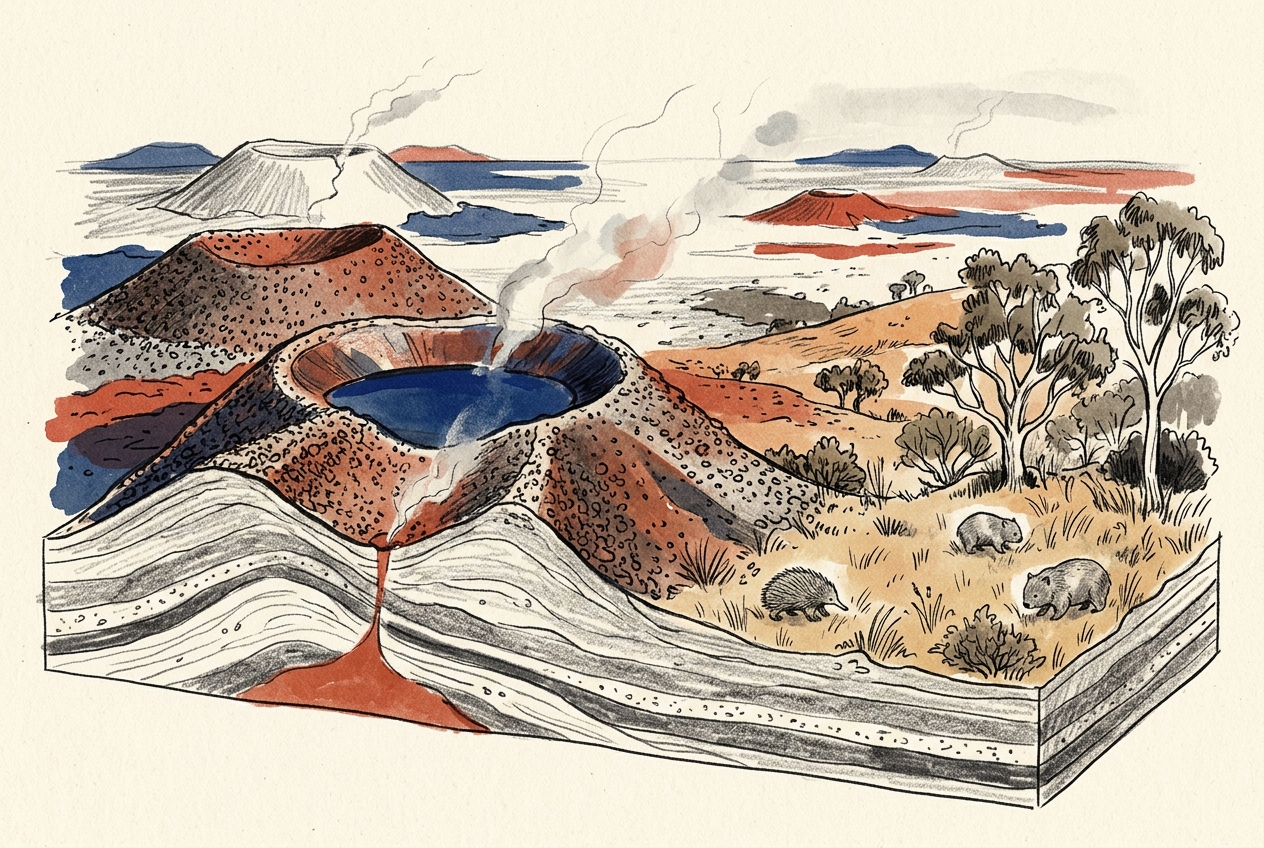
From a distance, Mount Gambier looks like any low hill on the Limestone Coast. But its summit hides a crater lake so blue it seems artificial, and the ground beneath it remembers fire only five thousand years old. Across western Victoria and into South Australia, four hundred volcanic vents mark the Newer Volcanics Province—the youngest volcanic field on the Australian mainland, and one of the most recent expressions of the continent's restless interior.
A Continent Still Settling
Australia is often called the oldest continent, its ancient cratons dating back three billion years. But the Newer Volcanics Province tells a different story. These volcanoes began erupting only five million years ago, and the most recent—Mount Gambier and Mount Schank—erupted within the last ten thousand years. By geological standards, that is yesterday.
The province covers 15,000 square kilometres, a patchwork of scoria cones, lava flows, and maar craters scattered across the volcanic plains west of Melbourne. Unlike the towering stratovolcanoes of the Pacific Ring of Fire, these are small, monogenetic volcanoes—each vent erupts once, briefly, then falls silent forever. The landscape they left behind is not a single mountain but a scatter of low, dark hills and circular lakes, each one a record of a single violent hour.
Mount Elephant, near Derrinallum, rises 380 metres above the plain—a perfect cone of scoria that locals call the 'volcano that built itself in a day.' Its symmetry is the signature of a single sustained eruption, probably lasting weeks or months, that piled red and black cinders around a central vent.
Lakes Where the Ground Exploded
The most dramatic features of the province are its maar lakes—craters formed not by lava but by steam. When rising magma met groundwater, the water flashed to steam and exploded, blasting a circular pit into the limestone bedrock. These craters later filled with water, creating deep, sheltered lakes.
Lake Bullen Merri, near Camperdown, is a maar lake 70 metres deep, its steep walls lined with basalt and volcanic ash. The water is so clear that sediment cores from its floor have given scientists a continuous climate record stretching back tens of thousands of years—pollen grains, charcoal from ancient fires, and the shells of tiny organisms that lived in its cold depths.
The Blue Lake of Mount Gambier is perhaps the most famous. Every November, its water turns from grey to vivid turquoise, a seasonal shift caused by calcium carbonate particles scattering sunlight. The crater that holds it was formed 5,000 years ago, when the last eruption in mainland Australia tore a hole in the earth.
The Flows That Built the Plains
Not all the violence was explosive. Much of the province is covered by basalt lava flows that spread across the landscape like slow, black rivers. The Stony Rises, near Colac, are a jumbled field of 'aa' lava—rough, clinkery basalt that crusted over as it cooled, creating a terrain so jagged that early settlers could barely cross it on foot.
These flows buried ancient river valleys, diverted drainage, and created the rich volcanic soils that now support Victoria's dairy and wine industries. The basalt itself is alkaline, rich in olivine and pyroxene, and its weathering releases nutrients that feed the pasture.
But the flows also preserved what they buried. Beneath the lava, archaeologists have found the bones of Diprotodon and other Pleistocene megafauna—animals that grazed these plains before the volcanoes woke. The lava sealed their remains in a time capsule of stone.
A Province That Holds Its Breath
The Newer Volcanics Province is not extinct. It is dormant. The same mantle processes that fed these eruptions are still active beneath southeastern Australia. Geologists measure subtle uplift, monitor gas emissions, and note that the last eruption—at Mount Gambier—is recent enough to be remembered in Aboriginal oral traditions.
No one knows when the next vent will open. It could be tomorrow, or ten thousand years from now. When it comes, it will probably be small—a single cone, a lake of steam, a flow of basalt that covers a few square kilometres of farmland. But it will be a reminder that the oldest continent on Earth is not finished yet.
More like this
- The 110-Million-Year-Old River That Runs Backwards UndergroundWestern Australia's 110-million-year-old dune system has been slowly dissolving into a labyrinth of caves where an ancient river still flows, carrying the taste of a Cretaceous desert.
- The 300-Million-Year-Old Forest That Died Standing UpIn New South Wales, a 300-million-year-old fossil forest preserves dozens of trees buried upright by a Permian volcanic eruption—an entire ecosystem frozen in ash.
- The 1.75-Billion-Year-Old Reef That Outranks the BarrierA 1.75-billion-year-old microbial reef in the Kimberley is the largest biological structure ever built by a single species, preserving a world without predators.