18 June 2026 · 3 min read
The Reef That Became a Mountain of Sapphire: New South Wales' Cudgegong Gemfields
: How 400-million-year-old volcanic heat transformed a Devonian limestone reef in central New South Wales into sapphire, diamond, and zircon deposits that still yield gemstones today.
Some of the world's finest sapphires come not from Sri Lanka or Madagascar but from a patch of scrubby farmland near the New South Wales town of Cudgegong, where 400-million-year-old volcanic pipes punched through an ancient coral reef and cooked it into gemstone.
The Reef Beneath the Plains
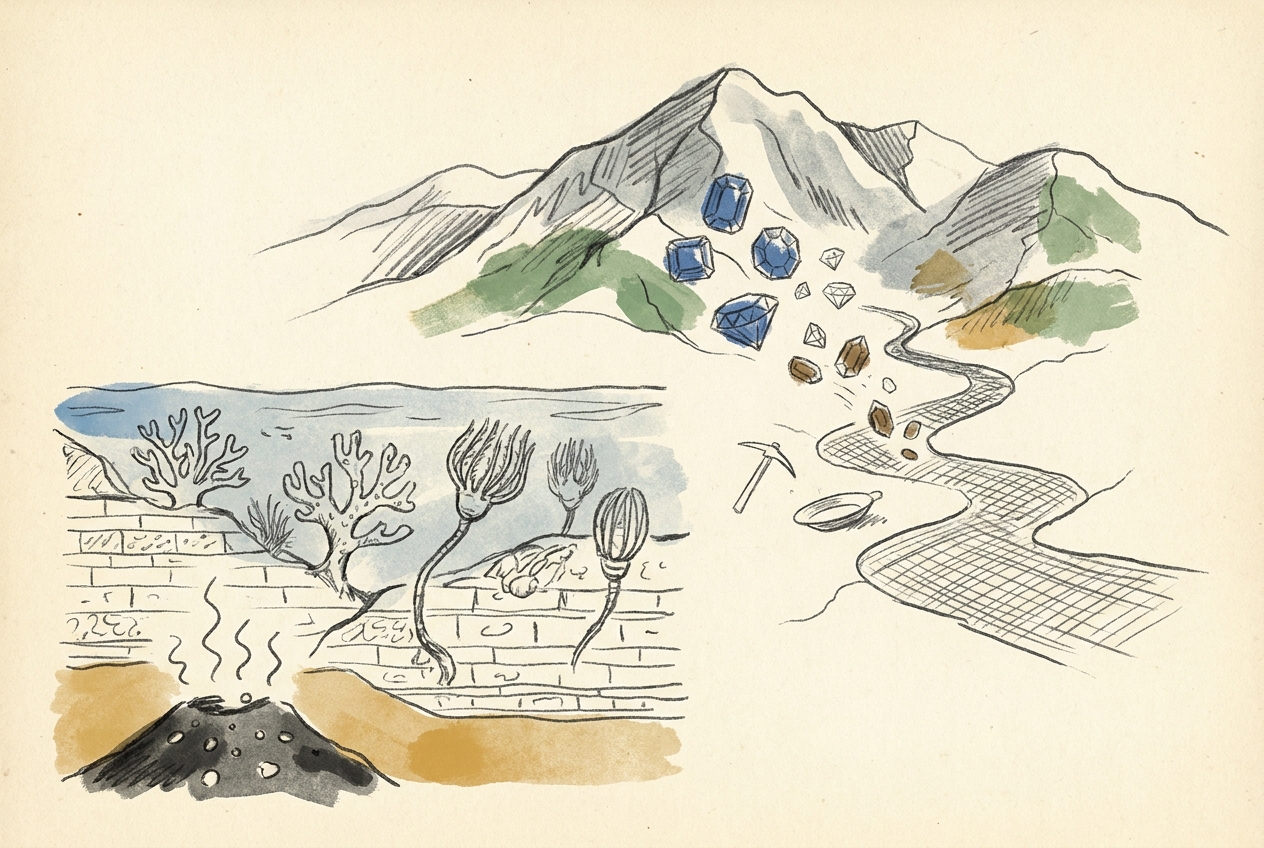
In the Devonian period, when the first forests were spreading across the continents, central New South Wales lay under a shallow tropical sea. Coral reefs grew in that warm water, building thick limestone platforms studded with marine life. Those reefs are long gone, but their ghost remains in the geology: a band of Silurian-Devonian limestone that runs beneath the modern landscape.
About 400 million years later, during the Tertiary period, a series of volcanic eruptions broke through this limestone basement. The magma that rose was not the runny basalt of Hawaii but a silica-rich, alkaline brew that carried dissolved trace elements—chromium, iron, titanium, and beryllium. As the magma cooled deep underground, these elements crystallised into corundum (sapphire and ruby), spinel, zircon, and even the occasional diamond.
The eruptions did not build dramatic cones. They produced diatremes—volcanic pipes that blasted through the limestone, mixing fragments of the reef with sapphire-bearing magma in a chaotic breccia. Over millions of years, the softer limestone weathered away, leaving the harder gemstones concentrated in the soils and creek beds above.
A Landscape of Gem Gravels
The Cudgegong gemfields stretch across about 50 square kilometres of rolling hills and creek valleys near the towns of Cudgegong, Gulgong, and Mudgee—a region better known for wine than for its underground riches. The gemstones are not mined from hard rock but from alluvial gravels: ancient river channels that carried sapphires, zircons, and diamonds downstream from the weathered volcanic pipes.
Miners work these gravels with small-scale operations: a backhoe, a washing plant, a keen eye. The sapphires range from pale blue to deep cornflower, with occasional green, yellow, and parti-coloured stones. Some are heat-treated to deepen their colour; others are sold as "Australian sapphires" in their natural state. The diamonds are small—rarely more than a carat—but they are genuine, and they have been found in these gravels for over a century.
What makes the Cudgegong sapphires distinctive is their colour zoning. Under a loupe, many stones show bands of blue and green and yellow, as if the crystal recorded the changing chemistry of the magma chamber as it grew. Each stone is a time capsule of that ancient volcanic event.
A single sapphire crystal from Cudgegong may contain the entire history of its formation: the chromium that made it pink, the iron that made it green, the titanium that turned it blue—all layered in the same stone.
The Deeper Story
The Cudgegong gemfields belong to a family of sapphire deposits that occur along the eastern margin of Australia, from Queensland's Anakie fields down to the New England region of New South Wales. All of them share a common origin: the rifting that tore Australia away from Antarctica about 100 million years ago, followed by a pulse of volcanic activity that lasted well into the Tertiary.
As the continent stretched and thinned, magma rose from the mantle along deep fractures. Where that magma encountered limestone or other aluminium-rich rocks, it picked up the ingredients needed to form corundum. The sapphires of Cudgegong are therefore not just pretty stones; they are evidence of a continent breaking apart, of mantle plumes and crustal melting, of the slow dance of plate tectonics that continues to shape Australia's eastern seaboard.
Today, the gemfields are quiet. A few small mines operate, mostly on weekends. The creeks run clear over gravel beds that still hold sapphires, waiting for the next flood to wash them downstream. The landscape looks ordinary—paddocks, gum trees, a few weathered cutting sheds—but beneath the grass lies a reef that became a mountain of gemstones, cooked by volcanic heat and scattered across the plains by the slow work of water and time.
More like this
- The 5,000-Year-Old Volcanoes That Still Smoke in the SouthIn Victoria's Newer Volcanics Province, 400 volcanic vents erupted as recently as 5,000 years ago—the youngest volcanic field in mainland Australia, where craters still hold blue lakes and scoria cone
- The 560-Million-Year-Old Garden That Never Saw a PredatorIn South Australia's Flinders Ranges, 560-million-year-old Ediacara surfaces preserve entire seafloor communities of fronds, discs, and quilts — a garden of soft-bodied life that flourished before pre
- The 300-Million-Year-Old Forest That Died Standing UpIn New South Wales, a 300-million-year-old fossil forest preserves dozens of trees buried upright by a Permian volcanic eruption—an entire ecosystem frozen in ash.