9 May 2026 · 3 min read
The Petrified Forest: The Nullarbor’s Eocene Woodlands
Beneath the Nullarbor Plain's limestone crust lie fossilized Eocene woodlands, where 45-million-year-old tree stumps and pollen reveal a lush temperate forest that once stretched across a continent on
The Nullarbor Plain is a lie. From the air it appears as a featureless white slab, the largest single exposure of limestone on Earth, stretching 200,000 square kilometers across southern Australia. But beneath that flat crust—a Miocene marine limestone laid down when the sea lapped at the continent's edge—lies a different world entirely. Scattered across the surface and entombed within the rock are the fossilized remains of trees that stood here 45 million years ago, when this arid plateau was a lush, temperate rainforest.
The Eocene Forest
In the early Eocene, Australia was still connected to Antarctica. The climate was warm and wet, even at high latitudes. The Nullarbor region, then a low-lying coastal plain, was covered in dense forests dominated by Nothofagus—southern beech—along with podocarps, araucarians, and flowering plants whose modern relatives survive only in refugia along Australia's east coast and in New Guinea.
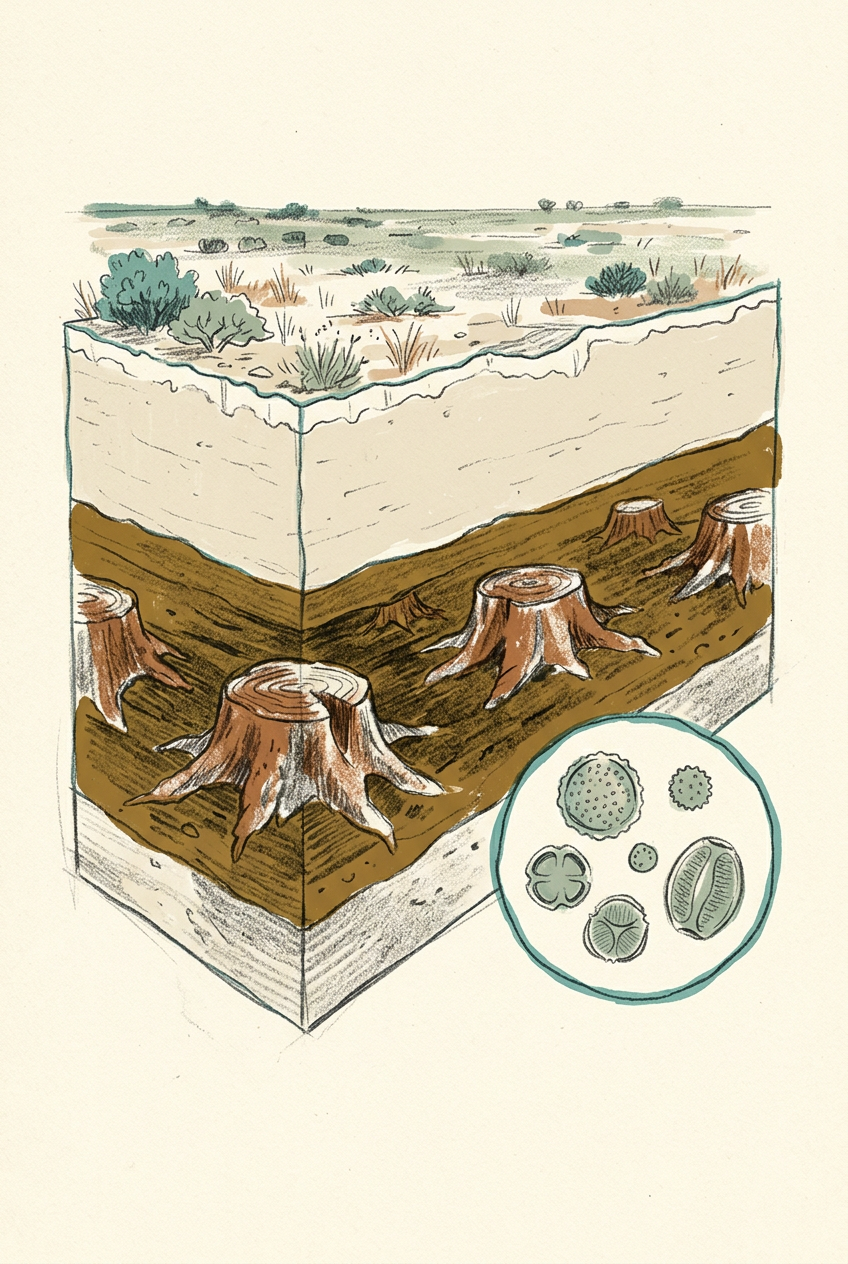
Fossil wood is scattered across the Nullarbor in remarkable abundance. At sites near Koonalda Cave and along the former cliffs of the Roe Plains, silicified tree stumps stand upright in the position where they grew, their root systems still penetrating the ancient soil horizon. The wood has been replaced by silica, preserving cellular structure in exquisite detail. Growth rings are visible, recording seasonal variations in a climate that had no frost but did experience periodic drought.
Pollen cores extracted from the Eucla Basin tell a consistent story. The Eocene Nullarbor supported a mixed forest with a closed canopy, high rainfall, and moderate temperatures. This was not a marginal ecosystem. It was the dominant vegetation of a continent that had not yet drifted into aridity.
The Limestone Lid
The preservation of these forests is a geological accident. During the Miocene, roughly 15 million years ago, rising sea levels flooded the Eucla Basin, depositing the Nullarbor Limestone—a white, fossiliferous marine sediment packed with bryozoans, foraminifera, and mollusk shells. This limestone blanketed the old Eocene landscape, sealing the forest floor beneath tens of meters of calcium carbonate.
The trees did not rot. They were buried rapidly by marine sediment, then slowly silicified by silica-rich groundwater percolating through the limestone. The result is a fossil assemblage of unusual fidelity: not just fragments and impressions, but whole trunks, branches, and root systems, preserved in three dimensions.
The trees of the Nullarbor were buried not by catastrophe, but by the slow advance of a sea that did not know it was covering a forest.
Erosion has since stripped away much of the limestone, re-exposing the ancient land surface. Where the limestone remains, it acts as a caprock, protecting the fragile fossil soils beneath. Where it has eroded, the silicified stumps stand exposed, weathering slowly in a landscape that no longer supports any tree at all.
A Continent Adrift
The Nullarbor fossil forests are significant not only for their preservation but for what they record: a continent in transition. During the Eocene, Australia was still attached to Antarctica, part of the last remnant of Gondwana. The forests that grew here were continuous with those of Antarctica, which were themselves temperate and lush. As Australia separated and drifted north, the climate cooled and dried. The forests retreated to the eastern highlands and to Tasmania. The Nullarbor became a desert.
By the late Miocene, the Nullarbor was already arid. The forests were gone, replaced by scrub and then by nothing at all. The trees that remain are ghosts of a different Australia—one with rivers, soil, and shade.
The Surface Archive
The Nullarbor's fossil wood is not carefully curated in museum drawers. It lies scattered across the plain, exposed to sun and salt and wind. Travelers along the Trans-Australian Railway or the Eyre Highway can find silicified wood fragments among the limestone rubble, if they know what to look for. The stumps near Koonalda are accessible only by four-wheel drive, across tracks that are impassable after rain.
Scientific study has been intermittent. The remote location and the sheer scale of the Nullarbor make systematic survey difficult. But every survey turns up new material: leaves, pollen, fruits, and seeds preserved in the same sediments as the wood. Together, they paint a picture of a forest that stretched from the Bight to the Antarctic coast, a green world that has since been erased by time and latitude.
The Nullarbor is not empty. It is a fossil library, its shelves made of limestone, its books made of stone trees.
More like this
- The 110-Million-Year-Old River That Runs Backwards UndergroundWestern Australia's 110-million-year-old dune system has been slowly dissolving into a labyrinth of caves where an ancient river still flows, carrying the taste of a Cretaceous desert.
- The 5,000-Year-Old Volcanoes That Still Smoke in the SouthIn Victoria's Newer Volcanics Province, 400 volcanic vents erupted as recently as 5,000 years ago—the youngest volcanic field in mainland Australia, where craters still hold blue lakes and scoria cone
- The 560-Million-Year-Old Garden That Never Saw a PredatorIn South Australia's Flinders Ranges, 560-million-year-old Ediacara surfaces preserve entire seafloor communities of fronds, discs, and quilts — a garden of soft-bodied life that flourished before pre