8 May 2026 · 3 min read
The Gypsum Dunes: The White Sands of Lake Eyre
The gypsum dunes of Lake Eyre, built from evaporite minerals over 30,000 years, reveal how Australia's driest landscape was once a vast inland sea shaped by Ice Age climates.
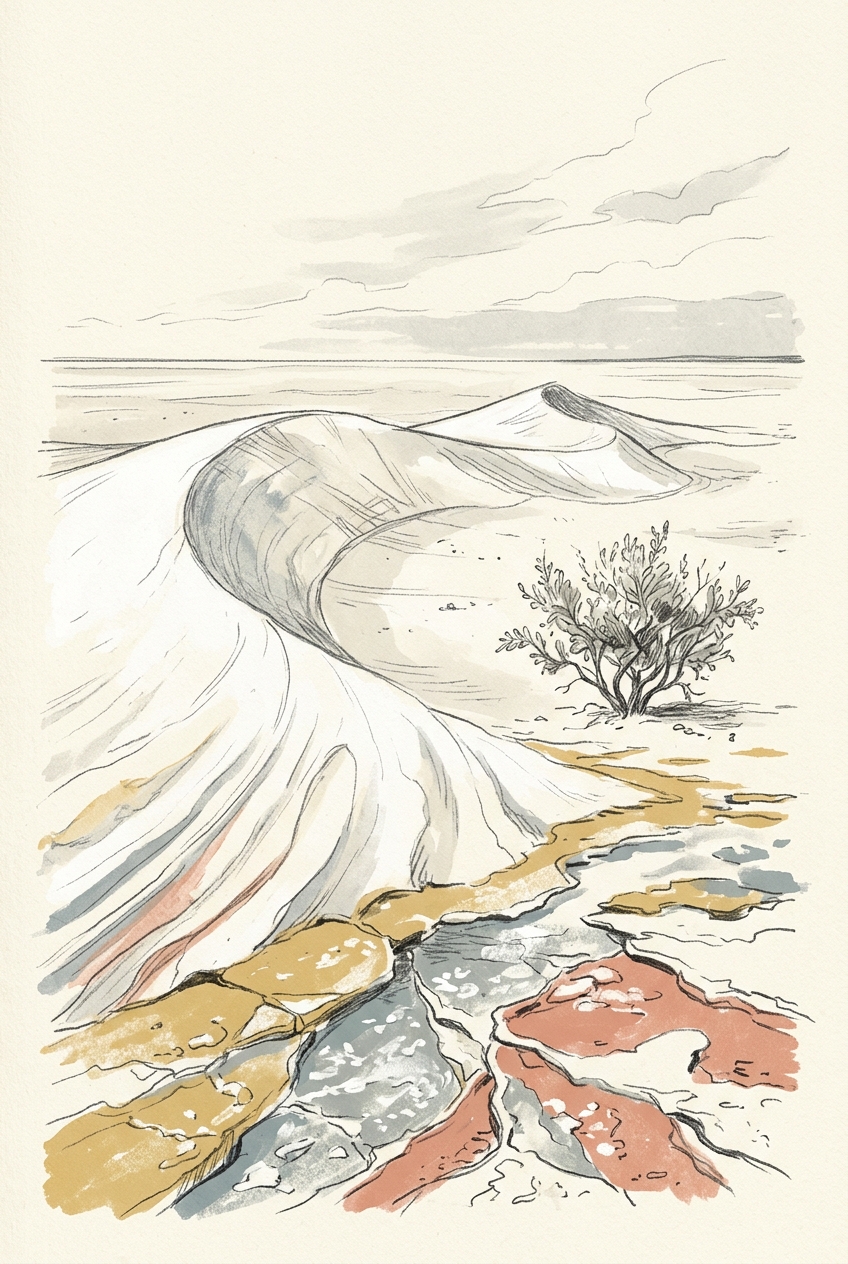
On the floor of Australia's driest desert, dunes the color of bone stretch toward a salt-rimmed horizon. These are not quartz sands but gypsum crystals—calcium sulfate accumulated over tens of thousands of years as ancient lakes evaporated and the wind sculpted their residue into crescent-shaped ridges.
The Salt Below
Lake Eyre, the continent's largest salt lake, sits in a vast internal drainage basin covering one-sixth of Australia. When full—which happens only a few times per century—it forms a shallow inland sea roughly the size of Lake Ontario. But for most of the past 30,000 years, it has been dry.
The key to the gypsum dunes lies beneath the surface crust. During the last glacial period, when the climate was cooler and windier, the lake held water intermittently. Each dry phase left behind a layer of evaporite minerals: halite first, then gypsum as the brine concentrated further. Over time, groundwater rich in calcium and sulfate ions continued to feed the gypsum precipitation, even after the surface water vanished.
The dunes are not static relics. They are active landscapes, slowly migrating as the wind reworks their surfaces grain by grain.
The Crescent Forms
On the eastern and southern shores of Lake Eyre, the prevailing southerly winds have shaped the gypsum into barchan dunes—crescent-shaped mounds that move downwind at rates of several meters per decade. These are among the largest gypsum dunes in the world, reaching heights of 10 to 15 meters.
The dunes form where the water table is shallow enough to wick moisture upward but the surface is dry enough for wind transport. Gypsum crystals, softer than quartz, break down into fine silt-sized particles that the wind lifts easily. Once airborne, they saltate—bouncing across the surface—and accumulate where the wind loses energy, typically in the lee of low ridges or vegetation patches.
A single dune may contain thousands of tonnes of gypsum. Mining operations on the lake's periphery extract the mineral for plasterboard and cement, but the core of the dunefield remains protected within the Lake Eyre National Park.
The Climate Archive
The gypsum dunes are more than a geological curiosity. Their internal structure records shifts in wind direction, rainfall, and groundwater chemistry over the past 30,000 years. Layers of darker organic matter alternate with pure white gypsum, marking wetter periods when algae blooms stained the sand, followed by hyper-arid phases when only the mineral accumulated.
Researchers have dated these layers using optically stimulated luminescence, which measures when quartz grains were last exposed to sunlight. The results show that the dunes were most active between 25,000 and 15,000 years ago, during the Last Glacial Maximum, when stronger winds and lower sea levels made Australia's interior even drier than today.
The Living Crust
Despite the harsh conditions, the gypsum dunes host a thin but resilient biological community. Cyanobacteria and lichens form dark crusts on the dune surfaces, stabilizing the sand and trapping moisture. In rare years when rain reaches the lake, the crusts turn green with dormant algae that spring to life within hours.
Small mammals and reptiles—including the Lake Eyre dragon, a lizard found nowhere else—burrow into the dune flanks to escape the midday heat. The white surface reflects sunlight, keeping the sand cooler than the surrounding desert by several degrees. This microclimate, combined with the mineral-rich groundwater, makes the gypsum dunes an unexpected refuge in one of Australia's most extreme landscapes.
The dunes of Lake Eyre are a quiet record of a continent's oscillation between wet and dry, built grain by grain over millennia. They remind us that even in the most barren places, the earth is never truly still.
More like this
- The 110-Million-Year-Old River That Runs Backwards UndergroundWestern Australia's 110-million-year-old dune system has been slowly dissolving into a labyrinth of caves where an ancient river still flows, carrying the taste of a Cretaceous desert.
- The 5,000-Year-Old Volcanoes That Still Smoke in the SouthIn Victoria's Newer Volcanics Province, 400 volcanic vents erupted as recently as 5,000 years ago—the youngest volcanic field in mainland Australia, where craters still hold blue lakes and scoria cone
- The 560-Million-Year-Old Garden That Never Saw a PredatorIn South Australia's Flinders Ranges, 560-million-year-old Ediacara surfaces preserve entire seafloor communities of fronds, discs, and quilts — a garden of soft-bodied life that flourished before pre