9 May 2026 · 3 min read
The Coral Staircase: The Limestone Terraces of the Eyre Peninsula
Along the Eyre Peninsula's southern coast, a 25-kilometre staircase of calcarenite terraces records 1.6 million years of wobbling sea levels and the slow work of windblown shell fragments.
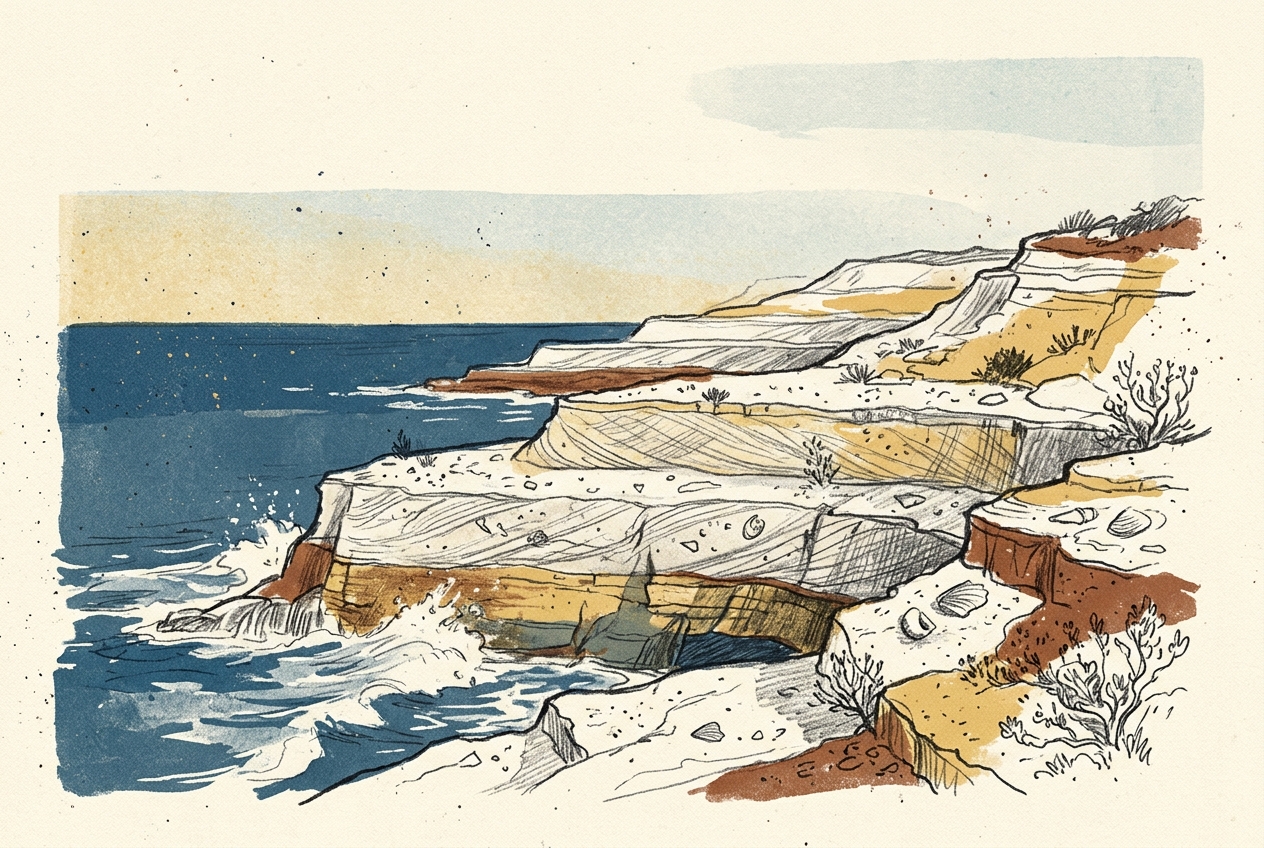
Near the southernmost tip of the Eyre Peninsula in South Australia, the sea has built a staircase. The limestone terraces of the Scratchface formation step down toward the Southern Ocean in a sequence so regular they resemble a giant's amphitheatre. Twenty-five kilometres of calcarenite shelves, each one marking a moment when the ocean paused, cut a platform, and then withdrew.
The Shell Archive
The rock here is not the ancient limestone of the Nullarbor or the Devonian reefs of the Kimberley. It is young — less than two million years old in its oldest parts — and it is made almost entirely of broken shells. The calcarenite that forms the terraces began as sand-sized fragments of bryozoans, molluscs, and foraminifera, swept by wind and wave into dunes along a Pliocene coastline. Over time, calcium carbonate dissolved from the upper layers and reprecipitated below, cementing the dunes into soft, porous rock.
This process, called eolianite formation, occurred repeatedly as sea levels rose and fell during the Pleistocene. Each time the ocean stabilised at a particular height, waves carved a flat bench into the existing rock. When the sea dropped again — by five metres, then ten, then twenty — a new terrace was cut at the lower level. The result is a topographic record of sea-level change, etched directly into the continent's southern margin.
The terraces are not merely geological curiosities. They are the most complete sequence of interglacial sea-level markers anywhere on Earth's passive margins.
The Wobbling Sea
The terraces of the Eyre Peninsula correspond to the major interglacial periods of the past 1.6 million years. The highest and oldest terrace, sitting roughly 30 metres above present sea level, dates to Marine Isotope Stage 31 — a warm interval roughly 1.07 million years ago when the Antarctic ice sheet was smaller and the sea stood higher. Below it, each successive terrace records a later interglacial: Stage 21, Stage 13, Stage 11, Stage 7, Stage 5.
Stage 11, around 400,000 years ago, was particularly significant. It was the longest and warmest interglacial of the past half-million years, with sea levels perhaps six to thirteen metres above today's. The terrace cut during that interval is broad and well-preserved, a platform wide enough to hold a coastal road. Driving south toward Port Lincoln, one crosses it without knowing — a flat stretch of farmland that was once the seafloor.
The Active Edge of a Quiet Continent
Australia is tectonically quiet. Unlike the Pacific Ring of Fire, the continent's southern margin is a passive rifted edge, left behind when Australia separated from Antarctica 45 million years ago. There are no subduction zones here, no volcanic arcs, no rapid uplift. The terraces of the Eyre Peninsula owe their preservation not to tectonic forcing but to its absence.
Without earthquakes or active faulting, the record of sea-level change remains undisturbed. The terraces have not been tilted, folded, or buried. They sit as they were cut, a clean measurement of ancient shorelines. The only modification has come from the wind, which has sculpted the soft calcarenite into low cliffs and blowholes along the terrace edges.
This stability makes the Eyre Peninsula sequence valuable. On more active coastlines — California, Japan, New Zealand — sea-level markers are often deformed or eroded before they can accumulate. Here, the record stacks neatly, layer upon layer, like pages bound in stone.
The Living Coast
The terraces are not static. At their seaward edge, the modern surf continues to cut a fresh platform into the lowest terrace, extending the sequence into the present. Bryozoans and coralline algae grow on the submerged bench, their skeletons destined to become the next layer of calcarenite in another hundred thousand years.
Walking the terraces at low tide, one steps across intervals of time measured in hundreds of millennia. The platforms are covered in shallow tidal pools, each one a miniature ecosystem of anemones, crabs, and small fish. The rock underfoot is sharp and honeycombed, weathered by salt spray into intricate patterns.
The Southern Ocean pounds the outer edge with a rhythm that has not changed since the Pliocene. Each wave carries a fine suspension of shell fragments, the raw material for the next terrace that will be cut, cemented, and abandoned when the ice sheets advance once more.
More like this
- The 110-Million-Year-Old River That Runs Backwards UndergroundWestern Australia's 110-million-year-old dune system has been slowly dissolving into a labyrinth of caves where an ancient river still flows, carrying the taste of a Cretaceous desert.
- The 5,000-Year-Old Volcanoes That Still Smoke in the SouthIn Victoria's Newer Volcanics Province, 400 volcanic vents erupted as recently as 5,000 years ago—the youngest volcanic field in mainland Australia, where craters still hold blue lakes and scoria cone
- The 560-Million-Year-Old Garden That Never Saw a PredatorIn South Australia's Flinders Ranges, 560-million-year-old Ediacara surfaces preserve entire seafloor communities of fronds, discs, and quilts — a garden of soft-bodied life that flourished before pre