9 May 2026 · 3 min read
The Opalised Beak: The Cretaceous Inland Sea of Lightning Ridge
Beneath the opal fields of Lightning Ridge lies the fossilised bed of a vast Cretaceous inland sea, where the bones of plesiosaurs, dinosaurs, and monotremes were replaced by precious opal over 100 mi
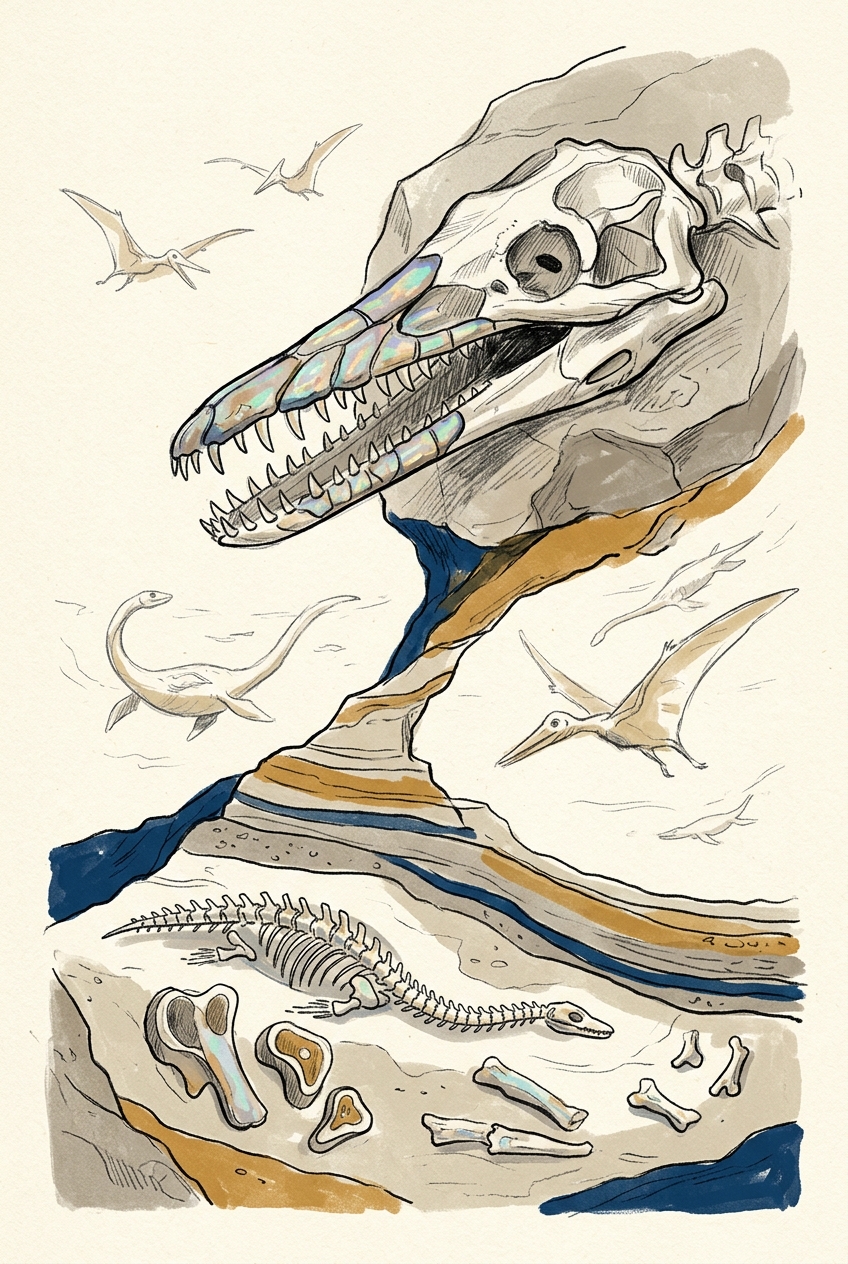
Beneath the black soil plains of north-western New South Wales, a Cretaceous seafloor has turned to gemstone. At Lightning Ridge, the bones of 110-million-year-old marine reptiles, dinosaurs, and early mammals have been replaced molecule by molecule by precious opal—silica spheres that diffract light into spectral fire. The fossils are not simply preserved in opal; they are opal.
The Inland Sea
During the Early Cretaceous, eastern Australia lay under water. A shallow epeiric sea—sometimes called the Eromanga Sea—stretched from the Gulf of Carpentaria south to the Otway Basin, flooding the Great Artesian Basin. The shoreline shifted with sea level; at its maximum, the sea covered roughly two million square kilometres.
Sediment from the rising eastern highlands poured into this basin, burying the remains of marine and terrestrial life in layers of sand, silt, and clay. These sediments became the Griman Creek Formation, a 20-to-30-metre-thick sequence of sandstone, siltstone, and claystone that now hosts the world's richest deposits of black opal.
The Silica Replacement
Opal forms when silica-saturated groundwater seeps through porous rock. Under the right conditions—low temperature, neutral pH, seasonal evaporation—silica precipitates as microscopic spheres that pack together in a regular lattice. The size and arrangement of these spheres determine the opal's colour.
At Lightning Ridge, the silica did not simply fill cavities. It replaced organic material, preserving three-dimensional cellular structure in exquisite detail. A bone buried in the Griman Creek Formation would slowly dissolve as silica-laden water moved through the sediment, precipitating opal in the exact space the bone had occupied. The result: a fossil made of gemstone.
The opal preserves not just the shape but the internal structure—a plesiosaur vertebra that fractures like a stone yet glows with green and blue fire.
Monotremes and Plesiosaurs
What emerged from the opal fields astonished palaeontologists. In 1985, a jaw fragment bearing two molars was identified as Steropodon galmani, the oldest known monotreme—a platypus-like mammal that swam in the Cretaceous waterways. Its opalised teeth, preserved in the Australian Museum, remain among the most precious fossils ever found.
The opal fields have also yielded:
- Kollikodon ritchiei, another early monotreme known only from an opalised dentary
- Plesiosaur vertebrae and flipper bones, their surfaces glowing in greens and blues
- Dinosaur claws and teeth, including those of theropods and ankylosaurs
- Freshwater mussels, fish scales, and the spiral shells of ammonites
These fossils represent a rare window into a polar ecosystem. During the Cretaceous, Australia was still attached to Antarctica, and the Eromanga Sea sat at roughly 70 degrees south latitude. The water was cold, but not frozen—seasonal darkness and light shaped the rhythms of life.
The Black Opal
Lightning Ridge is famous for its black opal, the rarest and most valuable variety. The darkness comes not from the opal itself but from the host rock—a dark ironstone or potch (common opal) that provides a deep background, making the colours appear more vivid. The opal forms as thin veins, nodules, or fossil replacements within the concretions and claystone bands of the Griman Creek Formation.
Mining is small-scale and personal. Miners sink shafts through the weathered sandstone, following the "opal dirt" by the light of a torch. A single fossilised bone, if complete, can be worth more than a house. But the opal is fragile; it can crack as it dries, and the finest specimens are stabilised with resin.
The Vanished Sea
By the end of the Cretaceous, 66 million years ago, the Eromanga Sea had drained away. Uplift, tilting, and erosion stripped much of the sediment from the basin, exposing the Griman Creek Formation at the surface. The opal that had formed deep underground was brought within reach of the miners' picks.
Today, Lightning Ridge is a semi-arid landscape of mulga scrub and red earth. The sea is gone, but its ghosts remain—glowing in museum cabinets, their bones turned to light.
More like this
- The 560-Million-Year-Old Garden That Never Saw a PredatorIn South Australia's Flinders Ranges, 560-million-year-old Ediacara surfaces preserve entire seafloor communities of fronds, discs, and quilts — a garden of soft-bodied life that flourished before pre
- The 1.75-Billion-Year-Old Reef That Outranks the BarrierA 1.75-billion-year-old microbial reef in the Kimberley is the largest biological structure ever built by a single species, preserving a world without predators.
- The 3.5-Billion-Year-Old Cones That Still Catch LightIn the Pilbara's Dresser Formation, 3.5-billion-year-old stromatolites preserve the oldest direct evidence of life on Earth—microbial mats that built layered domes in a volcanic caldera.