9 May 2026 · 3 min read
The Clay That Remembers: The Cambrian Shales of the Georgina Basin
In the Georgina Basin of Queensland, 500-million-year-old shales preserve trilobite exoskeletons so finely detailed that individual lenses in their compound eyes remain visible.
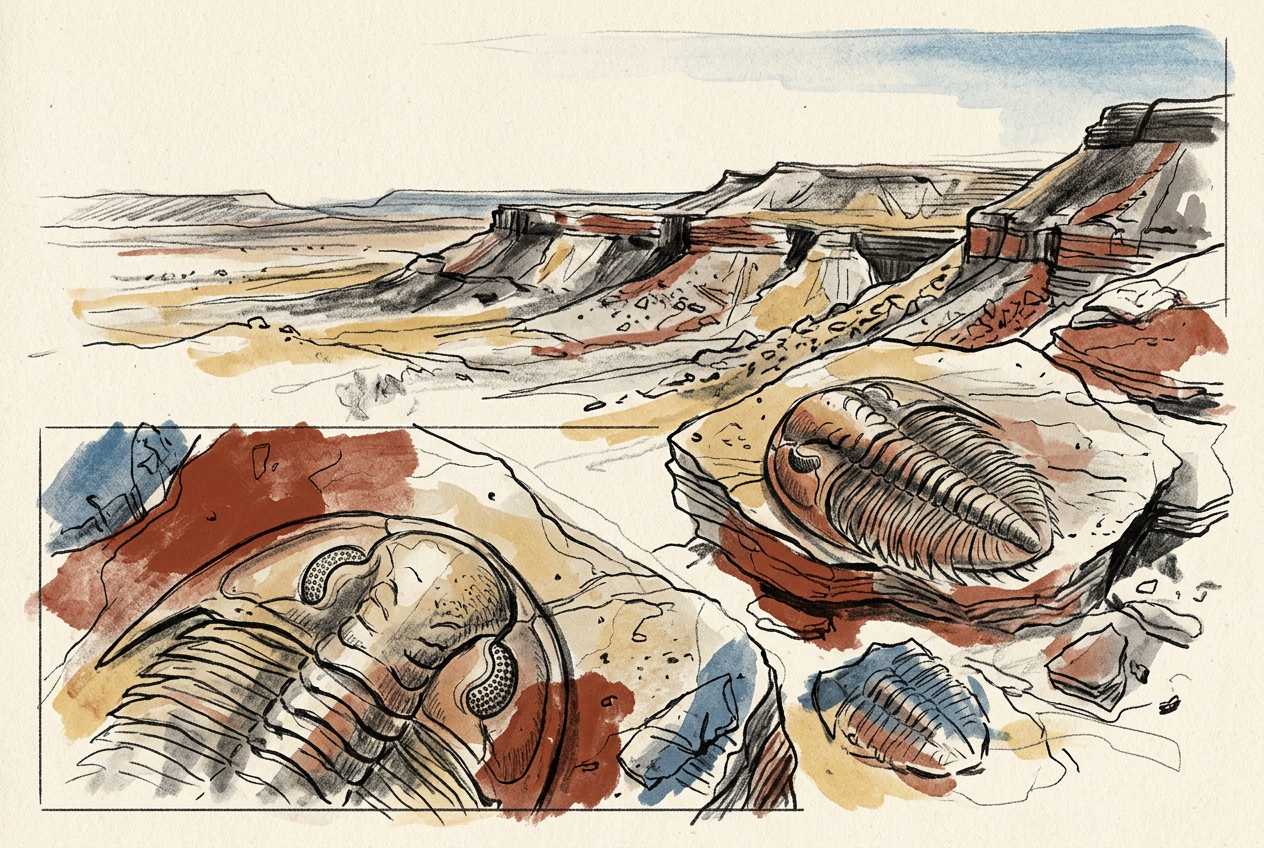
In the remote heart of western Queensland, where the land flattens into a red horizon and the only sound is wind across spinifex, a hillside of grey shale holds the exoskeletons of animals that died half a billion years ago. Split a slab of the Georgina Basin's Cambrian mudstone with a hammer, and you might reveal a trilobite so perfectly preserved that each lens of its compound eye still glints like a bead of dark glass.
The Inland Sea That Vanished
Five hundred million years ago, during the early Cambrian, much of central Australia lay beneath a shallow, sunlit sea. This was the Georgina Basin—a broad marine embayment that stretched across what is now Queensland and the Northern Territory. The water was warm, clear, and rich in calcium carbonate, ideal for shell-building organisms. Trilobites scuttled across the muddy bottom. Brachiopods anchored themselves to the seafloor. Small shelly fauna, now mostly vanished from the fossil record, multiplied in the water column.
Then, at intervals, the mud came. Fine-grained sediments—clay and silt washed from the adjacent landmass—settled in slow, steady pulses. These layers buried the seafloor communities in place, sealing them from scavengers and decay. The chemistry of the mud was just right: low in oxygen, high in dissolved silica. Over millions of years, the mud compressed into shale, and the organic remains within it turned to stone.
The result is a Lagerstätte—a deposit of exceptional fossil preservation—spread across an area larger than Tasmania.
The Eye That Outlasted the Body
The Georgina Basin's Cambrian fossils are famous not for their size but for their detail. The most spectacular specimens come from the Beetle Creek Formation near the town of Mount Isa, and from the nearby Thorntonia Limestone. Here, the shales yield trilobites of the order Redlichiida, some of the earliest complex animals on Earth.
In one known specimen of Redlichia takooensis, the compound eyes contain over 600 individual lenses, each a tiny calcite crystal aligned precisely to focus light.
The preservation is so fine that scientists have been able to study the trilobites' sensory systems, their feeding appendages, and even the fine bristles on their legs. The shales also preserve soft-bodied animals—worms, jellyfish, and enigmatic forms that do not fit neatly into any modern phylum. These are rarer, but when they appear, they offer a window into a world that otherwise leaves no trace.
The Georgina Basin does not have the celebrity of the Burgess Shale in Canada or the Chengjiang deposits in China. But in some respects, its fossils are better preserved. The Burgess Shale specimens are compressed and flattened. The Georgina trilobites are often three-dimensional, their exoskeletons uncrushed, the original mineralogy intact.
The Chemistry of Stillness
What made the Georgina Basin such a perfect preservational trap? Three conditions aligned.
First, the sedimentation rate was high but gentle. Layers of clay accumulated at a pace that smothered carcasses quickly but did not disturb them. Second, the bottom waters were anoxic—oxygen-starved—which prevented bacteria and scavengers from breaking down the soft tissues. Third, the pore waters of the sediment were rich in dissolved silica, which precipitated early and replaced organic structures before they could collapse.
This combination—rapid burial, low oxygen, early silicification—is rare in the fossil record. It requires a specific set of tectonic and oceanographic circumstances that lasted only a few million years in the early Cambrian. After that, the Georgina Basin shallowed, the sea retreated, and the conditions were never repeated.
The Landscape of Deep Time
Today, the Georgina Basin is a landscape of low ridges and flat plains, the shales exposed by erosion over tens of millions of years. The fossils weather out naturally; a single rainstorm can reveal dozens of specimens on a hillside. Collectors and paleontologists have worked the area since the 1960s, and the deposits continue to yield new species.
The basin itself is a geological archive of a different kind. The Cambrian shales sit atop Proterozoic basement rocks more than a billion years old. Above them lie Ordovician sandstones, Devonian limestones, and finally the Cretaceous sediments that record the last great inland sea to cover central Australia. The Georgina Basin is a stack of ancient oceans, each layer a different world.
In the split face of a single slab of shale, you can hold all of this: the mud, the stillness, the patient work of silica. The trilobite on that slab died in the Cambrian, but its eye still catches the light. The lens that focused photons half a billion years ago focuses them still, on the retina of a species that had not yet evolved.
More like this
- The 110-Million-Year-Old River That Runs Backwards UndergroundWestern Australia's 110-million-year-old dune system has been slowly dissolving into a labyrinth of caves where an ancient river still flows, carrying the taste of a Cretaceous desert.
- The 5,000-Year-Old Volcanoes That Still Smoke in the SouthIn Victoria's Newer Volcanics Province, 400 volcanic vents erupted as recently as 5,000 years ago—the youngest volcanic field in mainland Australia, where craters still hold blue lakes and scoria cone
- The 560-Million-Year-Old Garden That Never Saw a PredatorIn South Australia's Flinders Ranges, 560-million-year-old Ediacara surfaces preserve entire seafloor communities of fronds, discs, and quilts — a garden of soft-bodied life that flourished before pre