9 May 2026 · 3 min read
The Glass Highway: The Silcrete Pavements of the Lake Eyre Basin
Across the Lake Eyre Basin, ancient silcrete crusts—fused quartz pebbles bound by silica—preserve a 40-million-year record of deep weathering and aridification.
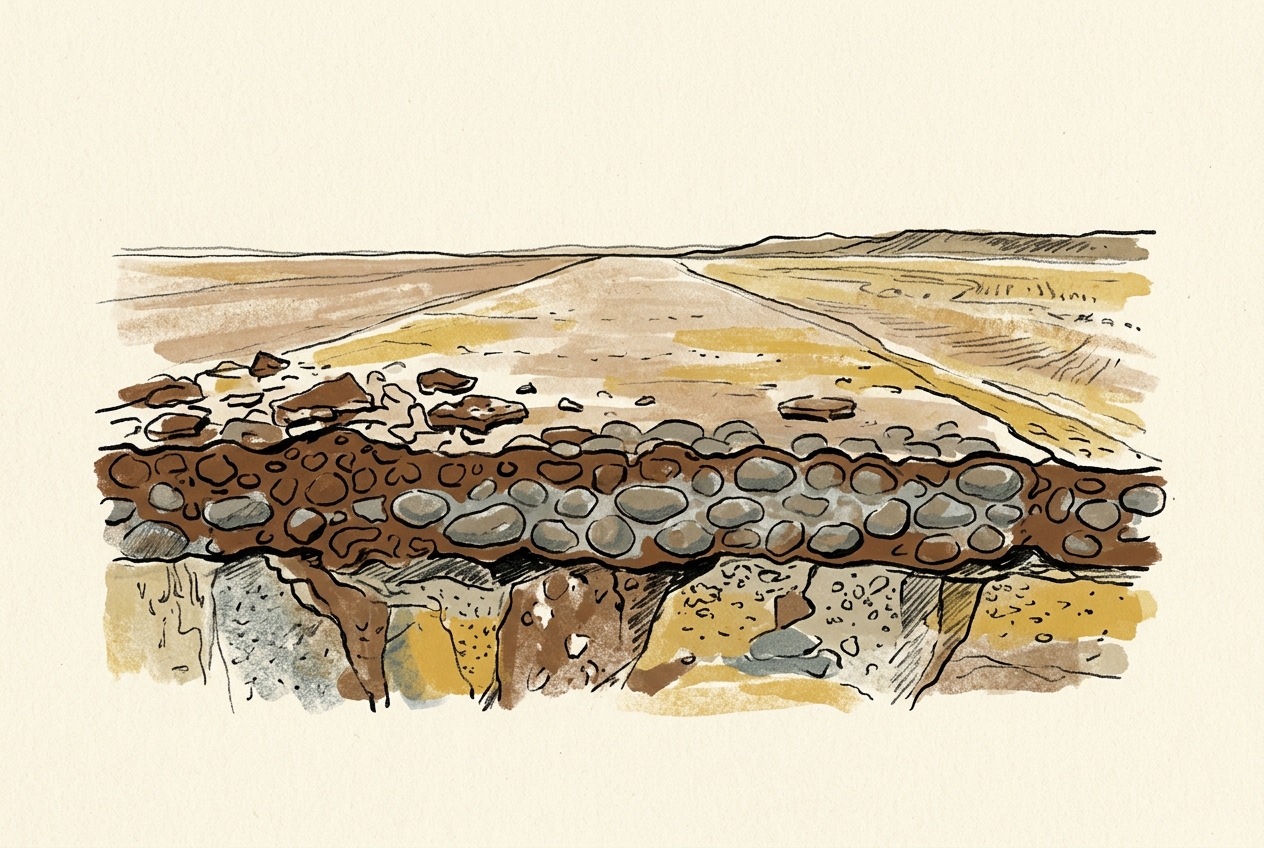
Fifty kilometres west of Birdsville, the dirt track crosses a surface that rings underfoot like fired ceramic. The ground is not rock in the usual sense. It is silcrete — a crust of quartz pebbles and sand grains welded together by dissolved silica into a material harder than granite. Across the Lake Eyre Basin, these pale pavements stretch for thousands of square kilometres, their glassy surfaces gleaming under the desert sun.
The Slow Cement
Silcrete begins with water. During the Eocene, roughly 40 million years ago, eastern Australia was warm and wet. Deep weathering penetrated tens of metres into the ancient landscape, breaking down feldspars and releasing silica into solution. Groundwater carried this dissolved silica through porous sediments. When the climate shifted toward aridity in the Miocene, the water table dropped. Evaporation concentrated the silica, and it precipitated as a cement between every sand grain and pebble.
The result is a rock that forms in place rather than being deposited from above. Unlike sandstone, which is buried and compressed, silcrete grows downward from the surface. It is a duricrust — a chemically hardened skin. The process can take millions of years, and once formed, silcrete is extraordinarily resistant to erosion. It caps mesas, forms low scarps, and spreads across plains as flat as a tarmac.
The Lake Eyre Basin contains some of the most extensive silcrete pavements on Earth. Near Cordillo Downs, the surface is so continuous that early pastoralists used it as a natural road. In the Sturt Stony Desert, the gibber plains are littered with silcrete fragments that have broken from the crust but remain scattered across the surface, polished by windblown sand to a dark patina called desert varnish.
The Inverted Landscape
Silcrete does more than preserve old surfaces. It creates new ones.
When a river deposits gravel in a channel, and that gravel later becomes cemented by silica into silcrete, the channel becomes harder than the surrounding plain. Over tens of thousands of years, the softer floodplain erodes away while the silcrete channel remains, standing as a raised ridge that traces the path of a river that no longer exists. Geologists call these features inverted channels.
The Lake Eyre Basin is rich with them. Near the Warburton River, sinuous ridges of silcrete snake across the landscape, their branching patterns clearly visible from satellite imagery. They record a drainage system from the Miocene, when rivers flowed more reliably across the interior. Today those same rivers run only after rare floods. The silcrete remembers what the water no longer does.
The landscape holds its own history in chemical form, written in silica where no other record survives.
The Ancient Glass
Some of Australia's silcrete is remarkably old. In the Tirari Desert, silcrete caps have been dated to the Oligocene — roughly 25 million years ago. This makes them among the oldest continuously exposed land surfaces on the planet. While most of Earth's crust is recycled by erosion and tectonics, these silcrete pavements have sat undisturbed since before the Himalayas rose.
Aboriginal people recognised the value of this material. Silcrete fractures with a conchoidal break, like flint or obsidian, and was used extensively for stone tools. Quarries in the Lake Eyre region show that silcrete was extracted and traded across hundreds of kilometres. The material's quality varies: some silcrete is fine-grained and glassy, ideal for spear points and knives; other varieties are coarser, better suited for grinding stones.
The same qualities that made silcrete useful to people also make it useful to geologists. Because it forms at the surface, silcrete can preserve fossil leaves, pollen, and even the impressions of raindrops. In the Lake Eyre Basin, silcrete has trapped the outlines of Eocene plants — ancestors of today's eucalypts and acacias — frozen in a silica matrix that records the precise moment of their burial.
The Fragile Crust
For all its hardness, silcrete is surprisingly vulnerable. Once the crust is broken — by vehicle tracks, by cattle, by the expansion of salt crystals — the underlying soft sediments erode rapidly. A single tyre track can initiate a gully that strips away millions of years of geological work in a few seasons. The silcrete pavements of the Lake Eyre Basin are not just a curiosity. They are one of the few remaining archives of Australia's transformation from a wet, forested continent into the driest inhabited land on Earth.
More like this
- The 110-Million-Year-Old River That Runs Backwards UndergroundWestern Australia's 110-million-year-old dune system has been slowly dissolving into a labyrinth of caves where an ancient river still flows, carrying the taste of a Cretaceous desert.
- The 5,000-Year-Old Volcanoes That Still Smoke in the SouthIn Victoria's Newer Volcanics Province, 400 volcanic vents erupted as recently as 5,000 years ago—the youngest volcanic field in mainland Australia, where craters still hold blue lakes and scoria cone
- The 560-Million-Year-Old Garden That Never Saw a PredatorIn South Australia's Flinders Ranges, 560-million-year-old Ediacara surfaces preserve entire seafloor communities of fronds, discs, and quilts — a garden of soft-bodied life that flourished before pre