8 May 2026 · 3 min read
The Fault-Valve Pulse: The Victorian Goldfields
An exploration of the tectonic forces and 'fault-valve' processes that created the world-class gold deposits of the Victorian Goldfields 400 million years ago.
On a clear day in the Goldfields of Victoria, the earth beneath the eucalyptus scrub is a chaotic jumble of white quartz and red clay, the wreckage of a nineteenth-century fever. Beneath this disturbed surface lies a far older architecture: a series of deep-seated crustal faults that once acted as the plumbing for a continent’s worth of gold.
The Deep Plumbing of the Lachlan
The Victorian Goldfields sit within the Bendigo Zone of the Lachlan Fold Belt, a complex tectonic province that was forged between 450 and 400 million years ago. During the Ordovician and Silurian periods, the edge of the Australian continent was a churning site of subduction and compression. As oceanic plates slid beneath the continental margin, the thick sequences of marine turbidites—sand and mud shed from ancient mountains—were squeezed, heated, and buckled.
This tectonic pressure didn't just fold the rock into the tight anticlines and synclines visible in the railway cuttings today. It triggered a massive release of fluids from deep within the crust. As temperatures rose, water trapped in the sedimentary minerals was driven out, carrying with it dissolved silica, sulfur, and trace amounts of gold. These hot, mineral-rich fluids migrated upward, seeking the path of least resistance along massive fault lines.
The Quake and the Quartz
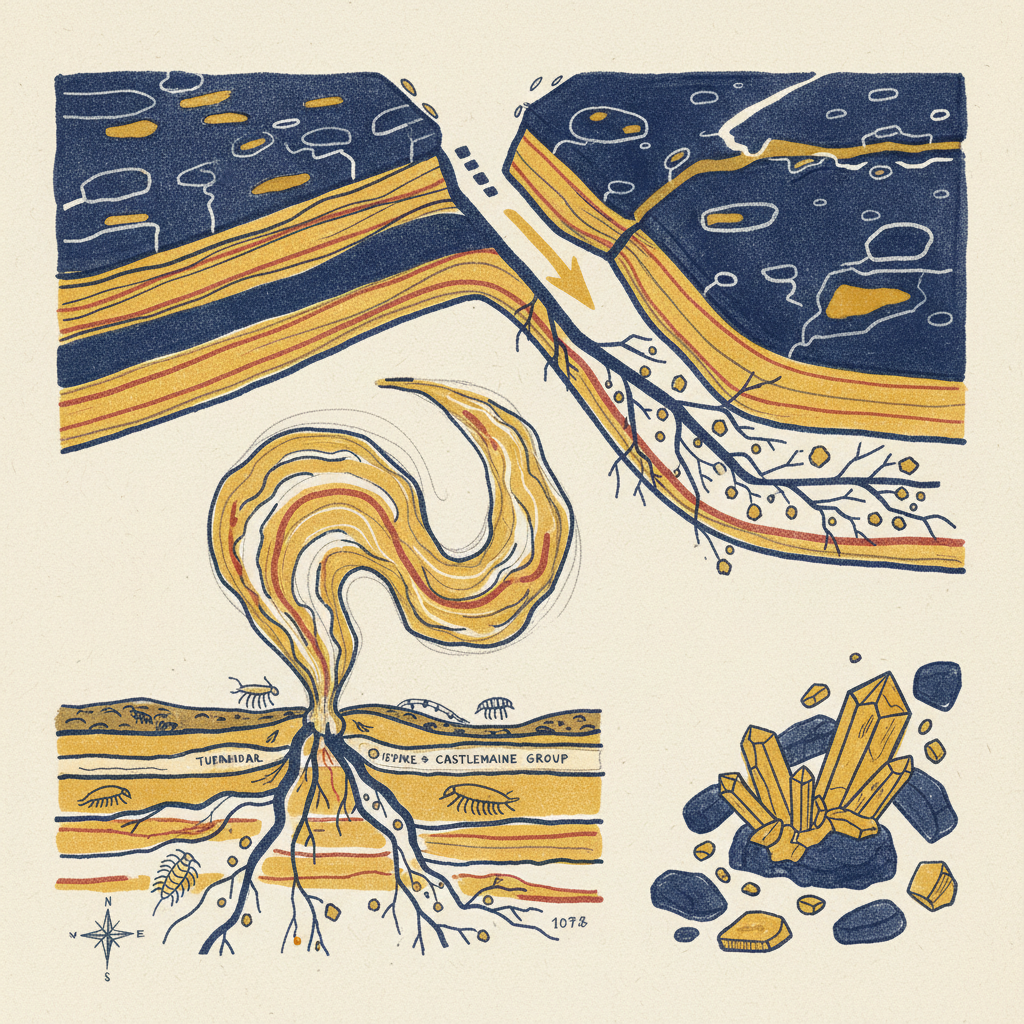
The deposition of gold was not a slow, steady trickle, but a violent, episodic event driven by ancient earthquakes. Geologists refer to this as "fault-valve" behavior. When the pressure of the subterranean fluids exceeded the weight of the overlying rock and the friction of the fault, the earth would snap.
In the sudden vacuum created by the fault’s movement, the pressure dropped instantly. This "flash vaporization" caused the dissolved minerals to drop out of solution. Quartz crystallized rapidly, filling the cracks to form the iconic white reefs of the region. Within these quartz veins, the gold precipitated in concentrated shoots, creating some of the richest alluvial and primary deposits ever discovered.
"The gold was not merely placed in the rock; it was injected during moments of tectonic crisis, a metallic record of the earth’s internal pressures."
The Geometry of Fortune
The Victorian fields are distinct from the ancient Archean deposits of Western Australia. Here, the gold is younger and the host rocks are sedimentary rather than volcanic. The distribution of the metal follows a strict structural logic:
- Anticlinal Caps: Gold often concentrated at the crests of tightly folded rock layers, known as 'saddle reefs.'
- Laminated Veins: Multi-layered quartz sheets that suggest the faults opened and closed hundreds of times over millions of years.
- Fault Scarps: Deep vertical conduits like the Whitelaw Fault, which served as the primary highways for the rising fluids.
By the time the tectonic engines cooled in the Devonian, the plumbing system was locked in stone. It remained hidden for hundreds of millions of years until the slow grind of erosion stripped away the overlying kilometers of rock. This process exposed the quartz reefs to the sun, eventually breaking them down into the rich alluvial leads that sparked the rushes of 1851.
A Legacy in the Dust
Today, the landscapes around Bendigo, Castlemaine, and Ballarat are defined by this "Deep Ordovician" history. The holes in the ground and the mounds of mullock are merely the superficial scars of a much deeper, more ancient event. What the miners called 'luck' was actually the intersection of human effort with a 400-million-year-old hydraulic map.
The gold of Victoria is a testament to the power of the Lachlan Fold Belt's assembly. It represents a brief window in geological time when the crust was permeable, the fluids were hot, and the earthquakes were frequent enough to sieve a fortune from the deep mud of a lost ocean floor.
More like this
- The 560-Million-Year-Old Garden That Never Saw a PredatorIn South Australia's Flinders Ranges, 560-million-year-old Ediacara surfaces preserve entire seafloor communities of fronds, discs, and quilts — a garden of soft-bodied life that flourished before pre
- The 1.75-Billion-Year-Old Reef That Outranks the BarrierA 1.75-billion-year-old microbial reef in the Kimberley is the largest biological structure ever built by a single species, preserving a world without predators.
- The 3.5-Billion-Year-Old Cones That Still Catch LightIn the Pilbara's Dresser Formation, 3.5-billion-year-old stromatolites preserve the oldest direct evidence of life on Earth—microbial mats that built layered domes in a volcanic caldera.